The best traffic-free bike rides around Castellfollit Del Boix
4.6
(102)
4,703
riders
140
rides
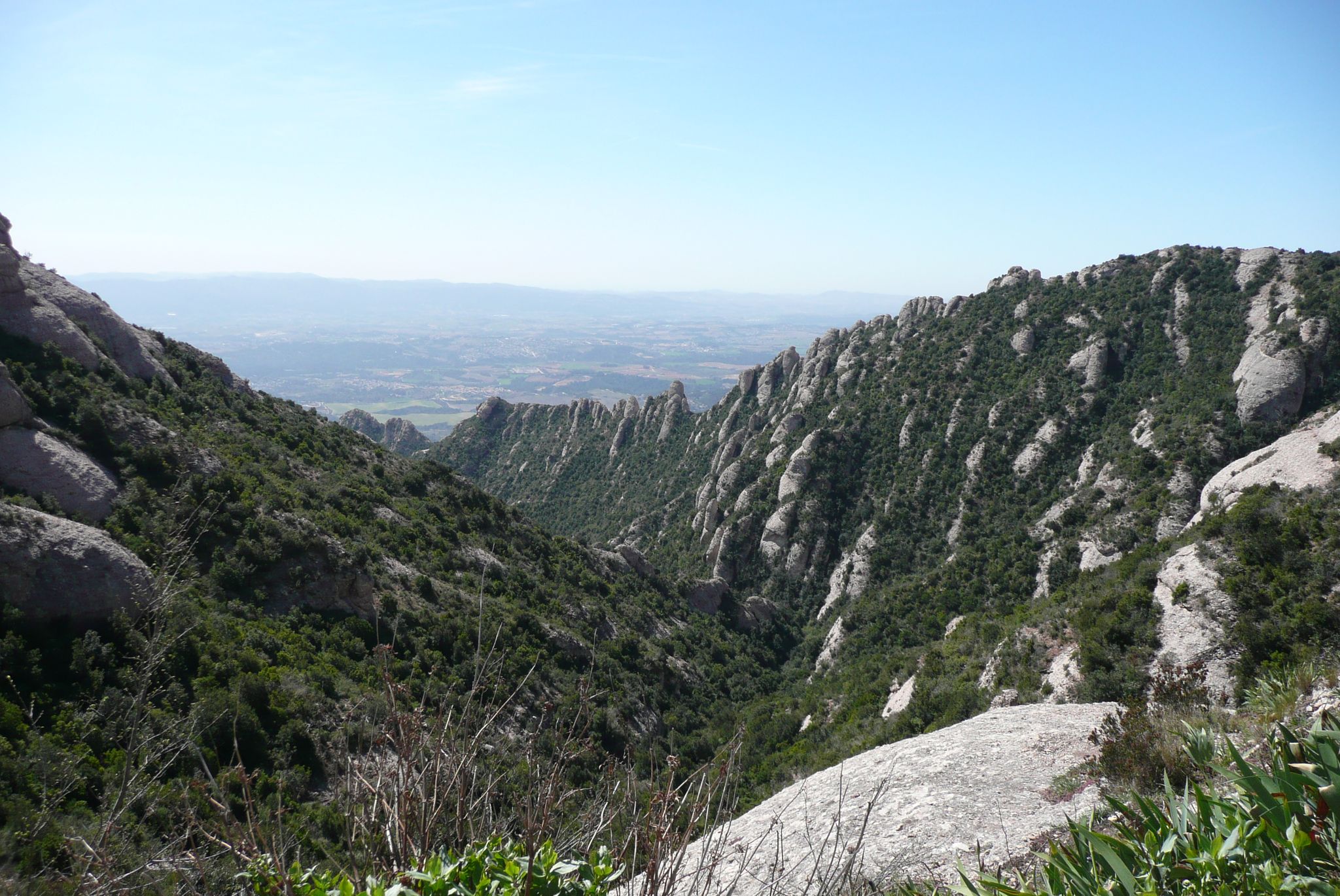
No traffic touring cycling routes around Castellfollit Del Boix traverse a landscape characterized by dense forests, expansive hills, and open agricultural lands, including vineyards. The region, situated between the Llobregat and Anoia basins, offers varied terrain with an average altitude of around 650 meters. Cyclists can experience panoramic views, including sights of Montserrat mountain, from elevated points like the Serra de Rubió. The area features a mix of oak groves and historical sites, providing diverse backdrops for cycling.
Best no…
Last updated: May 20, 2026
16
riders
27.5km
02:19
340m
340m
Moderate bike ride. Good fitness required. Mostly paved surfaces. Suitable for all skill levels.
12
riders
33.6km
02:43
510m
510m
Hard bike ride. Very good fitness required. Mostly paved surfaces. Suitable for all skill levels.

Sign up for free
10
riders
77.5km
06:24
1,290m
1,290m
Hard bike ride. Very good fitness required. You may need to push your bike for some segments of this route.
8
riders
22.8km
02:13
430m
430m
Moderate bike ride. Good fitness required. Mostly paved surfaces. Suitable for all skill levels.
7
riders
29.0km
02:34
670m
670m
Hard bike ride. Very good fitness required. Mostly paved surfaces. Suitable for all skill levels.
Get access to more routes and recommendations from other explorers.
Sign up for free
Already have an account?
Our route recommendations are based on thousands of hikes, rides, and runs completed by other people on komoot.
Start today with a free account
Your next adventure awaits.
Login or Signup


Other adventures around Castellfollit Del Boix

Tips from the Community

Small but charming old town. There is a fountain with water!
0
0

The Old Bridge of Manresa (Pont Vell) is one of the city's most emblematic monuments and forms part of its most distinctive skyline, along with the Basilica of La Seu and the Cave of Saint Ignatius. Of Roman origin, the current structure is a faithful reconstruction of a 12th-century medieval bridge. It was destroyed in 1939 during the Civil War and rebuilt between 1960 and 1962 by architect J. Pons Sorolla.
15
0

Historic center of Catalonia, more beautiful than the official one.
0
0

A carved fountain consisting of a semi-buried body framed by a large arch, which creates a small elliptical apse, at the midpoint of which is the fountain. The water falls, from a rectangular niche framed in another with a pointed arch, onto a circular sink with a base. On the side of the fountain there is a bench attached, running. The set is completed with a stone table in the center of the space. This is built with masonry and the ashlars are seen in its entire front part, and inside, up to half height, the curvilinear part of the chapel was plastered. There still remains, at the highest point of the arch, the part of a fastening element from which a chain hangs, and at an even higher point, crowning the set, there is a large piece of stone with the inscription "Girada 1923". Observations: The fountain is located in Monistrolet, in an artificial widening of the road and in a space formed from the fountain itself and small stone walls that follow the lateral profile of the work. It can be reached by the path that comes from Can Servitge passing through the deposits of Can Gallifa or Cisternes de Monistrolet (file 390) and the Font del Rector (file 391), crossing the Riera de Rajadell, or from Monistrolet, skirting Can Gallifa (file 98) along the path that surrounds it to the W., and passing through the Camp de la Girada, cross the Riera de Rajadell through a ford, and from there follow a path in a westerly direction. The fountain is located 700m. in a straight line to the SW of Can Gallifa. The name of the Girada is due to the curve that the Riera de Rajadell makes in this sector. Campaign masses have been celebrated at the site with the stone table as an altar. You can see that the beautiful vault of this fountain is in the shape of an ellipse. This design, apart from having an artistic motif, also gives it a surprising acoustic property. If we look for the two foci of this ellipse and place a person in the area near each of them, they will hear the other person's voice clearly amplified and with an enveloping effect. From an area close to the focus, such as the beginning of the stone benches, we can also hear the effect.
0
0
The Font de l’Arrel is located next to the torrent de l’Infern –or Vallformosa or Servitge-, very shortly before the confluence with the Rajadell stream, upstream of the Suanya. A path that leaves the asphalt road that goes to the Servitge urbanization, when it crosses the viaduct of the C-37 road above it, crosses the shady slope populated by oaks and black maples, visits the Font de l’Arrel, crosses the Torrent de l’Infern and continues along the right bank of the Rajadell stream towards the Gorg Blau. The itinerary “M2 – La riera de Rajadell” of the Anella Verda de Manresa passes by the Font de l’Arrel. The fountain is well maintained and has a space in front for rest or meeting, shaded by a large oak and some plane trees. The stream of water falls into a stone basin covered with hepatica thallus and capillaries that give it charm. The flow is rather scarce, but only very exceptionally does the spring dry up completely.
0
0

Thirsty work getting to Castellfollit del Boix, so this should be an important highlight ❤️
0
0

Pont Vell de Manresa, crosses the Cardener river and connects the old Abrera road and Rodalies station with the Santuari de Sant Ignasi and the Old quarter.
1
0

On top of a hill stands a massive building of considerable height, the castle of Rajadell. At the time of the Reconquest, the Spanish Marca needed to control the border that delimited the Christian territory from the Muslim. The Riera de Rajadell valley therefore became a key natural passage for the defense and control of this border and the Rajadell castle was built to meet the need for defense of the valley. Other castles such as Castellar, Boixadors and Torres de Fals also made it possible to defend the enemy's territory. From the 13th century, the history of the castle was linked to the lineage of the Rajadell family, lords of the area who participated in wars such as those of Provence, Navarre, Almeria, Sardinia and Mallorca. In the course of the Generalitat's war against Joan II (in 1471) the castle and the church suffered a lot of damage and were inactive for a long period. In the 16th century the Rajadells were left without a legitimate heir and in 1515 the Cruïlles, who would later come together through marriage ties with the Eimerics, bought the manor. In the 17th century, the Cruïlles-Eimeric heiress, Anna, married Domenico de Pignatelli. From then on, the Pignatelli would be the lords of the castle, despite residing in Naples. At the end of the 19th century, the Princess of Belmonte, owner of the castle, sold the property to Francesc Pons from Manres. Built on top of a hill, next to the stream and the old town, the castle forms a set of three bodies. The first written documentation we find dates from 1063, although we can say that it corresponds to the Gothic period (one of the walls and decorative elements, which could be from the 13th or 14th centuries) and the 17th century. It is difficult, however, to establish which parts correspond to each moment because it has been rebuilt several times. Together with the church, it was the origin of the town of Rajadell. The main building, the tallest, still contains rooms from the different inhabited stages: the dungeon, the armory, the alcoves, the stable, the kitchen, the bedrooms, the dining room, etc. In the northern part of the complex we find the house that was inhabited by the farmers and a defensive turret that faces west. At the end of the 19th century, the Pons repaired the building and furnished it. However, during the civil war the castle was requisitioned by the revolutionary committee and all the valuables there were lost.
0
0
Frequently Asked Questions
How many no-traffic touring cycling routes are available in Castellfollit Del Boix?
There are over 140 dedicated no-traffic touring cycling routes around Castellfollit Del Boix. These routes offer a wide range of distances and difficulty levels, ensuring a suitable option for every cyclist looking for a peaceful ride away from cars.
What kind of terrain can I expect on these no-traffic cycling routes?
The routes in Castellfollit Del Boix traverse a diverse landscape, from dense forests and expansive hills to open agricultural lands with vineyards and oak groves. You'll encounter varied surfaces, typical for touring cycling, offering both challenging climbs and rewarding descents. The region's average altitude is around 650 meters, with notable elevations like the Cogulló de Can Torre (877m).
Are there any family-friendly no-traffic cycling routes in the area?
Yes, while many routes are moderate to difficult, there are a few easier options perfect for families. These routes often feature gentler gradients and shorter distances, allowing everyone to enjoy the scenic beauty of Castellfollit Del Boix. For example, you can find routes that explore the agricultural lands and offer pleasant views without significant climbs.
What are the best times of year to go touring cycling in Castellfollit Del Boix?
The region is ideal for touring cycling during spring and autumn when the weather is mild and the natural scenery is at its most vibrant. Spring brings blooming landscapes, while autumn offers beautiful foliage. Summers can be warm, so early morning or late afternoon rides are recommended. Winters are generally mild, but it's always wise to check local weather conditions.
What natural features or landmarks can I see along the no-traffic touring cycling routes?
Many routes offer exceptional panoramic views, including sights of the majestic Montserrat mountain. You can also discover archaeological sites with ancient sea fossils, dolmens, and Neolithic tombs. Keep an eye out for unique rock formations like Cap de Mort rock formation or enjoy the tranquility of gorges such as the Gorg Blau of the Riera de Rajadell. The area is rich in natural monuments and viewpoints.
Are there any historical sites or cultural attractions accessible by bike?
Absolutely. The region boasts a rich rural heritage. You can cycle past the ruins of Castell de Maians, admire Lombard Romanesque churches, or visit the Sanctuary of Mare de Déu de la Salut. Other historical constructions like the Ermita de Sant Pere and Torre dels Moros are also part of the local patrimony, often found along or near cycling paths. You'll also see many vineyard huts and scattered farmhouses reflecting the area's agricultural traditions.
Are there any circular no-traffic touring routes available?
Yes, many of the no-traffic touring routes in Castellfollit Del Boix are designed as loops, allowing you to start and end your journey in the same location. An example is the Font de la Girada – Rajadell Castle loop from Rajadell, which offers a moderate 27.5 km ride. Another option is the more challenging Cogulló of Can Torra – Rajadell Castle loop from Castellfollit del Boix, covering almost 29 km.
What is the difficulty level of the no-traffic touring cycling routes?
The routes vary significantly in difficulty. While there are 4 easy routes, the majority are moderate (40 routes) or difficult (99 routes). Difficult routes often involve significant elevation gains, such as the Salellas Village – Pont Vell de Manresa loop from la Penyora, which covers over 77 km with more than 1200 meters of ascent. Moderate routes like the Molinot Nou Weighbridge – Church of Fonollosa loop from Rajadell offer a good balance of challenge and enjoyment.
What do other touring cyclists say about the routes in Castellfollit Del Boix?
The no-traffic touring cycling routes in Castellfollit Del Boix are highly regarded by the komoot community, with an average rating of 4.5 out of 5 stars from over 100 reviews. Cyclists frequently praise the tranquility of the paths, the stunning panoramic views, and the opportunity to explore the region's rich natural and historical heritage away from vehicle traffic.
Are there any specific viewpoints or scenic spots along the routes?
Yes, the region is known for its exceptional panoramic views. From points like the Mirador de Maioles on the Serra de Rubió, you can enjoy impressive vistas of the Òdena valley and the iconic Montserrat mountain. Many routes are specifically designed to pass through these scenic spots, offering plenty of opportunities for breathtaking photos and peaceful breaks.
Can I find routes that connect to other towns or villages?
Yes, some routes extend beyond the immediate vicinity of Castellfollit Del Boix, connecting to nearby villages and points of interest. For instance, routes like the Font de la Girada – Rajadell Castle loop from Ca l'Iscle allow you to explore the wider Bages region, passing through diverse landscapes and offering a glimpse into local life in surrounding communities.
Most popular routes around Castellfollit Del Boix
Most popular attractions around Castellfollit Del Boix

Get inspired with the komoot mobile app


Explore more
Browse the best Cycling routes in other regions.
