The best traffic-free bike rides around Hattersheim
4.6
(281)
2,380
riders
162
rides
No traffic gravel bike trails around Hattersheim are situated in the Main-Taunus district, directly on the Main River. The region is characterized by its riverine paths, extensive green spaces within the RheinMain Regional Park, and distant views towards the Taunus mountains. The terrain offers a mix of paved and unpaved surfaces, suitable for varied gravel biking experiences.
Best no traffic gravel bike trails around Hattersheim
- The most popular no traffic gravel bike trail is View of Mainz Cathedral – Flörsheimer…
Last updated: May 15, 2026
4.7
(3)
18
riders
Hard gravel ride. Very good fitness required. You may need to push your bike for some segments of this route.
5.0
(1)
7
riders
63.8km
04:26
970m
970m
Hard gravel ride. Very good fitness required. Mostly paved surfaces. Suitable for all skill levels.

Sign up for free
5.0
(1)
6
riders
Hard gravel ride. Good fitness required. You may need to push your bike for some segments of this route.
5
riders
Easy gravel ride. Great for any fitness level. Mostly paved surfaces. Suitable for all skill levels.
5.0
(1)
4
riders
Moderate gravel ride. Good fitness required. Mostly paved surfaces. Suitable for all skill levels.
Get access to more routes and recommendations from other explorers.
Sign up for free
Already have an account?
Our route recommendations are based on thousands of hikes, rides, and runs completed by other people on komoot.
Start today with a free account
Your next adventure awaits.
Login or Signup

Tips from the Community

The historic Hattersheim waterworks is located at the end of a striking, cobblestone-paved linden avenue in the middle of a spacious park. The city of Frankfurt had the facility built in 1909 after only nine months of construction to secure the rapidly increasing drinking water demand of the expanding metropolis. The main building, designed by architect Hans Dasen, is now a listed monument. Its architecture combines the playful design language of Art Nouveau with elements of the regional Heimatstil (vernacular style), recognizable by the characteristic wooden shutters and a prominent, widely visible brick chimney. A special technical highlight is hidden inside the engine house: the steam engine from 1927. The 13-meter-high and 330-ton colossal drive unit was once supplied with steam by the adjacent boiler house and kept the pumps running to extract groundwater from wells up to 60 meters deep. Although regular continuous operation was discontinued in the mid-1990s, the historic pumping station, including its suction system, has remained fully functional. It continues to serve the utility company Hessenwasser as an important strategic reserve, which can be quickly activated in the event of bottlenecks or contamination in the network. Through the recent construction of the modern treatment plant on the site, the historic industrial ensemble has taken on an important bridging role for the future of regional drinking water supply.
2
0
The Basalt Spheres: The artwork consists of large basalt spheres arranged in a circle. Each sphere has indentations that serve as orientation and symbolically point in specific cardinal directions. In the middle of the circle rests a central point.Orientation to the East: The sculpture is deliberately designed to open towards the east, towards the light. This orientation is determined by a geometric axis that runs from a so-called sound stele inside the circle to a separate pair of stelae outside.Play with Natural Phenomena: The work actively incorporates nature. The outer stelae cast long shadows throughout the day, creating a bright line between them. The sound stele inside is built to open to the wind, transforming the moving air into gentle sounds.Historical and Landscape ContextThe Kasteler Landwehr: The stones stand in a historically significant location. In the Middle Ages, the "Kasteler Landwehr" ran exactly here. This ditch and rampart system served as a border fortification to protect the territory of the Electorate of Mainz.Field of Tension of Modernity: The stone circle serves as a popular resting place for walkers amidst open fields. In good weather, it offers a wide view extending to the Odenwald. At the same time, it addresses the conscious coexistence of idyllic nature, agricultural landscape, and the modern infrastructure of the Rhine-Main region, as the nearby air and road traffic also acoustically becomes part of the backdrop.
7
0
The Weilbach (often locally called „die Bach“) is a right-bank tributary of the Main, approximately 14 km long, which significantly shapes the landscape around the Weilbach district of Flörsheim. Course and NamingIts source area lies in the southern Taunus, north of the Hofheim district of Langenhain on the edge of the Domherrenwald forest. Interestingly, the stream changes its name several times on its course:Upper course: Here it originates as Kassernbach. Middle course: After joining the Hartbach west of Diedenbergen, it is officially designated as Weilbach. Lower course: Shortly before its mouth, it picks up the Ardelgraben and often continues for its last two kilometers under the name Ardelbach (or Ardelgraben) before flowing into the Main near Flörsheim-Eddersheim. Ecology and Nature ConservationThe stream is classified as a fine-particle-rich, carbonate medium mountain stream and offers habitat for specialized species such as the bullhead (Groppe) and the kingfisher (Eisvogel). Particularly known is the connection to the project „100 Wilde Bäche für Hessen“ (100 Wild Streams for Hesse), which advocates for renaturation. In the past, the stream bed was heavily altered by piping and bank reinforcements; current efforts aim to remove these obstacles and restore more naturalness to the watercourse.
4
0
Here is a small, narrow path along the Wickerbach
4
0
Origin: It comes from the former Hoechst AG dye works (known as the "Red Factory"). Location: It stands in the orchard in Hattersheim, a site within the Rhine-Main Regional Park. Function: The machine was formerly used in the chemical industry to mix pigments and dyes on a large scale. Symbolism: As a technical monument on the Industrial Heritage Trail, it commemorates the importance of the chemical industry to the region. Special Feature: It forms a deliberate visual contrast between massive industrial technology and the surrounding natural landscape of the orchards.
2
0
Influential figures like the priest Franz Josef von Schwarz in the 19th century helped spread the idea of fruit growing in Kriftel. He established an orchard and demonstrated how well the soil was suited to fruit. • Although fruit production was often subject to weather-related fluctuations in the past, successful varieties gradually became established.
6
2
There is a beautiful avenue of service trees here. A few other trees have now sneaked in, but it's still great.
18
0
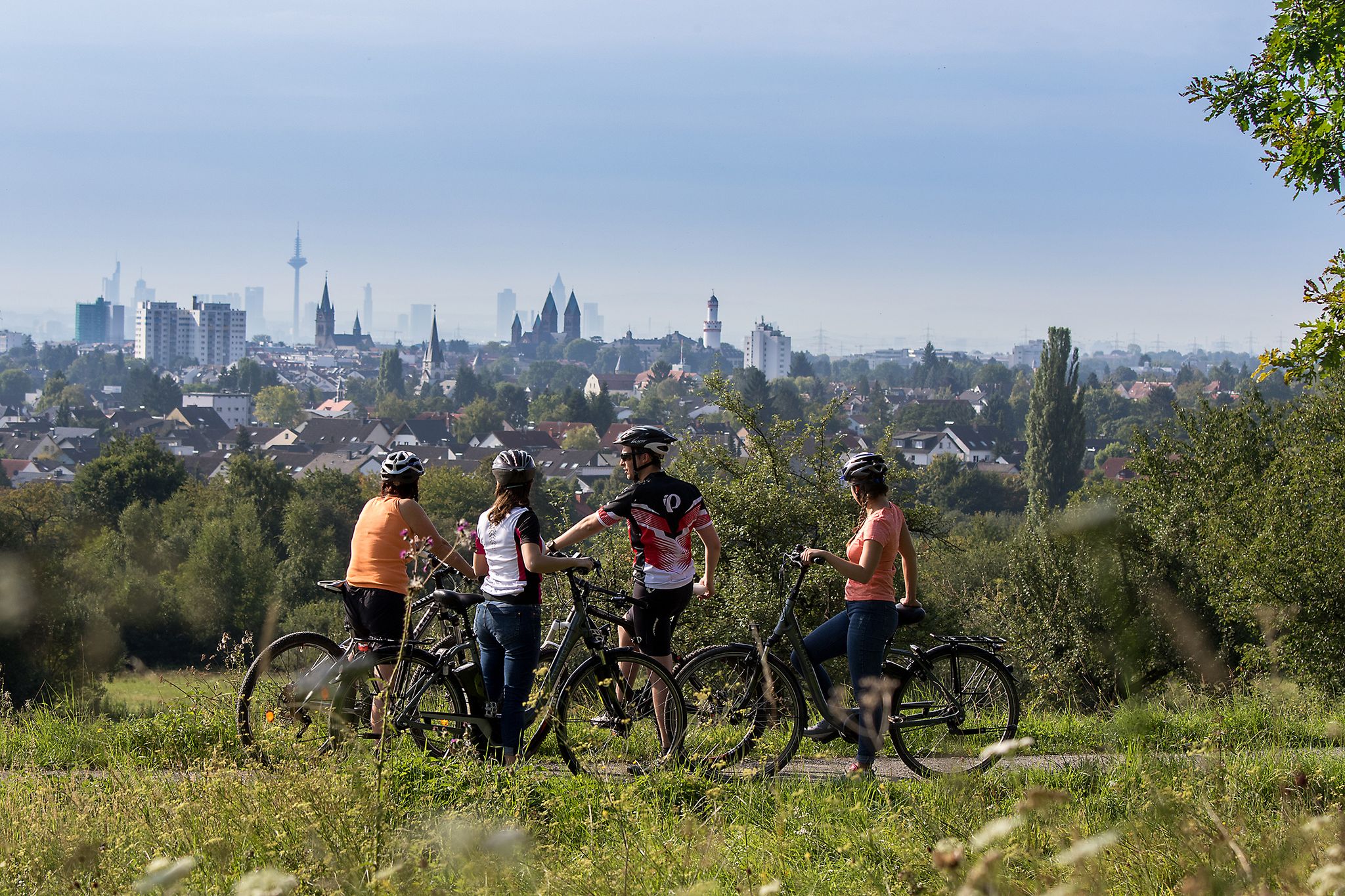
Here on the ridge there is a beautiful cycle path, which is great to ride and where you have a truly magnificent view
0
1
Frequently Asked Questions
How many traffic-free gravel bike trails are available around Hattersheim?
There are over 10 dedicated traffic-free gravel bike trails around Hattersheim, offering a range of difficulties from easy to difficult. These routes allow you to explore the diverse landscapes of the Main River and RheinMain Regional Park without vehicle interference.
Are there any easy or beginner-friendly traffic-free gravel routes?
Yes, Hattersheim offers several easy traffic-free gravel routes. For a more relaxed ride, consider routes that stick closer to the Main River, which tend to be flatter. While specific easy routes are not listed here, you can find options that are less demanding on komoot.
What kind of scenery can I expect on these traffic-free gravel trails?
The traffic-free gravel trails around Hattersheim offer a rich variety of scenery. You'll experience picturesque riverside paths along the Main, extensive green spaces within the RheinMain Regional Park, and views towards the Taunus mountains. Some routes also pass through areas like the Weilbacher Kiesgruben Nature Reserve, offering unique natural beauty. You might also encounter highlights such as the Großer Mannstein (Staufenschwur Lookout) or the View of the Frankfurt skyline from Oberwaldberg.
Are there any circular traffic-free gravel routes starting near Hattersheim?
Yes, many of the gravel routes around Hattersheim are designed as loops, allowing you to start and end in the same location. For example, the challenging View of Mainz Cathedral – Flörsheimer Watchtower loop from Eddersheim offers a substantial circular tour. Another option is the Hofheim Old Town – Speierlingsallee loop from Hattersheim (Main), which also provides a circular experience.
Can I bring my dog on the gravel bike trails around Hattersheim?
Generally, dogs are welcome on most public trails in the Hattersheim area, especially on gravel paths. However, it's always recommended to keep your dog on a leash, especially in nature reserves like the Weilbacher Kiesgruben, and to be mindful of other cyclists and pedestrians. Always check local regulations for specific areas.
Are the traffic-free gravel trails around Hattersheim suitable for families with children?
Many of the flatter, riverside sections along the Main are ideal for families, offering easy terrain and scenic views away from traffic. While some routes can be challenging, there are easier options available. Look for routes with less elevation gain and shorter distances if cycling with younger children.
What is the best time of year to go gravel biking in Hattersheim?
Spring and autumn are generally the best seasons for gravel biking in Hattersheim. The weather is mild, and the natural scenery is particularly beautiful. Summer can also be pleasant, especially along the shaded riverside paths, but be prepared for warmer temperatures. Winter riding is possible, but conditions can be muddy or icy, especially on unpaved sections.
Where can I park my car to access traffic-free gravel bike trails in Hattersheim?
Hattersheim and its surrounding towns offer various parking options. You can often find public parking near the Main River or in the town centers, which provide convenient access to the trail network. Specific starting points for tours like the Schwarzbach Steps – Small forest pond in Taunus loop from Hattersheim (Main) will typically have nearby parking facilities.
Can I reach the gravel bike trails around Hattersheim using public transport?
Yes, Hattersheim am Main is well-connected by public transport, making it easy to access the trails without a car. The local train station (S-Bahn) provides connections to Frankfurt and other towns in the Rhein-Main area. Many routes start directly from Hattersheim or nearby communities, allowing you to begin your ride shortly after arriving by train.
Are there any challenging traffic-free gravel bike trails for experienced riders?
Absolutely. For experienced riders seeking a challenge, routes like the View of Feldberg – View of Großer Feldberg loop from Hattersheim (Main) offer significant elevation gains and longer distances, pushing into the Taunus foothills. These routes provide a demanding workout with rewarding views.
What do other gravel bikers enjoy the most about gravel biking in Hattersheim?
The komoot community highly rates the gravel biking experience around Hattersheim, with an average score of 4.56 stars. Reviewers often praise the diverse landscapes, the well-maintained paths, and the ability to find routes that offer both scenic beauty and a good workout, all while enjoying traffic-free sections.
Are there places to stop for refreshments or coffee along the traffic-free gravel routes?
Yes, the region around Hattersheim is dotted with cafes, pubs, and restaurants, especially in the towns and villages along the Main River and within the RheinMain Regional Park. Many routes pass through or near these communities, offering convenient opportunities for a coffee break or a meal. For example, the Waldbembelsche Beer Garden & Climbing Park Ostpark Rüsselsheim is a highlight that could be incorporated into a longer ride.
Most popular routes around Hattersheim
Most popular attractions around Hattersheim

Get inspired with the komoot mobile app


Explore more
Browse the best Gravel rides in other regions.
