The best family-friendly hikes and walks around Gescher
4.6
(597)
2,464
hikers
179
hikes
Family friendly hiking trails around Gescher offer accessible outdoor experiences within a diverse natural landscape. The region is characterized by its flat topography, making it suitable for hikers of all experience levels, including families. Key natural features include the Fürstenkuhle and Kuhlenvenn nature reserves, known for their moorland and heathland ponds, and the scenic Berkel river valley. Gently rolling landscapes and extensive forest areas also contribute to the varied terrain.
Best family friendly hiking trails around Gescher
- The most popular…
Last updated: August 7, 2026
4.4
(37)
133
hikers
9.32km
02:21
10m
10m
Moderate hike. Good fitness required. Easily-accessible paths. Suitable for all skill levels.
4.5
(24)
82
hikers
Easy hike. Great for any fitness level. Easily-accessible paths. Suitable for all skill levels.

Sign up for free
4.6
(28)
113
hikers
2.69km
00:41
0m
0m
Easy hike. Great for any fitness level. Easily-accessible paths. Suitable for all skill levels.
4.7
(31)
114
hikers
Easy hike. Great for any fitness level. Easily-accessible paths. Suitable for all skill levels.
4.6
(21)
73
hikers
Easy hike. Great for any fitness level. Easily-accessible paths. Suitable for all skill levels.
Get access to more routes and recommendations from other explorers.
Sign up for free
Already have an account?
Our route recommendations are based on thousands of hikes, rides, and runs completed by other people on komoot.
Start today with a free account
Your next adventure awaits.
Login or Signup
Popular around Gescher
Other adventures around Gescher

Tips from the Community

The Kuhlenvenn nature reserve is a natural pearl in the agriculturally shaped cultural landscape.
0
0

Unfortunately, there was nothing to see except geese, beautiful landscape
0
0

Interesting natural landscape. Many grey geese.
0
0

The Fürstenkuhle is a nature reserve of approximately 99 hectares and an FFH area of approximately 87 hectares within the city limits of Gescher.
0
0

The former raised bog has been largely drained and converted into pastureland. These pastures are now managed extensively, meaning minimal use of resources (fertilizers, pesticides, machinery) and labor. A few Heck cattle graze on the pastures to keep the grasslands flat and open. In some areas, shallow pools have been created to provide a habitat for marsh and aquatic animals and plants. Here, one can find, for example, smooth newts, common frogs, moor frogs, slow worms, and adders. A birch-dominated bog forest now grows on the dried-out peat. Emerging shrubs are removed at irregular intervals to maintain open areas. Along the paths, oaks, rowan trees, and alder buckthorn have been planted among the birches. The over 4,000 square meter heath pond (also called Fürstenkuhle) is an important refuge for various, sometimes rare, animal and plant species. Together with the adjacent moorland and dry and wet heaths, it offers diverse habitats, especially for endangered plant and animal species such as the round-leaved sundew, one of the few carnivorous plants in Germany, and the rare moor frog. During the mating season in March, the males display a vibrant blue coloration to attract the females. Their loud courtship chorus can be heard from afar. Visitors can also observe teal, shoveler, greenshank, snipe, and reed warbler. (Source: various information panels in the Fürstenkuhle)
2
0
The Fürstenkuhle (Prince's Hollow) is part of the northern section of the Weiße Venn (White Fen), formerly the largest moorland area in the Münsterland region. The name does not originate from a prince, but rather derives from the Low German term "Voskenkuhle" (foxhole). It refers to the moor and heathland pond area, considered a remnant of the once vast Weiße Venn. The name evolved over time from its original Low German form to its current form. (Wikipedia) In the 20th century, peat was extracted on a large scale from the Weiße Venn. The remaining moorland area, the Fürstenkuhle, was first designated a nature reserve in 1942, encompassing only 26.9 hectares. Today, the protected area covers approximately 100 hectares. The remaining core moorland zones are now very small. Nevertheless, they exhibit the typical species composition and are of great importance for habitat and species conservation. The EU (European Union) has therefore declared this area a NATURA 2000 site.
2
0
This designated highlight, "Pond at Fürstenkuhle," is not a pond in the traditional sense, but rather a series of shallow pools (Blänke), which are created and found in various forms throughout the Fürstenkuhle area. The former raised bog has been largely drained and converted into pastureland. These pastures are now managed extensively, meaning minimal use of resources (fertilizers, pesticides, machinery) and labor. A few Heck cattle graze on the pastures to keep the grasslands flat and open. Shallow pools have been created in some parts of the pastures to provide a habitat for marsh and aquatic animals and plants. Here, you can find, for example, smooth newts, common frogs, moor frogs, slow worms, and adders. The ditches flowing through the area have been equipped with small reservoirs. This creates a build-up of water that extends into the surrounding areas and even onto the paths, thus generating wet and damp surfaces. The aim is to prevent the growth of woody plants and encourage the establishment of plants that prefer wet conditions. The 4,000 square meter heathland pond, also known as Fürstenkuhle, is not located at this particular spot. However, it also serves as an important refuge for various, sometimes rare, animal and plant species. The round-leaved sundew, one of the few carnivorous plants in Germany, is exceptionally delicate and only a few centimeters tall. It can be found at the edge of the heathland pond and can be spotted from the viewing platform. The rare moor frog can also be found here. During the mating season in March, the males display a vibrant blue color to attract the females. And their loud mating calls can be heard from afar. You can also observe teal, shoveler, greenshank, snipe, and reed warbler. (Source: various information panels in the Fürstenkuhle)
2
0
The peat layer formed over time by sphagnum mosses is up to 1.5 meters thick. To protect the delicate plants and structures, narrow wooden walkways have been built in the core area. Cycling is prohibited in the Fürstenkuhle to prevent damage to the sensitive plants along the narrow paths, especially when passing pedestrians. 🚲⛔
3
0
Frequently Asked Questions
How many family-friendly hiking trails are available around Gescher?
Gescher offers a wide variety of family-friendly hiking trails. With over 180 routes in total, the vast majority are classified as easy or moderate, making them perfect for families with children of all ages. You'll find plenty of options to explore the region's natural beauty.
What kind of natural landscapes can we expect to see on family hikes in Gescher?
The region around Gescher is characterized by diverse and accessible natural landscapes. You can expect to encounter significant nature reserves like the Fürstenkuhle and Kuhlenvenn, which feature moor and heathland ponds, perfect for birdwatching. Many paths also follow the scenic Berkel River valley, offering pleasant riverside walks. The area also boasts gently rolling landscapes and extensive forest areas.
Are there any specific trails suitable for families with strollers or toddlers?
Yes, Gescher's generally flat topography makes many trails suitable for strollers. For example, the Fürstenkuhle Boardwalk – Blänke at the Fürstenkuhle loop is an easy, short route ideal for younger children and strollers. The Waldlehrpfad (forest nature trail) is also specifically designed for families, offering an educational experience about the forest.
Can we bring our dog on the family hiking trails in Gescher?
Many hiking trails in Gescher are dog-friendly. However, when hiking in nature reserves like Fürstenkuhle and Kuhlenvenn, it's important to keep dogs on a leash to protect the local wildlife, especially ground-nesting birds and other rare species. Always check local signage for specific rules.
What are some interesting sights or attractions along the family-friendly routes?
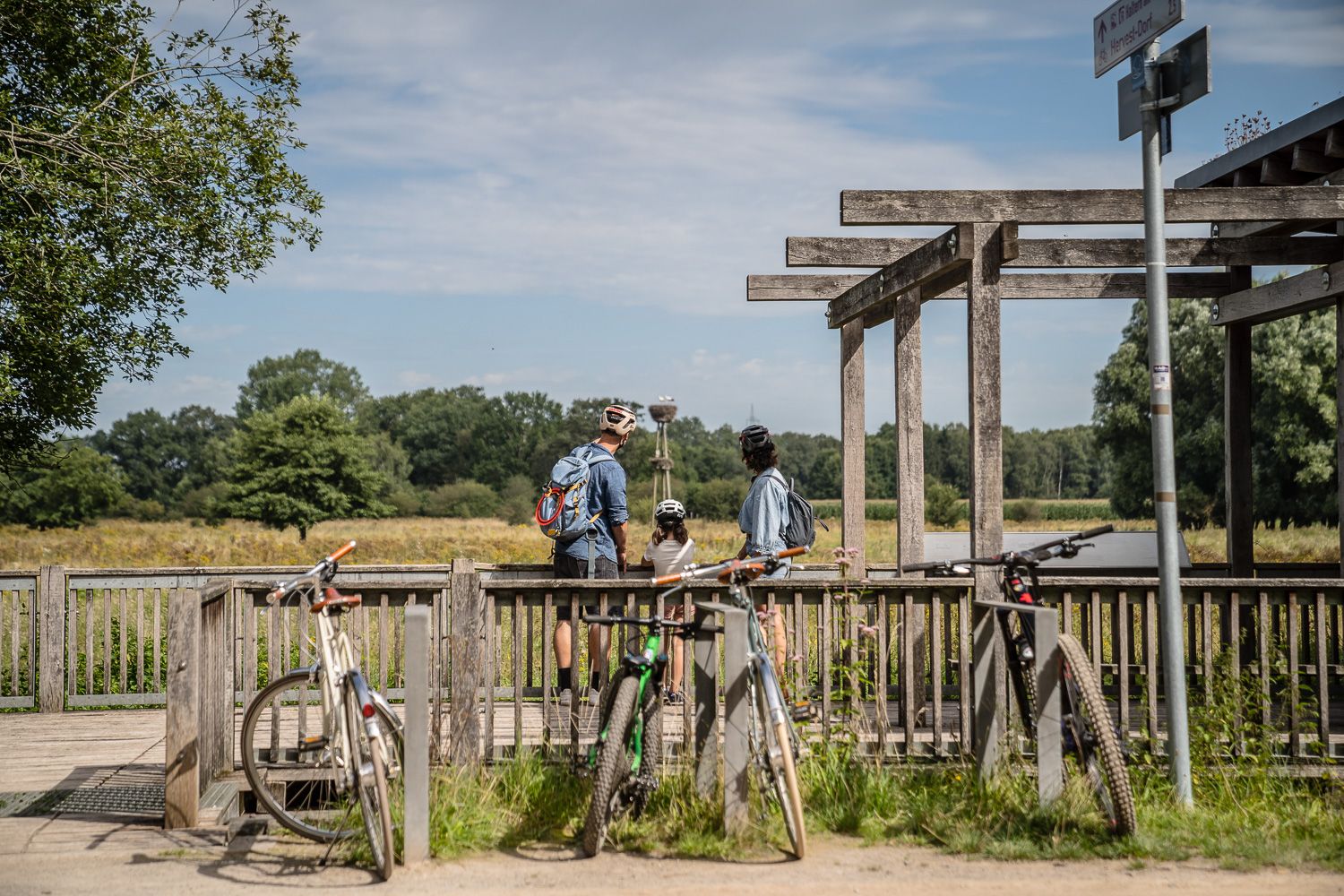
Beyond the natural beauty, you can discover several points of interest. The Kuhlenvenn Birdwatching Platform is a great spot for nature observation. You might also encounter historical sites like the Historic Sand Pit (Sandkuhle) in Coesfelder Heide. The region is also known for its moated castles, though these might require a short detour from Gescher itself.
What is the best time of year to go hiking with family in Gescher?
Gescher is wonderful for family hikes throughout the year. Spring brings blooming nature, while autumn offers beautiful foliage. Summer is ideal for longer days outdoors, and even winter walks can be magical, especially if there's snow. The flat terrain makes it accessible in most conditions, but always check the weather forecast before heading out.
Are there any circular routes suitable for families?
Absolutely! Many of the family-friendly trails around Gescher are circular, allowing you to start and end at the same point. For instance, the Kuhlenvenn nature trail loop from Kuhlenvenn is an easy circular option. Another great choice is the Fürstenkuhle Nature Reserve loop from Fürstenkuhle, perfect for a shorter family outing.
Where can we park when visiting the hiking trails in Gescher?
Parking is generally available near popular trailheads and nature reserves. For routes around the Fürstenkuhle and Kuhlenvenn, you'll often find designated parking areas. It's always a good idea to check the specific route details on komoot for recommended starting points and parking information.
Are there any longer, but still family-friendly, routes for older children?
For families with older children looking for a bit more distance, the Kuhlenvenn – Kuhlenvenn loop from Fürstenkuhle offers a moderate hike of just over 9 km. This route allows for a more extensive exploration of the nature reserve while remaining manageable for active families.
What do other hikers enjoy most about the family-friendly trails in Gescher?
The area is highly rated by the komoot community, with an average score of 4.5 stars. Reviewers often praise the quiet, well-maintained paths, the beautiful natural scenery of the nature reserves, and the accessibility of the trails for all ages, making it a perfect destination for a relaxing family day out in nature.
Are there places to eat or have a picnic near the hiking trails?
While specific cafes directly on every trail might be limited, Gescher and its surrounding villages offer family-friendly restaurants and cafes. Many trails also feature scenic spots ideal for a picnic, especially within the nature reserves or along the Berkel River. It's always a good idea to pack some snacks and drinks, especially when hiking with children.
Most popular routes around Gescher
Most popular attractions around Gescher

Get inspired with the komoot mobile app


Explore more
Browse the best Hikes in other regions.
