The best gravel rides around Pullay
7
riders
2
rides
Gravel biking around Pullay traverses varied rural landscapes, characterized by woodlands, open countryside, and paths connecting historic sites. The region offers routes that combine natural scenery with glimpses of local heritage, suitable for gravel cycling. Elevation changes are generally gentle, with most routes featuring less than 200 meters of ascent. The terrain consists primarily of unpaved roads, forest tracks, and greenways, offering diverse Pullay gravel biking terrain.
Best gravel bike trails around Pullay
- The most popular gravel bike trail is…
Last updated: October 7, 2026
2
riders
28.1km
01:46
160m
160m
Moderate gravel ride. Good fitness required. Mostly paved surfaces. Suitable for all skill levels.
2
riders
21.5km
01:26
130m
130m
Easy gravel ride. Great for any fitness level. Mostly paved surfaces. Suitable for all skill levels.

2
riders
30.3km
01:56
130m
130m
Easy gravel ride. Great for any fitness level. Mostly paved surfaces. Suitable for all skill levels.
1
riders
22.4km
01:31
140m
140m
Easy gravel ride. Great for any fitness level. Mostly paved surfaces. Suitable for all skill levels.
Our route recommendations are based on thousands of hikes, rides, and runs completed by other people on komoot.
Start today with a free account
Your next adventure awaits.



Tips from the Community

Very nice
0
0
Very good for taking photos
0
0
Very nice for taking photos, but you can't go inside
0
0

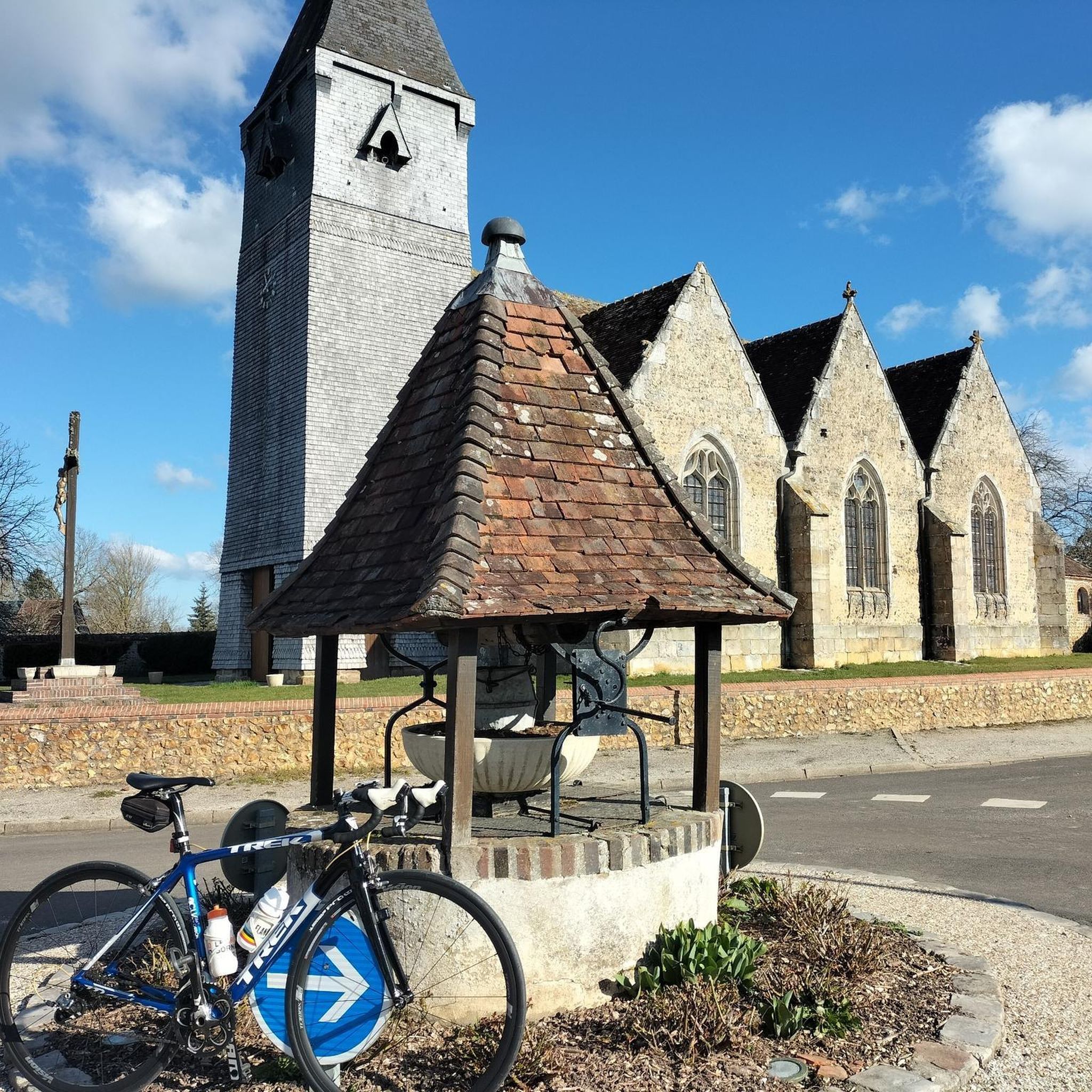
The church is closely inserted between the castle park and the houses of the village, which presents a harmonious ensemble of buildings from the 18th and early 19th centuries, combining flint and brick with lime plaster tinted with ochre. You have to step back a little to see its apse, the foundation of which probably dates back to the Romanesque period. Next to the entrance gable, dressed in Grison rubble, the bell tower was built in 1867 (according to the inscription preserving the names of the mason Gelin and the carpenter Hallier, with those of the priest, Abbot Porcher, the mayor, Viscount des Brosses, and the municipal councilors). The nave is extended by a rounded apse, with thick walls pierced by widely splayed semicircular openings, between which are placed the statues of Saint Sebastian, the Virgin and Child, Saint Michael and the dragon, and a holy bishop. On the "perque" (or beam of glory), a large Christ surrounded by the Virgin and Saint John. The transverse chapel, on the right, from the 15th or 16th century, vaulted with ribs resting on four pendentives with a central key carved like lace, was the seat of the brotherhoods. It houses the more recent statues of Saint Sebastian, the Virgin, Saint Michael and a holy bishop. The seigneury of Chennebrun, which belonged successively to Saint-Simon de Courtomer (1650), Caumont de la Force (1670), Grimoard de Beauvoir (1688), Laval Montmorency (1714), d'Espinay Saint-Luc (1765), etc., was acquired during the Restoration by Jacques-Alexandre Giroult des Brosses, whose father had been mayor of Dreux in 1771. In the seigneurial chapel on the left, inscriptions recall the names and dates of the members of this family linked for more than four generations to the life of the commune. We are grateful to them for having admirably maintained the castle, whose 18th century façade and the entrance to the park are visible from the gate. Their coat of arms appears on the stained glass window of this chapel, where we recognize in the center those of a Laval-Montmorency, Lord of Chennebrun, knight of honor of the Duchess of Orléans, master of the cavalry camp, who died in 1757, as indicated by his funerary slab on the threshold. The numerous 19th century stained glass windows with the names of the donors are worth seeing in detail. The one in the center, in the choir, lifts us to the sky with Our Lady of the Assumption. The statue of Mary, patron saint of Chennebrun, never ceases to watch over her church.
0
0
The church dedicated to Saint Christopher was under the patronage of the Abbey of Saint-Père de Chartres in the 12th century. Of Romanesque origin, the building was extensively enlarged and remodeled during the 16th and 19th centuries; it is currently undergoing a general restoration. This church owes its fame to the automobile pilgrimage held on the last Sunday in July. The single-aisled building, preceded by a porch, consists of a nave and a choir with a recessed flat chevet. To the south are the bell tower and a chapel. The use of traditional materials in this part of Normandy—flint and grison, a locally quarried ferruginous stone—indicates that the oldest parts of the building are of medieval origin. The nave is built of rubble masonry (grison and flint) set in mortar. In dressed stone, Grison was used to form, on one side, the corners of the exposed gable of the nave and, on the other, the corner buttresses, to frame the small arched openings, since walled up but still visible on the north and south walls, as well as the pointed arch of the portal. The same approach is found in the choir. The elevations are finished with a quarter-round cornice, part of which is also made of Grison stone. The use of brick corresponds to the 19th-century interventions, in two phases of work whose completion date is unknown. An examination of the construction reveals a first phase of repairs to the openings, particularly in the choir and nave, where large rectangular openings with curved lintels were created, the bricks of which are light in color. This was followed by further interventions with pointed arched openings framed in purplish brick, some of which replaced the rectangular openings of the previous phase. The porch features an ornate gable of light-colored, rendered brickwork, flanked by brick and chipped flint pilasters, and pierced by a central bay framed in brick and topped with a niche; the side sections are timber-framed on a masonry base. The southern flank of the building was added during the 16th century to a vast chapel and a bell tower, made of rubble blockwork, in which bays are pierced, framed in limestone, with curved profiles in the case of the bell tower. Restoration work has revealed several molded courses on the south face of the chapel, corresponding to a bay removed during later restorations, which confirm the dating of this part of the building. This chapel opens onto the nave through a large arcade adorned with several rows of moldings, resting on simple square piers devoid of decoration, with animal figures (reused?) at their bases, unearthed during the restoration work. The interior is remarkably simple, with whitewashed walls and geometric stained-glass windows. Only the choir is more ornate; its entrance is marked by a stone arch resting on hexagonal piers with historiated capitals, where a sculpted frieze of foliate ornaments, figures, and a coat of arms unfolds. The church has a painted faux-marble altarpiece, above which are visible traces of incomplete wall paintings depicting draperies. The rafter frame forming a truss was straightened and reinforced by restoring the removed or weakened kingposts and tie beams. According to tradition, the carpenters left the mark of their work by sculpting a scalloped ... The bell tower's belfry has also undergone a complete restoration. For this restoration, designed to strengthen the church and enhance its architecture, the Sauvegarde de l'Art Français (French Art Protection Agency) granted €10,000 in 2005.
0
0
Construction of the church began in the 12th century, and the building was subsequently remodeled, particularly in the 16th century.
0
0
The church is located near a departmental road and is surrounded by a cemetery. Church oriented with a longitudinal plan composed of a single nave. The entrance to the building is via a porch body. An annex building is attached to the north side of the choir. The western facade of the porch body rises on two levels delimited by a projecting cornice. It is pierced by a low-arched door as well as a rose window in the upper part. The bell tower, of polygonal plan, is positioned on the ridge of the roof. It is covered with a polygonal spire surmounted by a ridge cross and has two roof eaves. The building is covered with a gable roof. That of the annex building ends in a hip. The side walls are pierced with arched bays and supported by buttresses. The annex building is pierced by a quadrangular window and door. The buttresses of the choir bear witness to the Romanesque origins of the church. The nave, built in the 16th century, was enlarged in the 19th century by a bay to the west. The bays of the building were re-pierced around 1822.
0
0

Église Saint Madeleine is a church where beautiful various statues of Saints, famous and less famous. The reason for so many different statues is that the school of sculpture was established here.
0
0
Frequently Asked Questions
What kind of terrain can I expect on gravel bike trails around Pullay?
The gravel bike trails around Pullay primarily feature unpaved roads, forest tracks, and greenways. You'll traverse varied rural landscapes, including woodlands and open countryside, often connecting historic sites.
Are the gravel routes in Pullay suitable for beginners?
Yes, many routes in Pullay are suitable for beginners. The region generally offers easy to moderate gravel cycling routes, with gentle elevation changes, typically less than 200 meters of ascent.
What are some notable landmarks or attractions I can see along the gravel trails?
Several routes pass by interesting local landmarks. For example, you can explore the area around Bois Francs Castle or the Bois Francs Greenway. Other attractions in the vicinity include the La Madeleine Church in Verneuil-d'Avre-et-d'Iton and the Medieval town centre of Verneuil-sur-Avre.
Are there any longer gravel biking routes for more experienced riders?
While many routes are easy to moderate, you can find longer options. The Chapelle de Réveillon – Dovecote by the pond loop from Moussonvilliers is a moderate 17.2-mile (27.7 km) trail that takes about 2 hours to complete, offering varied rural terrain.
What do other gravel bikers say about the trails in Pullay?
The gravel biking routes in Pullay are highly rated by the komoot community, with an average score of 5.0 stars from 4 reviews. Users often praise the varied terrain and the combination of natural scenery with local heritage.
Are there any circular gravel routes available?
Yes, many of the gravel routes in Pullay are designed as loops. An example is the Saint-Denis Church – Notre-Dame Church loop from Montigny-sur-Avre, an easy 13.5-mile (21.7 km) path.
What is the typical elevation gain on gravel bike trails in Pullay?
Elevation changes on Pullay's gravel trails are generally gentle. Most routes feature less than 200 meters of ascent, making them accessible for a wide range of fitness levels.
Can I find routes that pass through villages or offer opportunities for stops?
The routes often connect local landmarks and pass through countryside, suggesting opportunities to encounter small villages or points of interest. For instance, the Le Trianon Cinema – Saint-Hilaire Church loop from Verneuil-sur-Avre starts near Verneuil-sur-Avre, which has a medieval town centre.
How many gravel bike trails are available around Pullay?
There are several gravel bike trails available around Pullay, offering various options for exploration.
What kind of natural scenery will I encounter on the gravel trails?
You will encounter varied rural landscapes, characterized by woodlands and open countryside. The trails are designed to showcase the natural beauty of the region.
Are there any specific greenways or dedicated cycle paths for gravel biking?
Yes, the region features greenways suitable for gravel cycling. The Bois Francs Greenway is a notable example, often incorporated into local routes.
Most popular attractions around Pullay

Get inspired with the komoot mobile app


Explore more
Browse the best Gravel rides in other regions.
