The best road cycling routes around Pullay
4.6
(57)
613
riders
22
rides
Road cycling around Pullay features a landscape characterized by gentle rolling terrain, greenways, and rural roads. The region includes areas like the Bois Francs, suggesting woodlands and open countryside. Routes often connect historical châteaux and follow riverbanks, such as the Iton. The elevation gains are generally modest, making the area suitable for various cycling abilities.
Best road cycling routes around Pullay
- The most popular road cycling route is Bois Francs Castle – Bois Francs Greenway loop from Les Barils,…
Last updated: July 16, 2026
5.0
(1)
30
riders
20.8km
01:19
80m
80m
Easy road ride. Great for any fitness level. Mostly well-paved surfaces and easy to ride.
4.0
(1)
4
riders
32.6km
01:53
100m
100m
Easy road ride. Great for any fitness level. Mostly well-paved surfaces and easy to ride.

Sign up for free
6
riders
Moderate road ride. Great for any fitness level. Some segments of this route may be unpaved and difficult to ride.
5.0
(1)
4
riders
25.4km
01:14
80m
80m
Easy road ride. Great for any fitness level. Mostly well-paved surfaces and easy to ride.
4
riders
64.8km
02:46
440m
440m
Moderate road ride. Good fitness required. Mostly well-paved surfaces and easy to ride.
Get access to more routes and recommendations from other explorers.
Sign up for free
Already have an account?
Our route recommendations are based on thousands of hikes, rides, and runs completed by other people on komoot.
Start today with a free account
Your next adventure awaits.
Login or Signup



Tips from the Community

Since 1823, the commune's territory has united the former parish of La Trinité, which was under the bishopric of Chartres, and that of Beaulieu, under the bishopric of Evreux, located on either side of the Avre River, which marked the separation. The tall brick bell tower-porch was added in the 19th century to the older nave (15th-16th centuries?), rectangular in plan, whose wooden vault rests on an exposed roof frame. This modest rural church houses, as a counterpart to the Curé d'Ars, a 15th-century polychrome stone Virgin of exceptional artistic quality. The two sculpted doors of the sacristy come from La Trinité, as well as the engraved "flat tomb" attached to the nave wall. It dates from the 15th century. and the inscriptions are difficult to decipher: Jean Fillon, wearing a canon's hood and a chasuble, his hands clasped and his feet resting on two small dogs, is depicted in a Gothic setting with two angels, silhouettes of altar boys, and canons. Near the baptismal font decorated with three fleurs-de-lis is a large painting of Saint Gilles the hermit, with the doe lying at his feet. A beautiful series of stained-glass windows from the early 20th century illustrate scenes from the New Testament, and two others show Joan of Arc at the king's coronation in Reims, then taking communion in her prison before being led to the stake.
0
0
The church is closely inserted between the castle park and the houses of the village, which presents a harmonious ensemble of buildings from the 18th and early 19th centuries, combining flint and brick with lime plaster tinted with ochre. You have to step back a little to see its apse, the foundation of which probably dates back to the Romanesque period. Next to the entrance gable, dressed in Grison rubble, the bell tower was built in 1867 (according to the inscription preserving the names of the mason Gelin and the carpenter Hallier, with those of the priest, Abbot Porcher, the mayor, Viscount des Brosses, and the municipal councilors). The nave is extended by a rounded apse, with thick walls pierced by widely splayed semicircular openings, between which are placed the statues of Saint Sebastian, the Virgin and Child, Saint Michael and the dragon, and a holy bishop. On the "perque" (or beam of glory), a large Christ surrounded by the Virgin and Saint John. The transverse chapel, on the right, from the 15th or 16th century, vaulted with ribs resting on four pendentives with a central key carved like lace, was the seat of the brotherhoods. It houses the more recent statues of Saint Sebastian, the Virgin, Saint Michael and a holy bishop. The seigneury of Chennebrun, which belonged successively to Saint-Simon de Courtomer (1650), Caumont de la Force (1670), Grimoard de Beauvoir (1688), Laval Montmorency (1714), d'Espinay Saint-Luc (1765), etc., was acquired during the Restoration by Jacques-Alexandre Giroult des Brosses, whose father had been mayor of Dreux in 1771. In the seigneurial chapel on the left, inscriptions recall the names and dates of the members of this family linked for more than four generations to the life of the commune. We are grateful to them for having admirably maintained the castle, whose 18th century façade and the entrance to the park are visible from the gate. Their coat of arms appears on the stained glass window of this chapel, where we recognize in the center those of a Laval-Montmorency, Lord of Chennebrun, knight of honor of the Duchess of Orléans, master of the cavalry camp, who died in 1757, as indicated by his funerary slab on the threshold. The numerous 19th century stained glass windows with the names of the donors are worth seeing in detail. The one in the center, in the choir, lifts us to the sky with Our Lady of the Assumption. The statue of Mary, patron saint of Chennebrun, never ceases to watch over her church.
0
0
The church dedicated to Saint Christopher was under the patronage of the Abbey of Saint-Père de Chartres in the 12th century. Of Romanesque origin, the building was extensively enlarged and remodeled during the 16th and 19th centuries; it is currently undergoing a general restoration. This church owes its fame to the automobile pilgrimage held on the last Sunday in July. The single-aisled building, preceded by a porch, consists of a nave and a choir with a recessed flat chevet. To the south are the bell tower and a chapel. The use of traditional materials in this part of Normandy—flint and grison, a locally quarried ferruginous stone—indicates that the oldest parts of the building are of medieval origin. The nave is built of rubble masonry (grison and flint) set in mortar. In dressed stone, Grison was used to form, on one side, the corners of the exposed gable of the nave and, on the other, the corner buttresses, to frame the small arched openings, since walled up but still visible on the north and south walls, as well as the pointed arch of the portal. The same approach is found in the choir. The elevations are finished with a quarter-round cornice, part of which is also made of Grison stone. The use of brick corresponds to the 19th-century interventions, in two phases of work whose completion date is unknown. An examination of the construction reveals a first phase of repairs to the openings, particularly in the choir and nave, where large rectangular openings with curved lintels were created, the bricks of which are light in color. This was followed by further interventions with pointed arched openings framed in purplish brick, some of which replaced the rectangular openings of the previous phase. The porch features an ornate gable of light-colored, rendered brickwork, flanked by brick and chipped flint pilasters, and pierced by a central bay framed in brick and topped with a niche; the side sections are timber-framed on a masonry base. The southern flank of the building was added during the 16th century to a vast chapel and a bell tower, made of rubble blockwork, in which bays are pierced, framed in limestone, with curved profiles in the case of the bell tower. Restoration work has revealed several molded courses on the south face of the chapel, corresponding to a bay removed during later restorations, which confirm the dating of this part of the building. This chapel opens onto the nave through a large arcade adorned with several rows of moldings, resting on simple square piers devoid of decoration, with animal figures (reused?) at their bases, unearthed during the restoration work. The interior is remarkably simple, with whitewashed walls and geometric stained-glass windows. Only the choir is more ornate; its entrance is marked by a stone arch resting on hexagonal piers with historiated capitals, where a sculpted frieze of foliate ornaments, figures, and a coat of arms unfolds. The church has a painted faux-marble altarpiece, above which are visible traces of incomplete wall paintings depicting draperies. The rafter frame forming a truss was straightened and reinforced by restoring the removed or weakened kingposts and tie beams. According to tradition, the carpenters left the mark of their work by sculpting a scalloped ... The bell tower's belfry has also undergone a complete restoration. For this restoration, designed to strengthen the church and enhance its architecture, the Sauvegarde de l'Art Français (French Art Protection Agency) granted €10,000 in 2005.
0
0
The church of Cintray has been listed as a historical monument since June 15, 1920. This building contributes to the beauty of the Eure landscapes and the richness of France's heritage. Over the centuries, the buildings that have been grafted or agglomerated in the surrounding area have been built within the framework of a social structure: the parish. These buildings constitute references in terms of local architecture, because they are often made with local materials: tiles or slates (from the 19th century), stones (flint, Grison, Seine Valley, sandstone, etc.), bricks or cob, lime plaster and nearby sand or earth. This gives colors that often range from beige to brown or red, and volumes perfectly suited to the Normandy climate (roof slopes, etc.). These churches have been the subject of specific analysis because their surroundings are not completely urbanized. The empty spaces or breathing spaces nearby help preserve their setting. The site of the church is very interesting because, located between the Iton and the very refined village square, it offers, to the south, large visual openings onto the monument. These spaces, little or not urbanized, must be preserved.
0
0
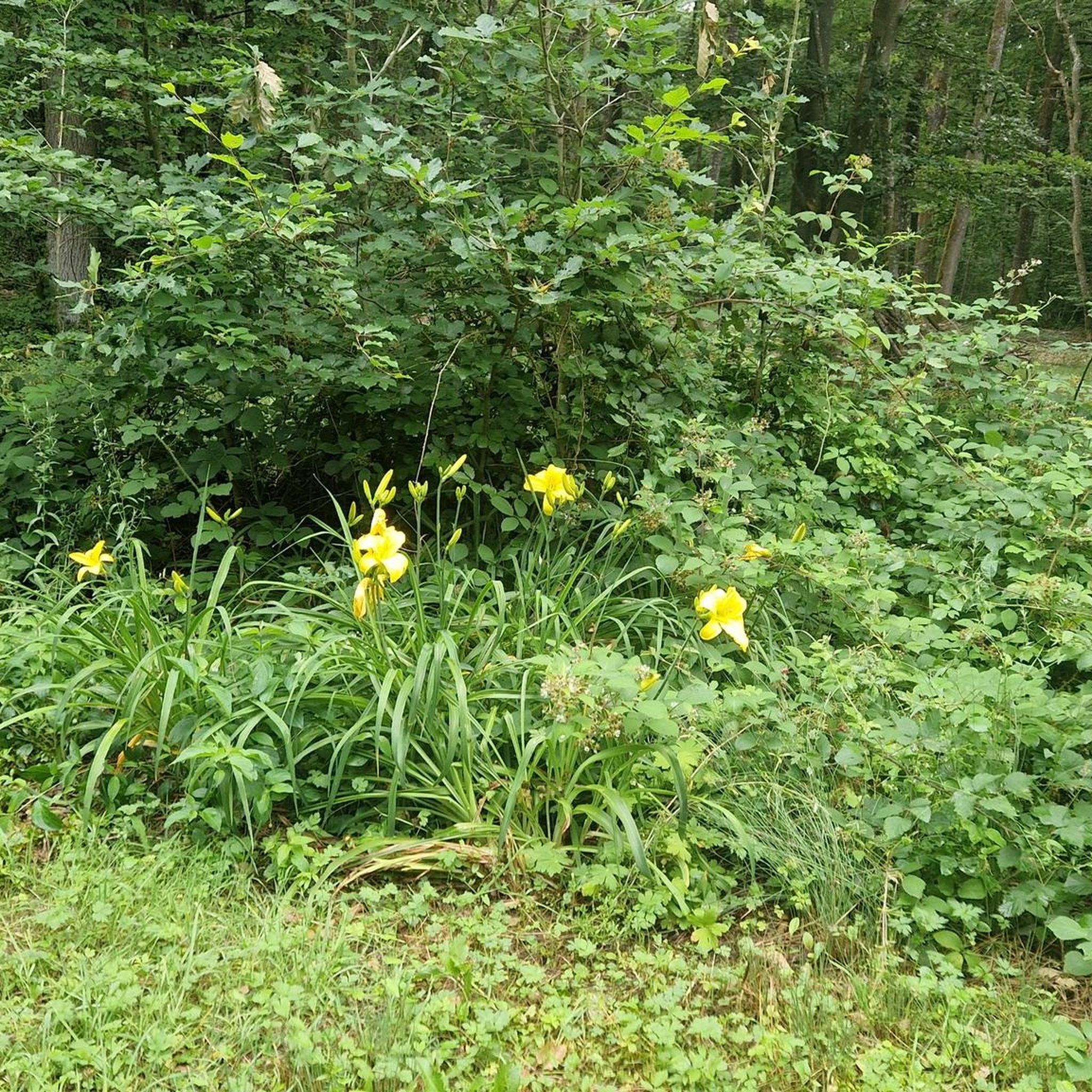
very beautiful section of greenway in very good condition and shaded thanks to a beautiful forest.
0
0

Located in the center of the village, it is dedicated to two twin brothers, Saint Gervais and Saint Protais, who were martyred in the 2nd century in Milan. Its construction dates from the 12th century. At that time, it included the flat-saddle nave and the choir. In the 15th and 16th centuries, it was completed by the south aisle and the ceiling covering. The south aisle was listed in July 1932, and the entire church has been listed since September 2011.
0
0

Église Saint Madeleine is a church where beautiful various statues of Saints, famous and less famous. The reason for so many different statues is that the school of sculpture was established here.
0
0
With a very simple plan, with its tiled nave and its small slate bell tower on the ridge, the church surrounded by its cemetery, set back from the road, overlooks the countryside planted with trees. The river is nearby, and its flowing water evokes that of the baptism of Jesus in the Jordan, as soon as we see the statue of the patron, Saint John the Baptist, in the choir. His arm raised towards the sky reminds us of his preaching in the desert of Palestine: "Prepare for the coming of the Messiah...". On the thin banner attached to his staff are written the words: "Ecce Agnus Dei", by which he already announced that he saw in Jesus the victim freely offering himself as a sacrifice for the Redemption of all men. Placed on the ground against the wall, a 17th century painting. depicts Jesus immersed up to his knees in the waters of the river, leaning with his hands crossed on his chest to receive the baptism of penance from the hand of John kneeling on the bank. We see “the Spirit descending on him like a dove” and we recall the words of John reported in the Gospel: “I am not worthy to bow down at his feet… I have baptized you in water; he will baptize you in the Holy Spirit.” Beside him, the angel wearing Jesus’ clothes turns his face towards a young child whom he guides with a hand placed on his shoulder, as if to teach him the profound meaning of baptism. Above the arch through which the nave opens onto the choir, the group of Christ on the cross surrounded by Mary and Saint John the Evangelist is a fine example of 16th century religious sculpture, faithful to traditional iconography. Similarly, at the back of the nave is the charming naive statue of Saint Fiacre: this young monk from Ireland loved to cultivate the vegetable garden of his monastery, near Meaux. Patron saint of gardeners, he holds his spade, and in the Perche region he was also invoked to cure various illnesses. More unique in style, the large Renaissance chest serving as a central altar was the former “work bench of the factory” reserved for the administrators of the parish’s resources and expenses. Let us admire the skill and imagination of the cabinetmaker who carved this series of full-length figures in oak under the arcades separated by “terms” inspired by Roman antiquity. Their distinctive attributes make us recognize Saints Christine, Barbara, Madeleine and Catherine on the front, and on the sides Saints Peter and Paul on the right, John the Baptist and Bartholomew on the left. Their silhouettes are more reminiscent of fairy tale characters…
0
0
Frequently Asked Questions
How many road cycling routes are available around Pullay?
There are over 20 road cycling routes in the Pullay region, offering a variety of experiences. The komoot community has explored 23 routes, with 12 rated as easy and 11 as moderate.
Are there easy road cycling routes suitable for beginners in Pullay?
Yes, Pullay is well-suited for beginners with 12 easy routes. A great option is the Bois Francs Castle – Bois Francs Greenway loop from Les Barils, which is 13.0 miles (20.9 km) and connects historical sites with dedicated greenway paths.
Are there more challenging road cycling routes for experienced riders in Pullay?
While the region is known for its gentle terrain, there are 11 moderate routes for those seeking a bit more challenge. The Mairie la Lande sur Eure – Château des Bois-Francs loop from Les Barils is a longer, moderate option at 64.8 km with more elevation gain.
What is the typical length of road cycling routes in Pullay?
Route lengths vary, but many popular options range from 20 km to over 60 km. For example, the Bois Francs Greenway – Château des Bois-Francs loop from 735 is 32.6 km, while the Bois Francs Greenway – Château des Bois-Francs loop from Les Barils extends to 46.0 km.
Are the road cycling routes in Pullay suitable for families?
Many routes in Pullay are family-friendly, especially those utilizing the greenways and rural roads with modest elevation gains. The 12 easy routes are particularly suitable for families looking for a relaxed ride.
What kind of scenery can I expect while road cycling around Pullay?
Road cycling around Pullay offers a picturesque landscape characterized by gentle rolling terrain, lush greenways, and quiet rural roads. You'll often find yourself passing through woodlands, open countryside, and along riverbanks like the Iton, with historical châteaux dotting the scenery.
Are there any circular road cycling routes in Pullay?
Yes, many of the routes in Pullay are designed as loops, allowing you to start and finish at the same point. Examples include the Bois Francs Castle – Bois Francs Greenway loop from Les Barils and the Washhouse on the banks of the Iton – Church of Saint Christopher loop from Les Barils.
What historical sites or landmarks can I see along the road cycling routes?
The routes often connect historical châteaux and other points of interest. You might pass by the impressive Bois Francs Castle, explore the Medieval town centre of Verneuil-sur-Avre, or see the Gray Tower of Verneuil-sur-Avre. The La Madeleine Church, Verneuil-d'Avre-et-d'Iton is another notable landmark.
What do other road cyclists enjoy most about road cycling in Pullay?
The area is highly rated by the komoot community, with an average score of 4.6 stars from over 40 reviews. Reviewers often praise the region's gentle terrain, the peaceful greenways, and the charming rural roads that connect historical sites.
When is the best time of year for road cycling in Pullay?
The gentle terrain and numerous greenways make Pullay enjoyable for road cycling throughout much of the year. Spring and autumn offer pleasant temperatures and beautiful scenery, while summer provides longer daylight hours. Always check local weather conditions before heading out.
Are there dedicated cycle paths or greenways in Pullay?
Yes, the region features dedicated greenways, such as the Bois Francs Greenway, which are integrated into many road cycling routes. These paths provide a smooth and often car-free experience, ideal for a relaxed ride.
Most popular attractions around Pullay

Get inspired with the komoot mobile app


Explore more
Browse the best Road cycling routes in other regions.
