The best MTB trails around Vieillevigne
4.3
(196)
1,103
riders
115
rides
Mountain biking around Vieillevigne features a network of routes traversing the region's varied landscape. The area is characterized by rolling countryside, agricultural fields, and sections of woodland, with gentle elevation changes. Many routes incorporate historical landmarks such as castles and chapels, alongside natural features like river valleys and footbridges. The terrain generally offers accessible paths suitable for different skill levels.
Best mountain bike trails around Vieillevigne
- The most popular mountain bike trail is La Sénardière Castle loop from Saint-Hilaire-de-Loulay,…
Last updated: May 7, 2026
5.0
(2)
32
riders
45.9km
02:50
240m
240m
Moderate mountain bike ride. Good fitness required. Suitable for all skill levels.
2
riders
40.8km
02:37
200m
200m
Moderate mountain bike ride. Good fitness required. Suitable for all skill levels.

Sign up for free
3.0
(1)
7
riders
43.0km
02:52
240m
240m
Moderate mountain bike ride. Good fitness required. Suitable for all skill levels.
4
riders
39.9km
02:31
120m
120m
Moderate mountain bike ride. Good fitness required. Suitable for all skill levels.
2
riders
32.1km
02:01
180m
180m
Moderate mountain bike ride. Good fitness required. Suitable for all skill levels.
Get access to more routes and recommendations from other explorers.
Sign up for free
Already have an account?
Our route recommendations are based on thousands of hikes, rides, and runs completed by other people on komoot.
Start today with a free account
Your next adventure awaits.
Login or Signup

Tips from the Community

It's a shame the tree is dead, but the chapel is still as amazing as ever.
0
0

. Originally, there was an ovoid-shaped enclosure flanked by about ten towers and a gatehouse, located to the northeast. The fortified town was located to the north of the fortress and extended a little to the east. A dry moat separated the fortified town from the fortress. A barbican protected the gatehouse. A Romanesque keep of the Niort type, with its courtyard and small enclosure, was located in the castle courtyard, roughly in the middle in the north-south direction and located to the west. The fortified city extended from the rue de Gaulle, a gate was located at the level of the Carré de l'Europe (the porte de Nantes), then the ramparts continued along the rue de la Place du Champ de Foire, then went back down the Esplanade des Olivettes, where a gate was located towards the roundabout of the rue des Jardins (porte de Tiffauges) then the ramparts ran along the Asson to go up the rue du Pont Jarlet and around the barbican not far from the Presbytery The dry moats surrounding the city were 16 meters deep in the 15th century, today they are flowered and are the subject of different colored squares decorating this part of the ramparts.
0
0
In the 9th century, a castrum, a wooden castle built on a mound of earth, was built to counter the Viking raids that had previously sacked the city of Durivum (Saint-Georges-de-Montaigu). For strategic reasons, this fortress was built on a rocky spur at the junction between the Maine and Asson rivers. Maurice I of Montaigu, the first known lord, witnessed the consecration of the church of Saint-Nicolas de la Chaize-le-Vicomte in 1099. His successor until 1174 was Brient I of Commequiers, married to his daughter, Agathe de Montaigu. Later, his grandchildren, Brient II, Maurice II "the Younger," and Marguerite, succeeded him. It was perhaps this Brient II who had the Romanesque keep built in 1218, a large square tower with flat corner towers. He also removed the wooden palisade, replacing it with a wide moat extending to the Saint-Georges Gate. The Montagues (also known as Belleville by marriage around 1180) pledged allegiance to the Plantagenets, Henry II, Richard the Lionheart, and John Lackland. Margaret of Belleville-Montaigu, daughter of Brient de Montaigu and Agnes de Belleville, granddaughter of Maurice I de Montaigu, sister of Maurice II de Belleville-Montaigu, married Hugh of Thouars in 1203. In 1227, the couple submitted to Philip Augustus through the ceremony of homage. Hugh of Thouars died in 1229, and Margaret remarried in 1235 to the Duke of Brittany, Mauclerc, whose real name was Pierre de Dreux. Marguerite de Montaigu died in 1241, childless. The lordship of Montaigu fell to her nephew, Maurice III de Belleville-Montaigu (d. c. 1297; son of Maurice II). He became lord of Montaigu upon the death of Mauclerc in 1250[2], and his son Maurice IV (d. c. 1292) ensured the succession through his children Jeanne (d. 1284 Geoffroy II David de La Flocellière) and Maurice V de Belleville-Montaigu (he married 1° Sibylle, daughter of Geoffroy VI de Châteaubriant, then 2° Isabelle/Létice de Parthenay, daughter of Guillaume V Larchevêque de Parthenay). Jeanne de Belleville (c. 1300-c. 1359), daughter of Maurice V of Montaigu and Létice of Parthenay, married Olivier IV of Clisson for the second time in 1328. Olivier IV was executed by beheading after being suspected of "felony" against the English, during the Hundred Years' War. Jeanne became a privateer with her children Olivier V and Jeanne de Clisson, in revenge, and was banished from the kingdom of France. While she attacked French ships, the fortress of Montaigu was held by the English, according to the Treaty of Brétigny-Calais, a garrison of which engaged in pillaging the surrounding area. Jeanne lost her ship and withdrew with her children to England. Olivier V, having grown up, rallied to the king of France, recovered his property in 1362 and fought the English with Bertrand du Guesclin. In 1373, Olivier and Bertrand succeeded in driving the English out of Montaigu, and Olivier ceded the lordship to his sister Jeanne, who had married an English captain, Jean Harpedenne. The latter sided with the King of France in 1373 and became Jean de Belleville. His grandson, Jean III, married Charles VII's half-sister, Marguerite de Valois, in 1433. Louis I de Belleville succeeded Jean III. King Louis XI advised him to fortify the town between 1464 and 1468 to protect it from the Bretons.
0
0

an essential route in the St Georges de Montaigu region for any mountain biker
0
0
13th century chapel, renowned for its Transfiguration altarpiece, dated from the 17th century and listed as a historic monument. Part of the Saint-Sauveur cultural site.
2
0

From the small garden at the foot of the ramparts, a lovely view of the remains of the medieval castle of Montaigu.
0
0

Formerly the manor of the Lords of Montaigu, this private 16th century granite castle has belonged to the same family since the beginning of the 18th century. During the Revolution, the manor was burned and drowned in blood during the passage of the Infernal Columns of General Turreau on January 19, 1794. This is still a private property and unfortunately no visits can be organized. More information on the castle and the commune: https://www.montreverd.fr/ma-commune/communes-deleguees/commune-deleguee-de-mormaison/
0
0
This rocky spur was fortified in the 9th century to fight against Viking invasions. In the 15th century, the entire medieval town was protected by ramparts, this time against the Bretons. The remains still visible today give an idea of the importance of this fortified castle at the time.
2
0
Frequently Asked Questions
How many mountain bike trails are there around Vieillevigne?
There are over 100 mountain bike trails around Vieillevigne, offering a wide variety of routes for different skill levels. The region features a mix of easy, moderate, and a few more challenging options.
What is the general difficulty level of mountain biking in Vieillevigne?
Mountain biking in Vieillevigne is generally accessible, with a good balance of easy and moderate trails. There are 39 easy routes, 71 moderate routes, and 5 more difficult options, making it suitable for a range of riders from beginners to those seeking a bit more challenge.
Are there any family-friendly mountain bike trails in Vieillevigne?
Yes, Vieillevigne offers several family-friendly mountain bike trails. Many routes feature gentle elevation changes and accessible paths. An excellent option for families is the Grande Maine Footbridge – Saint-Georges-de-Montaigu loop from Boufféré, which is an easy 19.2 km path following river sections.
What kind of scenery can I expect on mountain bike trails around Vieillevigne?
The mountain bike trails around Vieillevigne traverse a varied landscape of rolling countryside, agricultural fields, and sections of woodland. You'll also encounter natural features like river valleys and footbridges, alongside historical landmarks such as castles and chapels.
Are there any loop mountain bike trails in Vieillevigne?
Yes, many of the mountain bike trails around Vieillevigne are loops, providing convenient starting and ending points. For example, you could try the Grande Maine Footbridge loop from Vieillevigne, a moderate 41.8 km route.
What historical landmarks can I see while mountain biking in Vieillevigne?
The region's trails often pass by historical landmarks. You might encounter sites like La Sénardière Castle or the Church of St Georges. The Butière Castle – Saint Sauveur Chapel loop from La Planche is a great example of a route that leads past historical sites.
What do other mountain bikers say about the trails in Vieillevigne?
The mountain bike trails in Vieillevigne are highly rated by the komoot community, with an average score of 4.4 stars from over 190 reviews. Riders often praise the mix of open fields, river valleys, and the opportunity to explore historical points of interest.
Are there any trails that pass by castles?
Yes, several trails incorporate historical castles into their routes. The La Sénardière Castle loop from Saint-Hilaire-de-Loulay is a popular moderate trail that explores the local countryside and passes by historical castle grounds, including La Sénardière Castle itself.
Are there any trails that feature footbridges or river sections?
Yes, the region's trails often include natural features like river valleys and footbridges. The Grande Maine Footbridge – Saint-Georges-de-Montaigu loop from Boufféré is an easy path that specifically follows river sections and crosses a notable footbridge.
What are some other interesting sights or attractions near the mountain bike trails?
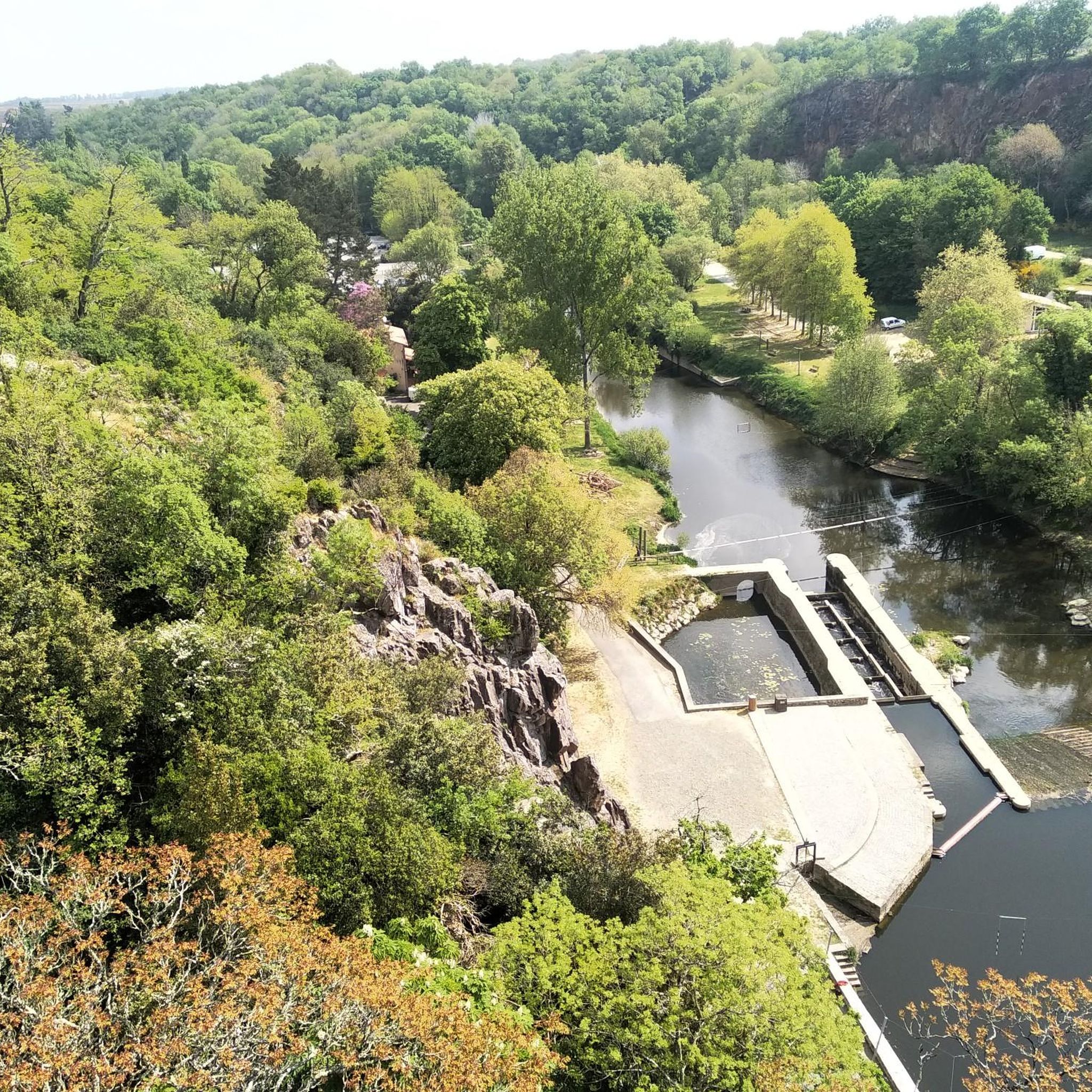
Beyond the trails, you can explore various attractions. Consider visiting The Old Bridge of Rocheservière, the Reuzard mill and footbridge, or the Dam and Mill of the Vieille-Écluse. There are also several castles in the vicinity, such as Logis de la Chabotterie and La Preuille Castle.
Are there any longer mountain bike routes for experienced riders?
For experienced riders looking for longer routes, Vieillevigne offers several moderate trails that cover significant distances. The La Sénardière Castle loop from Saint-Hilaire-de-Loulay is a moderate 46.8 km trail, and the Grande Maine Footbridge loop from Vieillevigne is another moderate option at 41.8 km.
Most popular attractions around Vieillevigne

Get inspired with the komoot mobile app


Explore more
Browse the best MTB trails in other regions.
