Attractions and Places To See around Tesson - Top 20
Attractions and places to see around Tesson, located in the Charente-Maritime department of France, offer insights into the region's historical and architectural heritage. The area is characterized by its Romanesque churches and medieval structures, reflecting centuries of regional history. Visitors can explore various sites that showcase the architectural evolution and cultural significance of Saintonge. This region provides opportunities to discover historical landmarks and local points of interest.
Best attractions and places to see around Tesson
- The most popular attractions is…
Last updated: May 9, 2026
Saint-Martin Church
Highlight • Other
Translated by Google •
Tip by

Pons Donjon
Highlight • Castle
Translated by Google •
Tip by

Sign up now to discover places like this
Get recommendations on the best single tracks, peaks, & plenty of other exciting outdoor places.
Sign up for free
You can spot a church by its steeple,
Highlight • Other
Translated by Google •
Tip by

A crypt built on an ancient underground refuge,
Highlight • Other
Translated by Google •
Tip by
Saint-Pierre-ès-Liens Church of Saintonge
Highlight • Religious Site
From the novel to the novel, there is only one step here and not only in the text!
Translated by Google •
Tip by
Sign up for free to discover even more attractions around Tesson.
Sign up for free
Already have an account?
Start today with a free account
Your next adventure awaits.
Login or Signup




Tips from the Community

You can also spend a night at the Saint James House B&B, quality guest rooms, swimming pool and view of the Donjon 🙂
0
0

The keep of Pons is located in the commune of Pons in the French department of Charente-Maritime in the Nouvelle-Aquitaine region. This tower is the old keep of the castle of Pons. 33 m high, it is visible from a long distance and is the symbol of the city. With the Saint-Gilles chapel, the remains of the ramparts and the main building, it constitutes the remains of the ancient castle of Pons.
1
0

Of the first church built in the 12th century, only the apse, the transept, the Gothic chapels and the bell tower remain, which is one of the best preserved and most elegant in Saintonge. It rises on three square floors supported by a powerful stump, and each face is decorated with a slender arcade with five arches supported by columns with capitals. The upper floor is pierced on each side by three elegant semi-circular twin bays. Of the church, entrusted to the Chaise-Dieu Abbey in 1084 by Robert de Pons, only the eastern part remains, the nave having disappeared during the Wars of Religion (16th century). Inside, note the dome divided into eight compartments as well as very beautiful capitals in the original sanctuary, decorated with acanthus leaves and palmettes. An ossuary crypt, from the end of the 12th or beginning of the 13th century, located under the chapel, extends the northern arm of the transept. It is accessible by a small staircase. It is covered with a primitive ribbed cross. A stone bench goes around the crypt about 50 centimeters from the current floor. Open on request at the town hall.
0
0
The Saint-Pierre-ès-Liens church: From the novel to the novel, there is only one step here and not only in the text! This church holds a special place in the Saintonge Romanesque landscape because it is built on the remains of a Gallo-Roman villa. The first bay of the choir, which carries the bell tower, reuses part of the walls of this villa and we can still observe fragments of a hypocaust, composed of an octagonal-shaped swimming pool. The church contains the oldest elements still visible in the religious buildings of Saintonge with masonry made of small regular rubble stones. Its classic plan has a two-bay nave and a pointed cradle vaulted transept. The choir bay is covered with a dome called “barlongue sur trompes”. The apse is decorated with an arcade which has beautiful sculpted capitals: a scene of the Holy Women at the Tomb; remains of archaic Romanesque sculpture which reveal lion tamers, a bow and falcon hunting scene. The front choir is a very old part of the building, dating from the 10th or 11th century, where magnificent Carolingian capitals decorated with fine arabesques remain. The church has two facades to the West and the South. Note the very curious series of modillions on the western facade, cubic in design.
0
0

The Church of Saint-Martin de Coucoury was built around the 11th century. It is a pretty example of a Romanesque church.
1
0

For people with a head for heights, it is worth climbing the 30-metre-high tower. There is also a museum in the building. It is one of the 'Monument historique' in France.
0
0
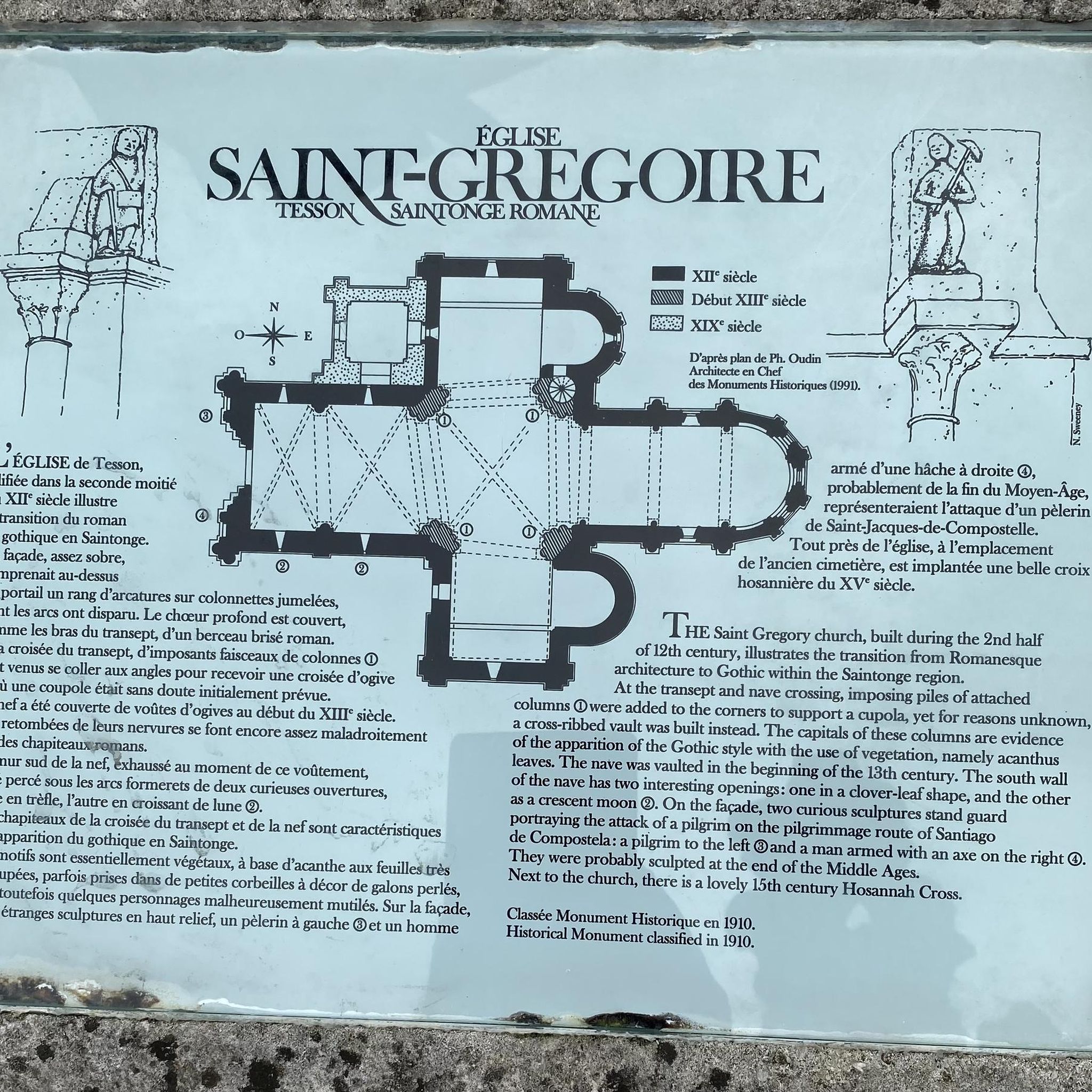
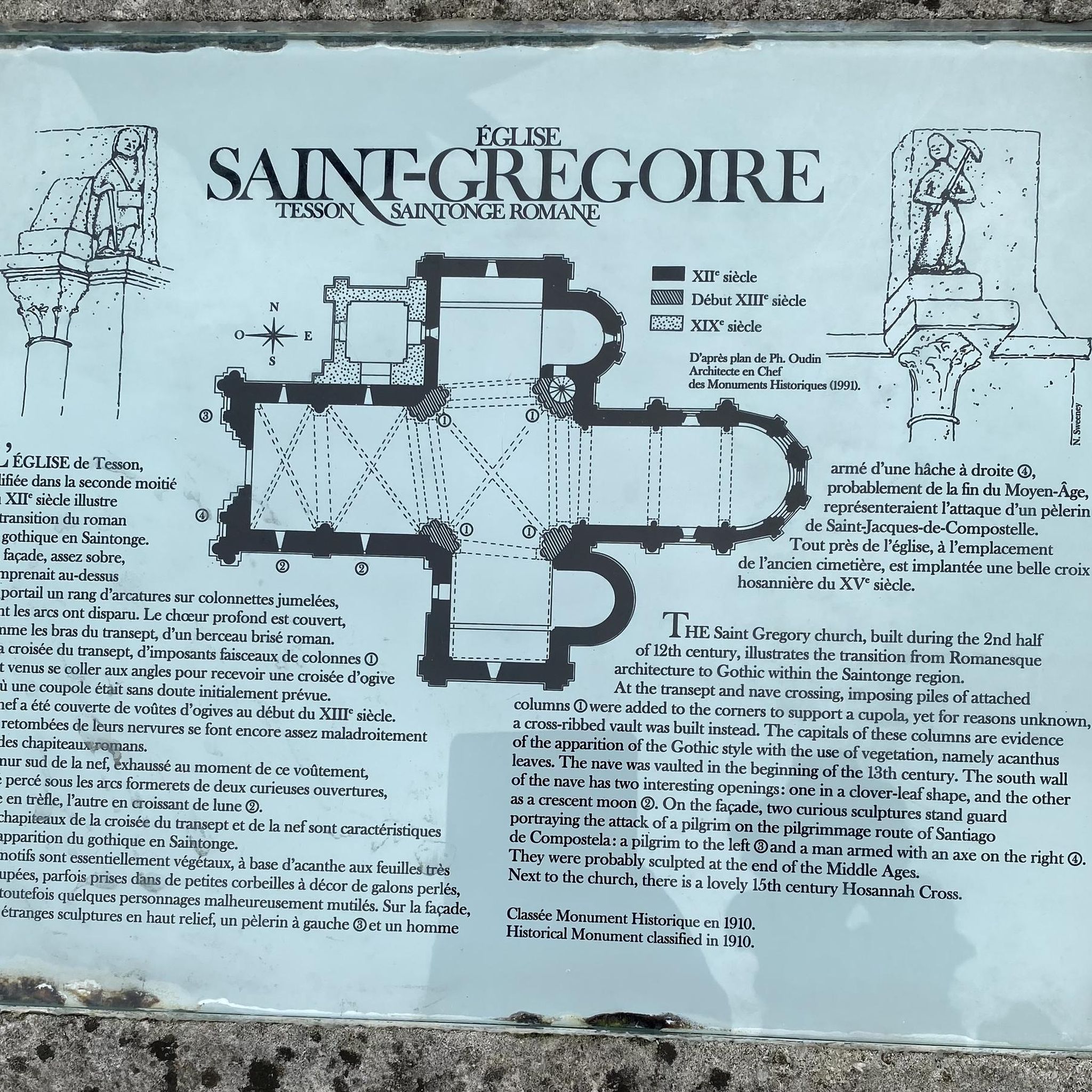
This sanctuary undoubtedly had to suffer depredations during the various conflicts that bloodied Saintonge, as evidenced by the various reconstruction campaigns, which make the building a synthesis of Saintonge Romanesque and late Gothic styles. The watchtower and machicolations of the southern transept bear witness to the wars of religion, which were particularly violent in the region. A crypt built on an old underground refuge, perhaps of Celtic origin, was rediscovered in 1976. The complex architecture of the Saint-Martin church bears witness to numerous alterations over the centuries. The oldest parts of this former Casadean possession seem to date back to the 12th century, a period which saw the flowering of many Romanesque churches in the Saintonge countryside. The facade, high and slender, consists of two horizontal registers and is crowned with a sharp gable, which adds to its monumentality. The lower part consists of a single arched portal, with four bare arches (the keystones having been redone in 1895) supported by small columns with capitals decorated with interlacing, sculpted faces and birds drinking from the same chalice. , or on the contrary turning away from each other. The upper part is made up of a central bay with three arches, framed by two blind arcades, separated by a series of finely worked small columns mounted on a cornice and a fluted base and ending in candles. The transition between this floor and the gable is formed by a series of modillions representing animals whose names the sculptor transcribed into Latin on the edge of the tablets (Leopardus, Colube) as well as a curious character sticking out his tongue, illustration of the character willingly facetious of the "ymagiers" of the Middle Ages. The nave is made up of four bays, covered with a basket-handle vault. A series of columns with capitals devoid of any ornamentation once carried the beams supporting the primitive barrel vault, which has now disappeared. Ample broken barrel arcades punctuate its side elevations. Transept and choir have been considerably redesigned. If the structure of the transept and the primitive pre-choir are found again, with their Romanesque capitals and their barrel vaults, the whole has been "enveloped" by Gothic additions, forcing the masonry of this part of the building to be redone. church. In fact, the square of the transept has the particularity of being surrounded by dissimilar pillars, carrying roughly assembled arches. These transformations date from 1488, the year in which a report mentions the construction of "d'ung arseau soulz the tower of the bell tower of the said place". The vast Gothic sanctuary “doubles” the Romanesque parts. It is made up of a choir and two side chapels, all covered with ribbed vaults, which fall on culs-de-lampe representing enigmatic birds and human heads. Large ogival bays, where trilobes and quatrefoils mingle, flood this part of the building with light. A gilded wooden altarpiece, surrounded by two Louis XV style credenzas, take place in the choir and the adjacent chapels. The central motif is "The Lamb of the Apocalypse" caught in a radiant background. This set, restored by the Beaux-Arts in 1975, was designed for the Abbaye aux Dames de Saintes. The dome of the medieval extension of the crypt. The entrance to the crypt is at the foot of the high altar. The latter was rediscovered in 1976 by the priest at the time, D.Héraud. Entirely carved into the rock, it seems to have been built in the 5th century, perhaps on an underground refuge of Celtic origin. Enlarged in the 12th century, it served for a long time as an ossuary. Outside, the square bell tower rises at the crossroads of the transept, where a dome on pendentives has been fitted. Built in the 14th century, it is flanked by a "pine cone" staircase turret. Traces of fortifications (watchtower and battlements), but also of fire, testify to the fights of the wars of religion in the 16th century. Church open daily.
0
0
The church of Coucoury, built along a Roman road, succeeded older sanctuaries of which only a few traces remain. It is dedicated to Saint-Martin. Most of the single nave building that exists today dates from the second half of the 12th century. Outside, the apse is the most remarkable element; it is limited, on either side, by two buttresses and divided, by two semi engaged columns, into three parts each pierced with a semicircular window. The whole is unified by an elegant border surmounting the windows and connecting them to each other. This very simple harmony is completed by a modillion cornice. On the south wall, the elevation of the nave has preserved fragments of a facing of small cubic rubble and traces of windows, witnesses of an older construction (11th century). This wall is pierced by three Romanesque windows. The square bell tower is massive. It is covered with a four-sloped, almost flat roof, and has two of its faces with beautiful twin Romanesque windows. At the end of the 15th century a chapel was added on the north side. Finally, the western facade is much more recent; indeed the nave, lengthened by nine meters in 1770, ends with a classic facade of fairly good quality with its bosses and its pediment. We can regret the elevation of this new facade in the 18th century because it deprives us of the 12th century facade. You enter the church through a bare door surmounted by a rectangular bay and an imposing triangular pediment (late 18th century). Inside, the nave – high, quite large and without side aisles – is lit by five pierced semicircular windows pierced in the 18th century. The stained glass windows were made in 1869. The walls, in exposed rubble, reveal breaks in the structure, which makes it possible to distinguish the constructions of the Romanesque period from those of the Classical period. In particular on the south wall where you can still see the walled bays of the first Romanesque building (11th century). On the left as you enter: an original stone baptismal font, made up of two twin basins and engraved with eight crests bearing the names of priests. These baptismal fonts date from the 17th century. At the other end of the nave: a stone pulpit dating from 1876. It is a very beautiful Romanesque church in the Saintonge countryside where the centuries have mixed styles for the greatest pleasure of the eyes.
1
0
Frequently Asked Questions
What kind of attractions can I expect to find around Tesson?
The area around Tesson, located in the Charente-Maritime department of France, is rich in historical and architectural heritage. You'll primarily find Romanesque churches and medieval structures that reflect centuries of regional history in Saintonge. These include impressive religious buildings and historical sites.
Are there any notable historical landmarks to visit near Tesson?
Absolutely. A prominent historical landmark is the Pons Donjon, a 33-meter-high medieval defense tower that serves as a symbol of the city of Pons. It dates back to 1187 and is one of the finest examples of a Romanesque donjon in western France.
Which churches are particularly significant for their architecture or history?
Several churches stand out. The Saint-Martin Church, built around the 11th century, is a beautiful example of a Romanesque church with a distinctive apse and semicircular windows. Another is the church known as You can spot a church by its steeple,, which boasts one of the best-preserved and most elegant bell towers in Saintonge, dating from the 12th century.
Are there any unique historical features, like crypts or ancient ruins, to explore?
Yes, you can visit the church featuring A crypt built on an ancient underground refuge,. This crypt, possibly of Celtic origin, was rediscovered in 1976 and is believed to have been built in the 5th century, later enlarged in the 12th century to serve as an ossuary. The church itself showcases a blend of Saintonge Romanesque and late Gothic styles.
What is special about the Saint-Pierre-ès-Liens Church of Saintonge?
The Saint-Pierre-ès-Liens Church of Saintonge is unique because it's built on the remains of a Gallo-Roman villa. It contains some of the oldest visible elements in Saintonge's religious buildings, including fragments of a hypocaust and magnificent Carolingian capitals from the 10th or 11th century.
Are there family-friendly attractions in the Tesson area?
Yes, the Pons Donjon is categorized as family-friendly, offering an engaging historical experience for visitors of all ages with its medieval tower and historical significance.
What do other visitors enjoy most about the attractions around Tesson?
Visitors appreciate the rich historical and architectural insights offered by the region's Romanesque churches and medieval structures. The attractions have garnered over 50 upvotes and 10 shared photos from the komoot community, highlighting their appeal.
Can I find viewpoints to enjoy scenic views near Tesson?
The Pons Donjon is also listed as a viewpoint. Its 33-meter height means it's visible from a long distance and likely offers good views of the surrounding area from its top.
What kind of cycling routes are available near Tesson's attractions?
You can find various cycling opportunities. For road cycling, routes like the 'Pons Keep loop from Villars-en-Pons' are available. If you prefer touring, there are options such as the 'Donjon de Pons – Pons loop from Saint-Léger'. Mountain biking enthusiasts can explore trails like the 'La Roche Madame Cave loop from Saint-Léger'. You can find more details on these and other routes in the dedicated guides for Road Cycling Routes around Tesson, Cycling around Tesson, and MTB Trails around Tesson.
Are there any hiking or walking trails near the historical sites?
While specific hiking trails directly linked to these historical sites aren't detailed, the region's rural setting in Charente-Maritime suggests opportunities for walks and exploring the countryside between attractions. For more structured outdoor activities, consider the cycling and mountain biking routes mentioned, which often pass through scenic areas.
What is the best time of year to visit Tesson for sightseeing?
Given the focus on historical sites and architecture, Tesson can be visited year-round. However, spring and autumn generally offer pleasant weather for exploring, with fewer crowds than peak summer and comfortable temperatures for walking between sites. Always check specific opening hours for individual attractions, as these may vary seasonally.

Get inspired with the komoot mobile app


Explore more
Still not found the Highlight you’re looking for? See guides of the top attractions in other regions:
