Attractions and Places To See around Varzay - Top 20
Best attractions and places to see around Varzay. Varzay serves as a base for exploring historical, natural, and cultural attractions within the Charente-Maritime region, particularly in nearby Saintes. The area is characterized by its rich Roman heritage, significant religious sites, and diverse natural landscapes. Visitors can discover ancient monuments, historic abbeys, and expansive natural spaces along the Charente river.
Best attractions and places to see around Varzay
- The most popular attractions is Abbaye aux Dames de Saintes, a religious…
Last updated: May 9, 2026
Abbaye aux Dames de Saintes
Highlight • Religious Site
Translated by Google •
Tip by

Saint-Pierre Cathedral (Saintes)
Highlight • Religious Site
Translated by Google •
Tip by

Sign up now to discover places like this
Get recommendations on the best single tracks, peaks, & plenty of other exciting outdoor places.
Sign up for free
You can spot a church by its steeple,
Highlight • Other
Translated by Google •
Tip by

Notre-Dame Church of Corme-Écluse
Highlight • Religious Site
Translated by Google •
Tip by
Saint-Romain Church of Saint-Romain-de-Benet
Highlight • Religious Site
Translated by Google •
Tip by
Sign up for free to discover even more attractions around Varzay.
Sign up for free
Already have an account?
Start today with a free account
Your next adventure awaits.
Login or Signup

Tips from the Community

The church suffered little damage during the Hundred Years' War and the Wars of Religion. From the end of the 18th century, maintenance work was undertaken mainly inside the church. In 1822, the reconstruction of the bell tower framework began, followed in 1852 by the restoration of the west facade. A further restoration took place around 1860, and the sacristy was enlarged by the construction of a semicircular annex extending the Romanesque apse. Beginning in 1880, a roof repair campaign began, and a new belfry was installed in the bell tower. From 1890 to 1900, the cemetery surrounding the church was moved to the "Fief des Rentes," and the former burial site was transformed into a public square. Starting in 1926, the choir roof was replaced and the bell tower was made watertight. In 1971, the work program included the renovation of the exterior walls, the demolition of the false apse and the sacristy that concealed the apse of the south transept. In 1990, the main door was replaced with oak leaves, the stones were repointed, and the collapsed arch keystone was reinstalled. In the 2000s, the municipality repaired the mechanism of the two belfry bells, and the building was illuminated and maintenance work was carried out.
0
0
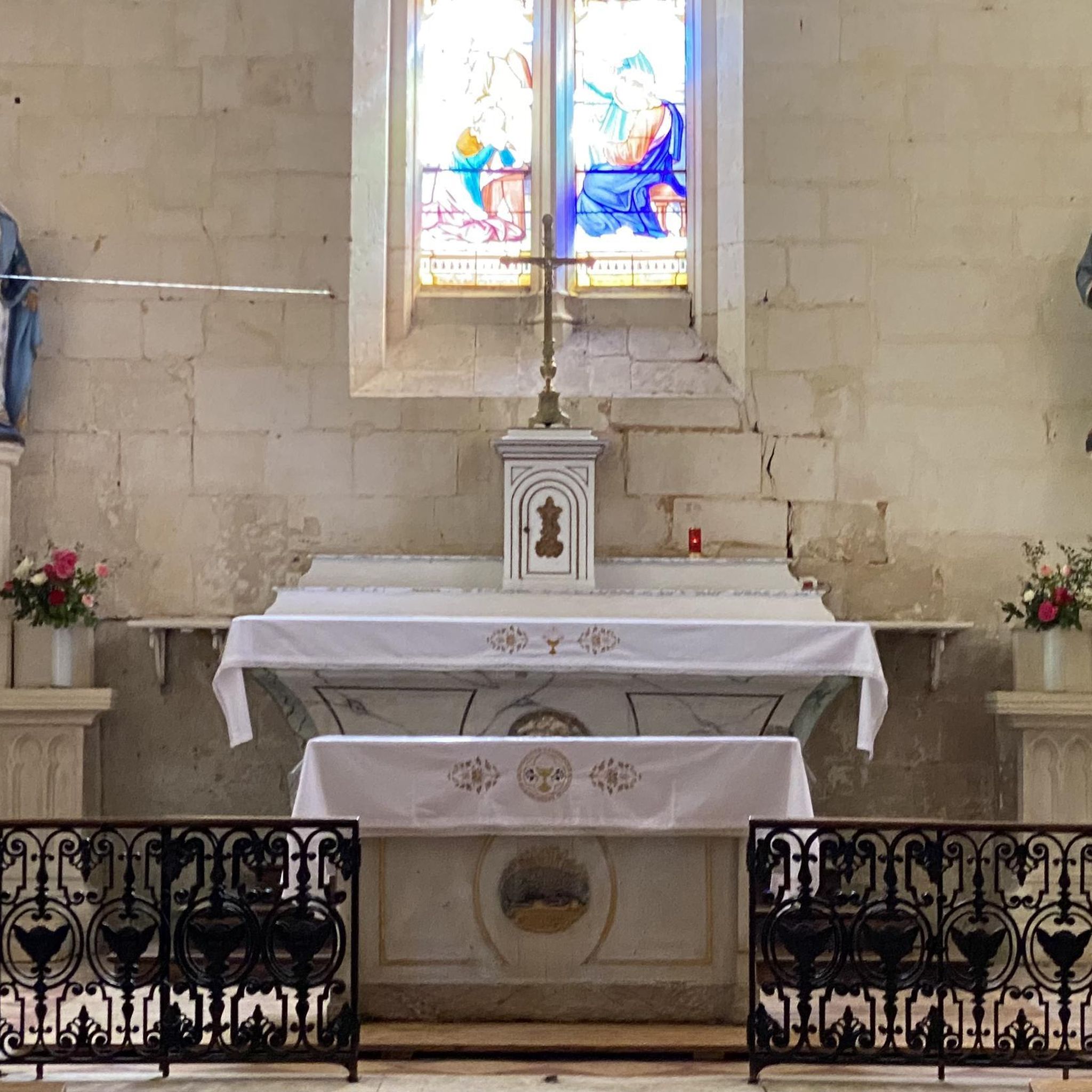
The Church of Our Lady of Corme-Écluse, the seat of a former Benedictine priory of the Abbey of the Ladies of Saintes, was donated around 1104 by Ramnulfus Focaudi (Bishop of Saintes between 1083 and 1106) to the Royal Abbey of Saint-Jean-d'Angély "so that he might always enjoy it and possess it in perpetuity." This abbey was thus responsible for the reconstruction of the sanctuary in the mid-12th century in the Romanesque style. A plaque affixed to the south wall of the nave contains a few historical snippets, still legible: 1200, the Benedictines completed the construction and adorned the church with an oak statue of the Blessed Virgin; 1327, the Abbot of Saint-Jean-d'Angely and an envoy of Pope John XXII prayed before the venerated image; In 1628, a pilgrimage was established to venerate the statue; In 1733, the statue was mutilated. The desecrator was punished. The church's plan is a slightly asymmetrical Latin cross (the north arm of the transept is longer than the south arm). The nave consists of two bays covered by pointed barrel vaults. It is lit by three symbolic windows rebuilt in the 13th century. A transverse arch separates the nave from the transept, whose crossing, under the bell tower, is covered by a cupola on squinches. The south arm of the transept opens onto an apse with a semi-dome vault. However, the north arm, rebuilt in the 17th century in the Romanesque style, is slightly longer than the south arm, and is designed on a rectangular plan without an apse. This arm has a portal with columns and toric rollers. After passing the triumphal arch, the choir begins with a straight bay covered with a semi-circular barrel vault and ends with a semi-circular vaulted arch.
0
0
Upon arriving in Corme-Écluse, it's only natural to stop at the church square, the heart of the Cormillon village. On this square, facing the town hall, stands the Church of Notre-Dame. Walk around it to admire the architectural details characteristic of the 12th-century Saintonge Romanesque style. The church was the seat of a former Benedictine priory of the Abbey of the Ladies of Saintes. The sculpted decoration of the Abbey of the Ladies certainly inspired that of the church of Corme-Écluse. This was often the case; mother abbeys were taken as examples by the priories that depended on them in terms of architecture and sculpture. In some cases, it is even assumed that the sponsors, artists, or craftsmen were the same people or at least from the same circle, sometimes descendants. Since the 13th century, the monument has been the destination of numerous pilgrimages that continue to this day. The pilgrimage takes place on the third Sunday of July in the convent gardens, followed by a procession to the Church of Our Lady.
0
0

The Abbaye-aux-Dames is built around the church of Sainte-Marie, built in the twelfth century. Famous for its facade and its characteristic "pinecone" bell tower, it is one of the emblematic monuments of Saintonge's Romanesque art. After several wars and fires, the place was restored in the 1970s and 1980s and is now a hotel. When you walk through the long corridors you feel like you have been transported back to the time when the abbey was still alive.
4
0
The Saint-Pierre Cathedral is located in the heart of the old town on the left bank of the Charente. According to tradition, the founding of this episcopal see goes back to Saint Eutrope. The construction of the first Christian building on the site of the current cathedral could not be dated with any precision. It probably dates back to the 6th century.
5
0
Of the first church built in the 12th century, only the apse, the transept, the Gothic chapels and the bell tower remain, which is one of the best preserved and most elegant in Saintonge. It rises on three square floors supported by a powerful stump, and each face is decorated with a slender arcade with five arches supported by columns with capitals. The upper floor is pierced on each side by three elegant semi-circular twin bays. Of the church, entrusted to the Chaise-Dieu Abbey in 1084 by Robert de Pons, only the eastern part remains, the nave having disappeared during the Wars of Religion (16th century). Inside, note the dome divided into eight compartments as well as very beautiful capitals in the original sanctuary, decorated with acanthus leaves and palmettes. An ossuary crypt, from the end of the 12th or beginning of the 13th century, located under the chapel, extends the northern arm of the transept. It is accessible by a small staircase. It is covered with a primitive ribbed cross. A stone bench goes around the crypt about 50 centimeters from the current floor. Open on request at the town hall.
0
0

A former Benedictine abbey created in 1047, Abbaye-aux-Dames was the first women's monastery in Saintonge. These powerful women were nuns, that is to say, nuns living cloistered and having taken a vow of piety, occupying their lives in contemplation. They carried the crosier, in other words the pastoral staff of a bishop, and minted coins. Richly endowed, the abbey carried its influence well beyond the borders of the county and over time it became one of the most powerful women's monasteries in all of South-West France. With up to a hundred nuns at its peak, it was entrusted with the mission of instructing young girls, often from the French nobility, and counted among its most illustrious residents the future Marquise de Montespan, favorite of Louis XIV. The Abbaye-aux-Dames is structured around the Sainte-Marie church, built in the 12th century, famous for its facade and its characteristic “pine cone” bell tower. The premises were restored during the 1970s and 1980s and now house a Cité de la musique in which the Saintes Festival dedicated to classical music takes place each year. You can also stay in a wing of the building, the cells having been converted into hotel rooms, and leave your bike in a secure room.
0
0
This rather atypical-looking church is the result of several reconstruction campaigns, which spanned nearly eight centuries from the 12th to the beginning of the 20th century. The characteristic element lies mainly in its line of domes, built in 1901, and left visible. Built in cement, they give the building a false oriental air.
0
0
Frequently Asked Questions
What historical and cultural landmarks can I explore near Varzay?
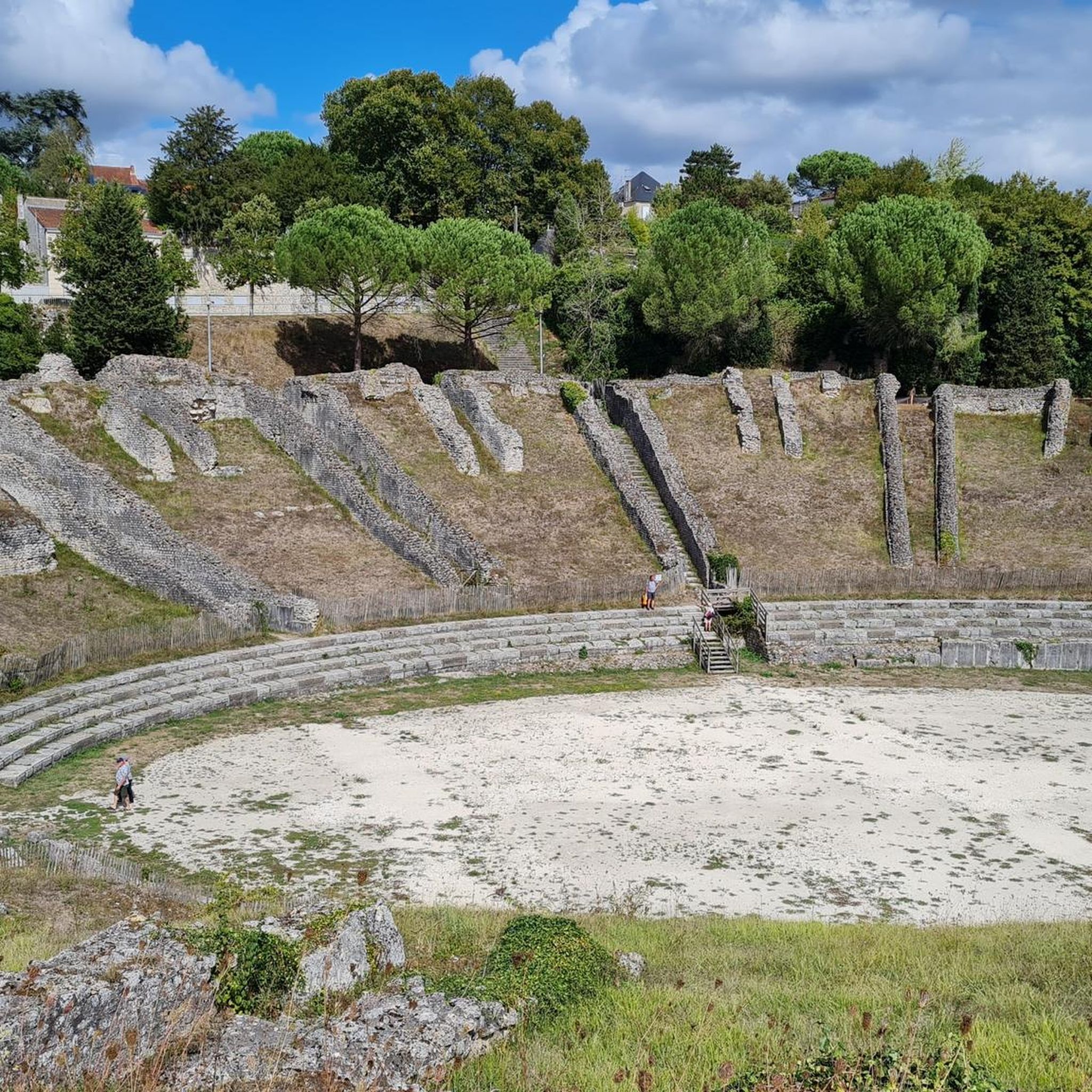
The region around Varzay is rich in history. You can visit the impressive Roman remnants in Saintes, such as the Amphitheatre and the Arch of Germanicus. Significant religious sites include the Abbaye aux Dames de Saintes, known for its 12th-century Sainte-Marie church, and the Saint-Pierre Cathedral (Saintes). Other notable churches include the Saint-Romain Church of Saint-Romain-de-Benet with its unique cement cupolas, and the Notre-Dame Church of Corme-Écluse.
Are there any castles or châteaux to visit in the area?
Yes, approximately 13km from Varzay, you can explore the historic Château de la Roche Courbon, which also features remarkable gardens. Additionally, the Parcs et jardins du château de Beaulon offer another beautiful green space to discover.
What natural features and parks are there for nature lovers?
Nature enthusiasts will enjoy La Prairie de la Palu in Saintes, a vast 120-hectare natural space along the Charente river, classified as a Natura 2000 zone. Several forests like the Forêt de Pons, Forêt de Suzac, and Forêt de la Lande offer opportunities for walks and exploration. Further afield, but within the region, you can find coastal features such as Pointe de Suzac.
What towns or villages are worth visiting for their charm or historical significance?
Beyond Saintes, which is a key destination, consider visiting the picturesque villages of Mornac-sur-Seudre and Talmont. Talmont is particularly known for its Church Sainte-Radegonde. The town of Pons also holds historical significance, including its ancient hospital for pilgrims.
Are there family-friendly attractions around Varzay?
Many of the historical and religious sites are suitable for families. For instance, the Abbaye aux Dames de Saintes, Saint-Pierre Cathedral (Saintes), and the Saint-Romain Church of Saint-Romain-de-Benet are categorized as family-friendly. Exploring the natural spaces like La Prairie de la Palu or the local forests also provides great family outings.
What outdoor activities, like cycling or running, can I do near Varzay?
The area offers various outdoor activities. For cycling, you can find numerous routes, including those that visit multiple churches or explore forests. Check out the Cycling around Varzay guide for options. If you prefer gravel biking, there are routes like the 'View of the Arch of Germanicus – Port of the Lys loop from Saintes'. Explore the Gravel biking around Varzay guide for more details. Runners can find trails such as the 'Running loop from Varzay' or 'Combe des Morins loop from Varzay' in the Running Trails around Varzay guide.
What do visitors enjoy most about the attractions around Varzay?
Visitors particularly appreciate the rich historical and architectural significance of the sites. For example, the Abbaye aux Dames de Saintes is praised for its beautiful Romanesque art and the feeling of being transported back in time. The unique architecture of churches like the Saint-Romain Church of Saint-Romain-de-Benet also captures attention, with its distinctive cement cupolas giving it a 'false oriental air'.
Are there any specific tips for visiting the Abbaye aux Dames de Saintes?
Yes, the Abbaye aux Dames de Saintes is known for its 12th-century Sainte-Marie church and characteristic 'pinecone' bell tower. It was the first women's monastery in Saintonge and has a rich history. The premises were restored in the 1970s and 1980s and now house a Cité de la musique. You can even stay in a wing of the building, as some cells have been converted into hotel rooms.
What is the best time to visit Varzay and its surrounding attractions?
The Charente-Maritime region generally enjoys pleasant weather from spring through early autumn (April to October), making it ideal for exploring historical sites and natural landscapes. Summers are warm and sunny, perfect for outdoor activities, while spring and autumn offer milder temperatures and fewer crowds.
Where can I find cafes or restaurants near the attractions?
The city of Saintes, being a central hub for many attractions, offers a wide array of cafes and restaurants. You'll find options ranging from traditional French cuisine to more casual eateries, particularly in the old town area near the cathedral and Roman sites. Smaller towns and villages like Pons also have local establishments.
Are there any easy walks or trails suitable for all abilities near Varzay?
While specific 'easy walks' are not detailed in the provided data, the natural spaces like La Prairie de la Palu in Saintes offer flat terrain along the Charente river, which would be suitable for leisurely strolls. Many of the forests, such as the Forêt de Pons, also contain paths that can be enjoyed at a relaxed pace.
What is the significance of the Saint-Pierre Cathedral in Saintes?
The Saint-Pierre Cathedral (Saintes), located in the heart of Saintes' old town, is dedicated to Saint Peter. Its founding dates back to the 6th century, making it a site of profound historical and religious importance. It has undergone significant construction and restoration throughout its long history and is a key landmark in the city.

Get inspired with the komoot mobile app


Explore more
Still not found the Highlight you’re looking for? See guides of the top attractions in other regions:
