The best road cycling routes around Saint-Simon
4.3
(29)
560
riders
165
rides
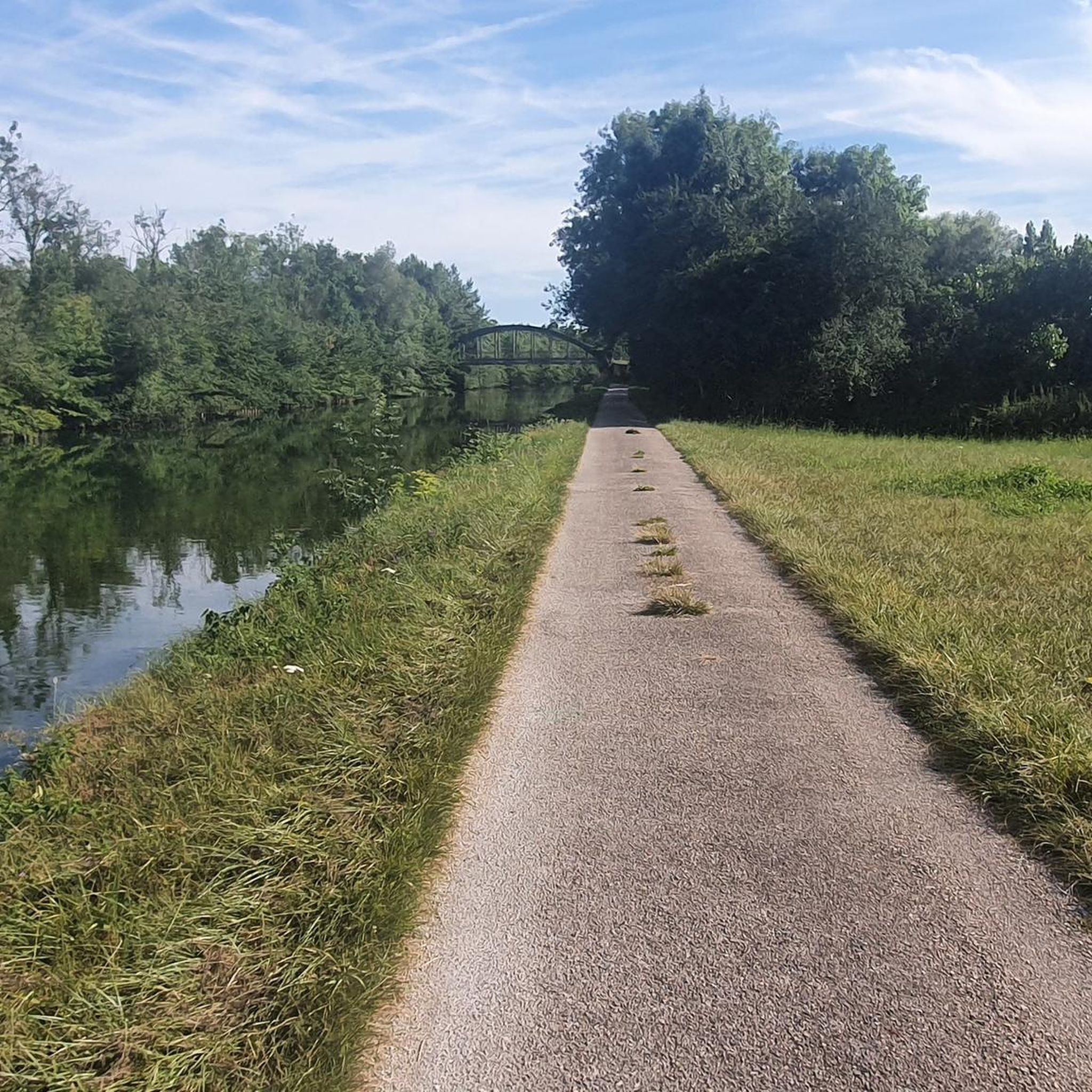
Road cycling around Saint-Simon, located in the Hauts-de-France region, features a landscape characterized by generally flat to gently rolling terrain. Routes often follow canals and traverse open rural areas, providing consistent surfaces for cycling with modest elevation gains. The region offers a mix of agricultural land and forested sections, making it suitable for various road cycling skill levels.
Best road cycling routes around Saint-Simon
- The most popular road cycling route is St Quentin Canal – Canal de Saint-Quentin Path loop…
Last updated: May 18, 2026
5.0
(16)
25
riders
Moderate road ride. Good fitness required. Some segments of this route may be unpaved and difficult to ride.
7
riders
49.4km
02:06
270m
270m
Moderate road ride. Good fitness required. Mostly well-paved surfaces and easy to ride.

Sign up for free
6
riders
48.0km
02:00
290m
290m
Moderate road ride. Good fitness required. Mostly well-paved surfaces and easy to ride.
8
riders
148km
06:11
630m
630m
Hard road ride. Very good fitness required. Mostly well-paved surfaces and easy to ride.
3
riders
Moderate road ride. Good fitness required. Some segments of this route may be unpaved and difficult to ride.
Get access to more routes and recommendations from other explorers.
Sign up for free
Already have an account?
Our route recommendations are based on thousands of hikes, rides, and runs completed by other people on komoot.
Start today with a free account
Your next adventure awaits.
Login or Signup



Tips from the Community

The sight of military cemeteries is always very sad, but we must not forget history.
0
0

This impressive cemetery was built in 1920-1921 on a site that was heavily contested during the First World War. It contains the remains of 1,258 French soldiers, 547 of whom are buried in two ossuaries. One French soldier from the Second World War is also buried here. Adjacent is a German military cemetery with the remains of 1,095 soldiers, 388 of whom are buried in collective graves, together with four British and two French soldiers. The necropolis is located in a region where the German advance towards Paris passed through in 1914, and where fierce fighting took place in 1918 during the Battle of Matz. Today it is a serene place of remembrance and reconciliation, in the middle of a landscape that was once the scene of devastating battles.
4
0

"God loves every soul with an undying love. He approaches each one with repeated, unspeakably patient offers of redemption. Even a small sign of love is enough for him to forgive and redeem. Our dear departed ones lacked a life preserver for the body; but the spiritual life preserver was not lacking, the breath of God in which the soul can clothe itself in a tiny moment, much more quickly than the body could." (Text by Albino Luciani / Pope John Paul I)
0
0

As a memorial to the many dead, such a "MONUMENT AUX MORTS" (usually called a "Central Memorial" or "War Memorial" in German-speaking countries) is still very important today. "Now, Lord, you let your servant depart in peace, as you have said..." it says in the so-called "Hymn of Simeon" (Luke's Gospel, Chapter 2, Verse 29). However, the people who are remembered here did not depart in peace, but became victims of war and tyranny. Therefore, the term "fallen memorial" is now sometimes used instead of the "war memorial" that was previously common in German. In the French-speaking world, however, this aspect of commemoration of the dead has long been included in the most commonly used term "MONUMENT AUX MORTS". Regardless of language and nation, such a memorial has two important and at the same time everlasting tasks: -1- to keep the memory of the suffering and horror of war alive, -2- and to remind people of the need to maintain peace in the long term.
2
0
The British cemetery of Seraucourt was created from 1920 to 1926, where the remains of soldiers buried in graves located on the nearby battlefield were grouped together, most of them killed in 1918. The cemetery contains 1,378 bodies including: 1 371 British, 5 Canadians and 2 Australians. Among them are around twenty airmen shot down in 1944. Only 496 bodies have been identified.
7
1

The Grand-Seraucourt British Cemetery is a historic site dating from the First World War, where nearly 2,000 British soldiers and airmen are buried. The cemetery covers an area of 4,732 m² and is surrounded by a stone wall. You can run along the paths that connect the different sections of the cemetery and admire the memorial stones and flowers that adorn them. You can also learn more about the history of the cemetery and the people buried there by reading the information panels or scanning the QR codes with your smartphone. The cemetery is open daily from 8 a.m. to 6 p.m. and entry is free. Running in the Grand-Seraucourt British Cemetery is a way to honor the memory of those who fought for freedom, and to appreciate the beauty and tranquility of this place.
3
0
If you're looking for a scenic and historic route, you can try the Saint-Quentin Canal in northern France. This canal connects the Escaut, the Oise and the Somme, and crosses the watershed at a summit level 20.4 km long with two tunnels. You can run along the towpath, admire the views of the countryside and the waterway, and discover the towns and villages along the route. The canal was built in the 18th century and was an important link for trade and transport. You can learn more about its history and engineering at the Musée du Touage in Riqueval, where you can also see the electric tugboats that pull the boats through the long tunnel. The Saint-Quentin canal is an ideal destination for runners who love culture and adventure.
2
0
Frequently Asked Questions
What kind of terrain can I expect for road cycling around Saint-Simon?
Road cycling around Saint-Simon, located in the Hauts-de-France region, features generally flat to gently rolling terrain. Routes often follow canals and traverse open rural areas, providing consistent surfaces for cycling with modest elevation gains. You'll find a mix of agricultural land and forested sections.
How many road cycling routes are available in Saint-Simon?
There are over 170 road cycling routes available around Saint-Simon. This includes a wide range of options, with approximately 50 easy routes, over 110 moderate routes, and a few more challenging options for experienced cyclists.
Are there any easy road cycling routes suitable for beginners?
Yes, Saint-Simon offers several easy road cycling routes. A great option for beginners is the St Quentin Canal – Canal de Saint-Quentin Path loop from Artemps, an easy 27.9 km (17.3 miles) trail that takes about 1 hour 10 minutes to complete, offering scenic views along the canal.
What do other road cyclists think about the routes in Saint-Simon?
The road cycling routes in Saint-Simon are highly rated by the komoot community, with an average score of 4.4 stars from over 40 reviews. More than 600 road cyclists have used komoot to explore the varied terrain, often praising the canal paths and open rural roads.
Are there any longer, more challenging road cycling routes?
For those seeking a longer ride, the Ham Castle – Forest Trail Near Grandrû loop from Flavy-le-Martel is a moderate 101.9 km (63.4 miles) path. This route leads through varied rural landscapes and forested sections, offering a more extensive cycling experience.
Can I find routes that explore the local countryside and forests?
Absolutely. Routes like the Saint-Gobain Glassworks – The guard's house loop from Flavy-le-Martel, a 69.6 km (43.3 miles) trail, take you through open countryside and often include forested sections, allowing you to experience the diverse landscape of the region.
What kind of landmarks or points of interest can I see along the routes?
Along the road cycling routes, you can explore various points of interest. The Cycle path along the Canal de Saint-Quentin and the Canal de Saint-Quentin Path itself are prominent features. You might also pass through areas like Seraucourt-le-Grand, home to the Seraucourt le Grand British Cemetery, and cross historic structures like the Bridge over the Saint-Quentin canal.
Are there any circular road cycling routes available?
Yes, many of the road cycling routes around Saint-Simon are designed as loops, allowing you to start and end at the same point. For example, the Canal de Saint-Quentin Path – Forest road loop from Flavy-le-Martel is a moderate 60.2 km (37.4 miles) circular route that combines canal paths with forest roads.
What is a good moderate-difficulty route for road cycling?
A popular moderate route is the Roadbike loop from Flavy-le-Martel. This 49.3 km (30.6 miles) route offers a balanced challenge with varied scenery, typically taking around 2 hours 5 minutes to complete.
What are the typical surfaces for road cycling in this region?
The road cycling routes in Saint-Simon primarily feature consistent surfaces, often following well-maintained canal paths and open rural roads. You can expect paved roads suitable for road bikes, traversing agricultural plains and occasional forested sections.
Is Saint-Simon suitable for long-distance road cycling?
Yes, the region's generally flat to gently rolling terrain and extensive network of rural roads make it well-suited for longer distances. Many routes exceed 50 km, with some, like the Ham Castle – Forest Trail Near Grandrû loop from Flavy-le-Martel, offering over 100 km of cycling.
Most popular attractions around Saint-Simon

Get inspired with the komoot mobile app


Explore more
Browse the best Road cycling routes in other regions.
