The best road cycling routes around Vaudeville
4.7
(37)
956
riders
99
rides
Road cycling around Vaudeville, a commune in the Meurthe-et-Moselle department of north-eastern France, benefits from the region's extensive network of cycle paths. The area is characterized by bucolic landscapes, including farmlands and forests, and is traversed by waterways such as the River Madon, the Moselle River, and the Canal des Vosges. These features provide a varied terrain for road cyclists, ranging from flat canal-side paths to routes with moderate elevation changes. The department offers approximately 600 kilometers of cycle paths,…
Last updated: November 15, 2026
23
riders
41.1km
01:40
100m
100m
Easy road ride. Mostly well-paved surfaces and easy to ride.
5.0
(1)
20
riders
11.4km
00:34
130m
130m
Easy road ride. Mostly well-paved surfaces and easy to ride.

4.0
(1)
6
riders
43.7km
02:00
440m
440m
Moderate road ride. Good fitness required. Mostly well-paved surfaces and easy to ride.
7
riders
45.0km
02:00
460m
460m
Moderate road ride. Good fitness required. Mostly well-paved surfaces and easy to ride.
5
riders
54.6km
02:53
680m
680m
Moderate road ride. Good fitness required. Some segments of this route may be unpaved and difficult to ride.
Get access to more routes and recommendations from other explorers.
Already have an account?
Our route recommendations are based on thousands of hikes, rides, and runs completed by other people on komoot.
Start today with a free account
Your next adventure awaits.


Tips from the Community

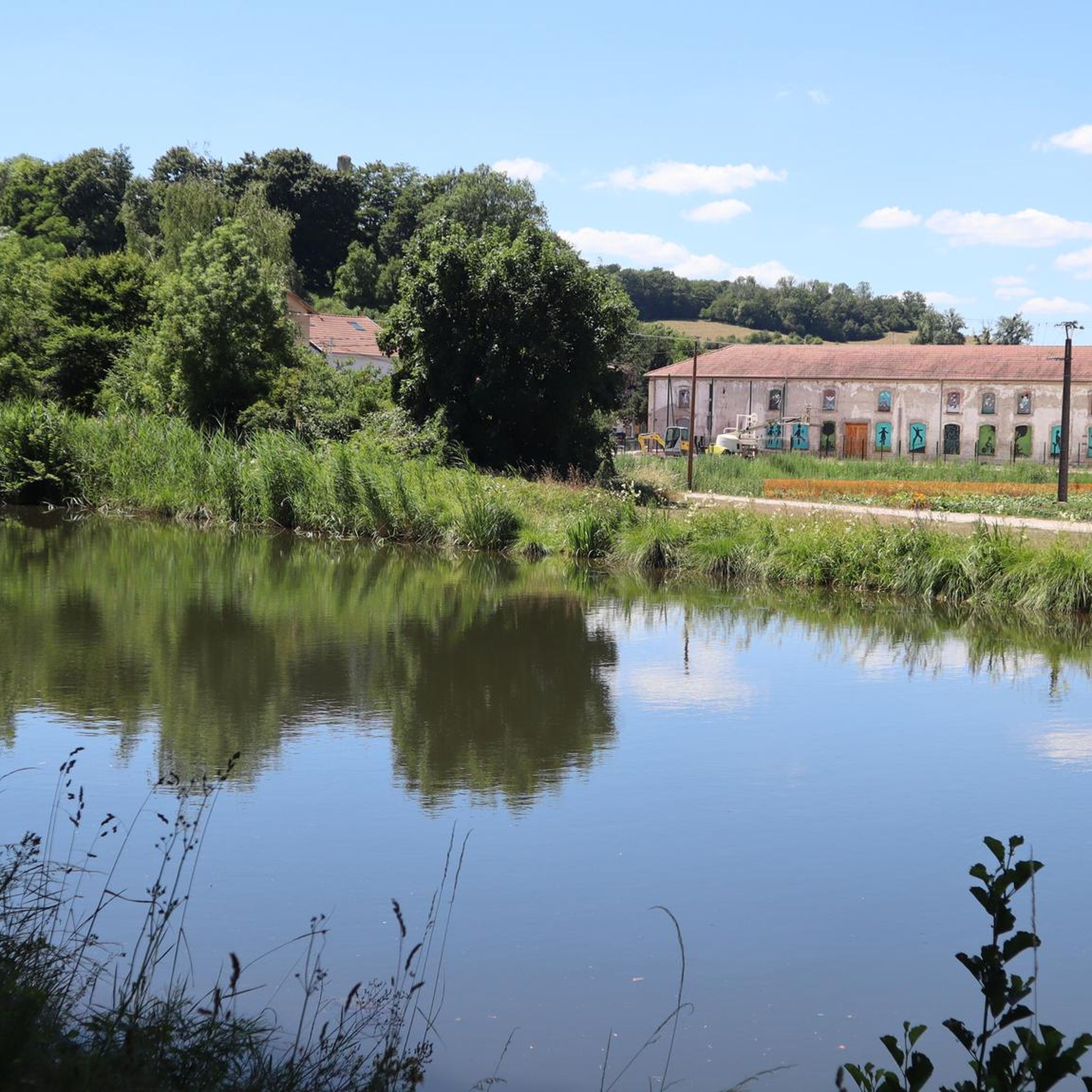
beautiful cycle path la voie bleue
0
0
another lock on the canal
0
0

For several centuries, it was the old castle chapel that served as the parish church in Bayon. In 1865, Mgr Charles-Martial ALLEMAND-LAVIGNE, bishop of Nancy and Toul, moved by the advanced state of degradation of the chapel, which was threatening to collapse, urged the parishioners to raise a subscription for the reconstruction of a church worthy of a cantonal capital. It was not until 1879 that this subscription was set up by Abbé MICHEL, parish priest, and raised 101,022 F, distributed as follows: 76,022 F from subscriptions, 15,000 F donated by the church fabric, and 10,000 F by the Commune. The new church being estimated at 153,000 F, the difference was the subject of a subsidy request to the State and the Department. Work began in 1881. The new church was consecrated on September 24, 1884, by Mgr TURINAZ, bishop of Nancy and Toul. It is in the shape of a Latin cross and oriented to the West, opposite the previous church. In the Neo-Renaissance style, the building was designed by Mr. GIGOUT, architect, and built by Mr. JEUDY, contractor. In 1905, 21 years after its consecration, numerous defects were noted which compromised the structural stability of the building. The diagnosis established by the expert appointed by the Commune and the Prefect noted, among other things, the fall of a complete section of cornices onto the square, where children were playing. It also noted that vegetation was taking root and dislodging the stones. The installation of scaffolding to carry out the essential repairs allowed for a deeper diagnosis and revealed the "unheard-of" defects of the building. In October 1918, the sacristy was set on fire, as was part of the choir, where the tiling lifted in places. Cracks appeared in the transept and some plaster panels detached from the vault. In the inter-war period, the church underwent numerous repairs. On June 20, 1940, the church was hit by shell fire. The vault over the choir and the high altar were destroyed. The central vault was damaged. The lighting and the bells were put out of order. The bell tower, particularly targeted, was heavily damaged, as were the clock and the organ. From 1948 onwards, major renovations were financed thanks to "war damages". In 1952, the church was equipped with a sound system and the stained glass windows were restored. The following year, a new altar, designed by Abbé GUÉNAIRE and built by the THOMAS company of Bayon, was installed. In January 2012, following a negative opinion from the district safety commission, the church had to be closed to the public "as long as the stability of the bell tower was not assured". After very significant work was carried out, the building has welcomed the faithful again since May 2015. The Saint Martin church is 44.25 meters long, 18.25 meters wide, and originally housed 520 chairs (390 today). Its height is 15 meters under the vault and 18 meters under the dome. The spire soars to a height of 54 meters. By prefectural decree of March 28, 2012, the Saint-Martin church was entirely listed as a Historical Monument "as a representative example of Neo-Renaissance architecture in Lorraine and of the work of architect Léopold GIGOUT". It houses religious heritage which is also listed in the inventory of Historical Monuments but as "objects": a pietà and three 15th-century statues from the old church, as well as a deposition scene dating from the early 16th century and from the chapel of the Hospital.
0
0

Magnificent site with a view over the entire Saintois.
2
0

Remains of the castle of the Counts of Vaudémont.
1
0
Frequently Asked Questions
How many road cycling routes are available around Vaudeville?
There are over 90 road cycling routes around Vaudeville, offering a wide range of options for different skill levels and preferences. The komoot community has explored these routes over 700 times.
Are there road cycling routes suitable for beginners or families in the Vaudeville area?
Yes, the Vaudeville area is well-suited for beginners and families, with 22 easy road cycling routes available. Many of these routes, like the Lock on the Canal des Vosges loop from Bainville-aux-Miroirs, follow flat canal-side paths, providing a gentle and scenic experience.
What types of landscapes can I expect to see while road cycling around Vaudeville?
Road cycling around Vaudeville offers diverse landscapes, from bucolic farmlands and forests to tranquil waterscapes along the Moselle River and the Canal des Vosges. Routes often feature charming Lorraine villages and provide views over the Saintois region.
Are there any notable landmarks or attractions I can visit along the road cycling routes?
Yes, several routes pass by interesting landmarks. For instance, the Haroué Castle loop from Haroué offers a glimpse of the historic Haroué Castle. You might also encounter the Gripport Lock or other industrial heritage sites along the Canal des Vosges.
What do other road cyclists enjoy most about road cycling in Vaudeville?
The area is highly rated by the komoot community, with an average score of 4.6 stars from over 20 reviews. Cyclists often praise the varied terrain, from flat canal paths to routes with moderate elevation, and the scenic beauty of the bucolic landscapes and waterways.
Are there any long-distance or major cycling routes that pass through or near Vaudeville?
Yes, the region is part of larger cycling networks. The Moselle Loop, an 85 km route with little elevation gain, is nearby. Additionally, the Voie Bleue (V50), connecting Luxembourg to Lyon, and the V52 route, part of a European connection between Paris and Prague, both traverse the Meurthe-et-Moselle department and can be accessed from the area.
What is the best season for road biking around Vaudeville?
The spring, summer, and early autumn months generally offer the most pleasant conditions for road biking around Vaudeville, with milder temperatures and vibrant natural scenery. Always check the local weather forecast before heading out.
Are there loop road cycling routes available in the Vaudeville area?
Yes, many of the road cycling routes around Vaudeville are designed as loops, making it convenient to start and end your ride at the same point. Examples include the Ponds of the Saussaie de Bayon – Lock on the Canal des Vosges loop from Roville-devant-Bayon and the Lock on the Canal des Vosges – Haroué Castle loop from Bayon.
Can I find routes that combine cycling with cultural or gastronomic experiences?
Absolutely. The Meurthe-et-Moselle department is known for blending athletic pursuits with cultural and gastronomic exploration. The Moselle Loop, for instance, passes through charming Lorraine villages, and a 12 km round trip near it allows discovery of a 'secret vineyard' and its producers. Nancy, a significant cultural hub, is also within cycling distance.
How can I access the road cycling routes around Vaudeville using public transport?
The Moselle Loop, a significant cycling route in the region, is accessible by train at various points, making it convenient for multi-stage rides or reaching starting points. For specific local routes, checking regional bus or train services for connections to towns near route starting points is advisable.
Are there any challenging road cycling routes for experienced riders?
While the region is known for its relatively flat canal paths, there are 72 moderate and 3 difficult road cycling routes available around Vaudeville. These routes often feature more significant elevation changes, providing a greater challenge for experienced riders.
Where can I find parking for road cycling trails in Vaudeville?
Many of the road cycling routes start from villages or towns in the Vaudeville area, such as Bainville-aux-Miroirs, Haroué, or Roville-devant-Bayon. These locations typically offer public parking facilities. It's recommended to check specific starting points for available parking options.
Most popular attractions around Vaudeville

Get inspired with the komoot mobile app


Explore more
Browse the best Road cycling routes in other regions.
