The best MTB trails around Lanhères
4.7
(10)
19
riders
15
rides
Mountain bike trails around Lanhères are set within the Meuse department of France, characterized by extensive forests and rolling hills. The landscape features varied terrain, including picturesque river valleys and gentle slopes. This topography provides diverse routes for mountain bikers, from easier paths to more demanding climbs. The region's natural features offer a mix of wooded environments and open areas.
Best mountain bike trails around Lanhères
- The most popular mountain bike trail is Baignade loop from Warcq, an 11.3…
Last updated: November 22, 2026
5.0
(3)
6
riders
17.8km
01:14
50m
50m
Easy mountain bike ride.
5.0
(1)
3
riders
41.3km
02:18
250m
250m
Moderate mountain bike ride. Good fitness required.

5.0
(3)
4
riders
49.4km
02:49
340m
340m
Moderate mountain bike ride. Good fitness required.
5.0
(1)
3
riders
39.3km
02:16
220m
220m
Moderate mountain bike ride. Good fitness required.
3.0
(1)
1
riders
33.8km
02:24
140m
140m
Moderate mountain bike ride. Good fitness required. Advanced riding skills necessary.
Get access to more routes and recommendations from other explorers.
Already have an account?
Our route recommendations are based on thousands of hikes, rides, and runs completed by other people on komoot.
Start today with a free account
Your next adventure awaits.



Tips from the Community

Crash site of the Caudron G4, ->Two heroes rest in peace. We will remember them 🌸. If you want to know their stories. I recommend the book by Damien Legrand "A young aviator fallen at Verdun" From Editions coollibri. Facebook page: Chroniques de guerre.
1
0

This beautiful gravel path, known as the Tacot path, connects the Verdun Memorial to Vaux-devant-Damloup. It's the perfect track for picking up speed in a lovely natural setting steeped in history.
0
0

The Mémorial de Verdun, located near the ruined village of Fleury-devant-Douaumont, is a leading museum and commemoration site for the Battle of Verdun (1916). The museum displays more than 2,000 objects and uses authentic objects, photographs and audiovisual installations to show how French and German soldiers experienced this battle – in the exact same place where they fought.
8
3

Silent witnesses to the destructive madness
1
0
For enthusiasts who want to marvel at this impressive hall. Here you come face to face with a war machine.
6
0
Fort Douaumont is a remnant of the First World War. One of the most powerful constructions and a symbol of the Battle of Verdun. More than a return to the past, a visit to this place immerses us in the heart of a legendary confrontation and tells us about the lives of those who lost their lives there. Fort Douaumont was built between 1884 and 1886 and was an extremely strategic location during the Battle of Verdun. It is also to this battle that the Fort owes its fame. The fort has been a listed historical monument since 1970 and, at an altitude of 400 metres, it offers a view of the valley south-west of Douaumont. As a building barely finished, it was almost immediately outdated because of its masonry construction. Indeed, at that time, new shells were able to destroy masonry structures. That is why Fort Douaumont was covered with a thick layer of concrete in the most sensitive and exposed places. The effectiveness and resistance of the weapons make this fort one of the most powerful buildings in the entrenched camp of Verdun. From the beginning of the First World War, the village of Douaumont and its surroundings were put in a state of defense: trenches were dug, barricades were built, barricades were hung. At first, the village managed to defend itself. But, from 1915, the village could no longer hold out. The stabilization of the front line then changed the type of battle. On February 21, 1916, the Germans attacked Verdun. Fort Douaumont was a privileged target: in two days, it was hit by 800 shells. In a few days, the front line came dangerously close to the fort. Four days after the start of the battle, it was already in the hands of the German army. For eight months, the French army fought to retake the fort, using many shells. It was not until October 1916, after 6 days of preparation and the deployment of exceptionally dense artillery, that yet another attack succeeded in recapturing the fort. In the Fort Douaumont Museum, many films, photos, archive material and testimonies tell the story of the fort and the heroic soldiers who fought there. A moving discovery that is a good addition to a visit to the fort. Source: https://www.landofmemory.eu/nl/sites-historiques/fort-douaumont/
4
1

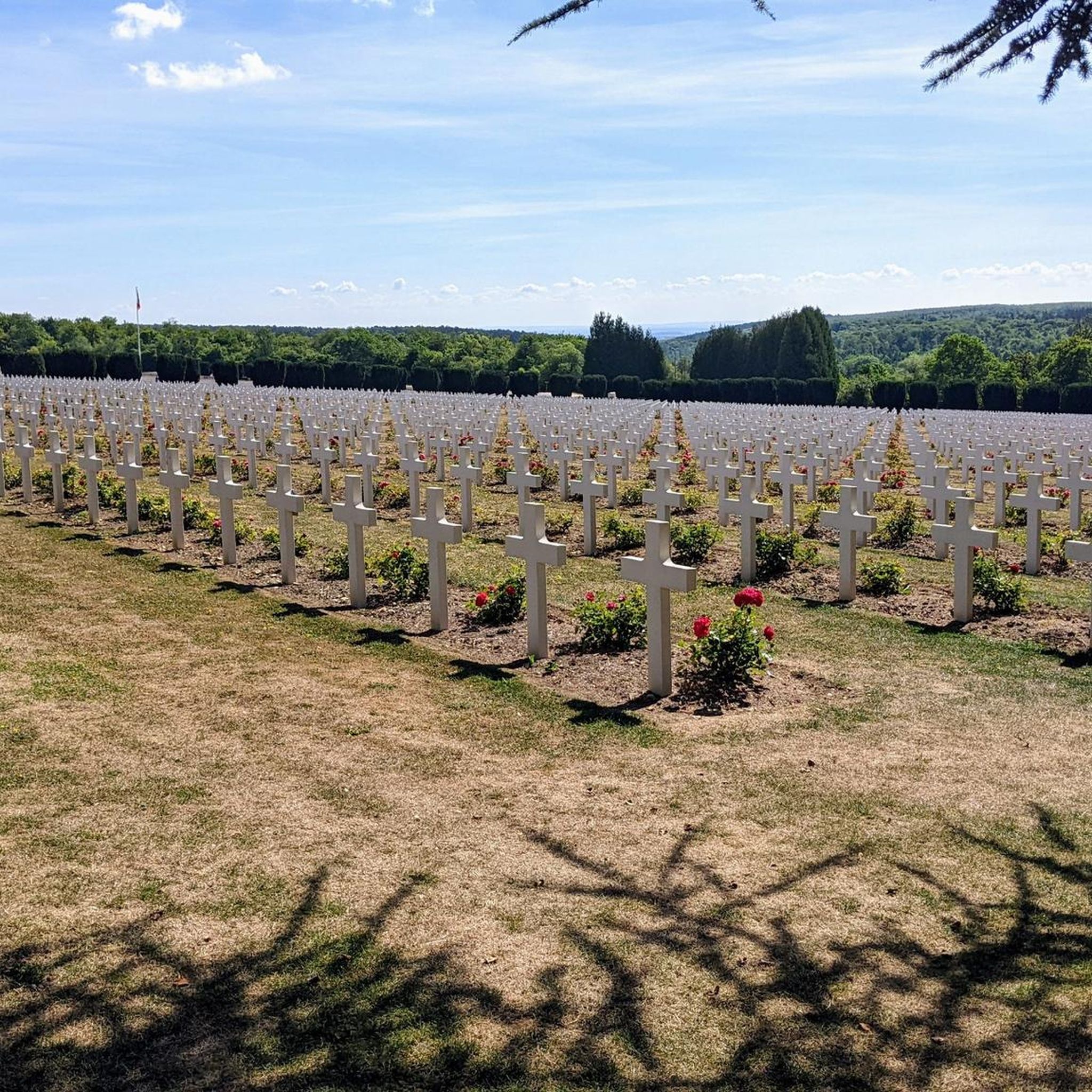
Take a moment to pause between the ossuary and this stone garden; tranquility reigns here. Don't forget to thank our brave soldiers for their ultimate sacrifice.
1
0
Be careful of roots and slopes which could send you swimming in shell holes filled with water during wet weather.
0
0
Frequently Asked Questions
How many mountain bike trails are available around Lanhères?
There are over 15 mountain bike trails around Lanhères, offering a variety of experiences for different skill levels. The region features extensive forests and rolling hills, providing diverse routes.
What kind of terrain can I expect on mountain bike trails near Lanhères?
The terrain around Lanhères, situated in the Meuse department, is characterized by extensive forests, rolling hills, and picturesque river valleys. You'll find a mix of wooded environments, gentle slopes, and more demanding climbs and descents, with some routes featuring varied elevation changes.
Are there mountain bike trails suitable for beginners or families in Lanhères?
Yes, Lanhères offers trails suitable for various abilities, including easier paths. For a gentle introduction, consider the Baignade loop from Warcq, an easy 11.3-mile (18.1 km) route that provides a pleasant ride through the local landscape.
Are there any circular mountain bike routes around Lanhères?
Yes, many of the mountain bike routes around Lanhères are designed as loops. For example, the Baignade loop from Mouaville is a 25.8-mile (41.4 km) circular trail that takes you through rolling hills and forested sections.
What are the more challenging mountain bike trails near Lanhères?
For those seeking a more challenging ride, the region offers moderate trails with significant elevation gain. The Douaumont Ossuary – La Ferme de Thiaumont. loop from Étain is a moderate 31.6-mile (50.9 km) path featuring substantial climbs and descents.
What do other mountain bikers say about the trails in Lanhères?
The mountain bike trails around Lanhères are highly rated by the komoot community, with an average score of 4.7 stars from more than 10 reviews. Riders often praise the varied terrain, the immersion in nature provided by the extensive forests, and the well-maintained paths.
Are there any historical landmarks or points of interest along the mountain bike routes?
Yes, some routes pass by significant historical sites. For instance, the Douaumont Ossuary – La Ferme de Thiaumont. loop from Étain takes you past historical landmarks, offering a blend of outdoor activity and cultural exploration.
What is the best time of year for mountain biking in Lanhères?
The Meuse department, where Lanhères is located, offers pleasant conditions for mountain biking during spring, summer, and autumn. The extensive forests provide shade in warmer months, while autumn brings beautiful foliage. Winter riding might be possible, but trails could be muddy or icy depending on conditions.
Is parking available at the trailheads around Lanhères?
While specific parking details for every trailhead are not always listed, routes often start from towns or villages like Warcq, Étain, or Mouaville, where public parking is generally available. It's advisable to check local signage upon arrival.
Are there any other notable mountain bike routes in the wider Meuse department?
Beyond Lanhères, the Meuse department features hundreds of mountain bike routes with varying difficulty levels. The region is known for its diverse terrain, including parts of the Lorraine Regional Nature Park. For broader cycling options, the EuroVelo 19 "Meuse by Bike" route also traverses the area, though it caters to all cycling levels, not just mountain biking.
Can I find amenities like cafes or accommodation near the mountain bike trails?
Lanhères is situated within the Meuse department, which includes charming towns and villages. Routes often start from or pass through places like Étain, Mouaville, or Warcq, where you can typically find local amenities such as cafes, restaurants, and accommodation options to refuel or stay overnight.
Are there any specific regulations for mountain biking in the forests of the Meuse region?
The Meuse department features extensive forested areas, including parts of the Argonne. While specific permits for general mountain biking are not typically required on public trails, it's always recommended to respect local regulations, stay on marked paths, and be mindful of other forest users and wildlife. For information on regional outdoor activities, you might find resources like Visit Ardenne helpful, as the Ardennes massif extends into this area.

Get inspired with the komoot mobile app


Explore more
Browse the best MTB trails in other regions.
