The best traffic-free bike rides around Saint-André-De-Cubzac
4.1
(118)
2,240
riders
77
rides
No traffic road cycling routes around Saint-André-De-Cubzac traverse a landscape characterized by the confluence of the Garonne and Dordogne rivers, creating varied terrain. The region features rolling countryside, vineyards, and wetlands, with elevations generally remaining below 200 meters. Cyclists encounter a mix of paved surfaces and dedicated cycle paths, some of which integrate into larger networks like the Canal des 2 Mers by bike.
Best no traffic road cycling routes around Saint-André-De-Cubzac
- The most popular no traffic road cycling route…
Last updated: May 25, 2026
5.0
(1)
33
riders
Moderate road ride. Good fitness required. Some segments of this route may be unpaved and difficult to ride.
14
riders
Hard road ride. Very good fitness required. Mostly well-paved surfaces and easy to ride.

Sign up for free
7
riders
Moderate road ride. Good fitness required. Some segments of this route may be unpaved and difficult to ride.
4
riders
Moderate road ride. Good fitness required. Mostly well-paved surfaces and easy to ride.
6
riders
24.9km
01:00
140m
140m
Easy road ride. Great for any fitness level. Mostly well-paved surfaces and easy to ride.
Get access to more routes and recommendations from other explorers.
Sign up for free
Already have an account?
Our route recommendations are based on thousands of hikes, rides, and runs completed by other people on komoot.
Start today with a free account
Your next adventure awaits.
Login or Signup
Popular around Saint-André-De-Cubzac

Other adventures around Saint-André-De-Cubzac

Tips from the Community

Very beautiful Romanesque church from the 12th century.
0
0

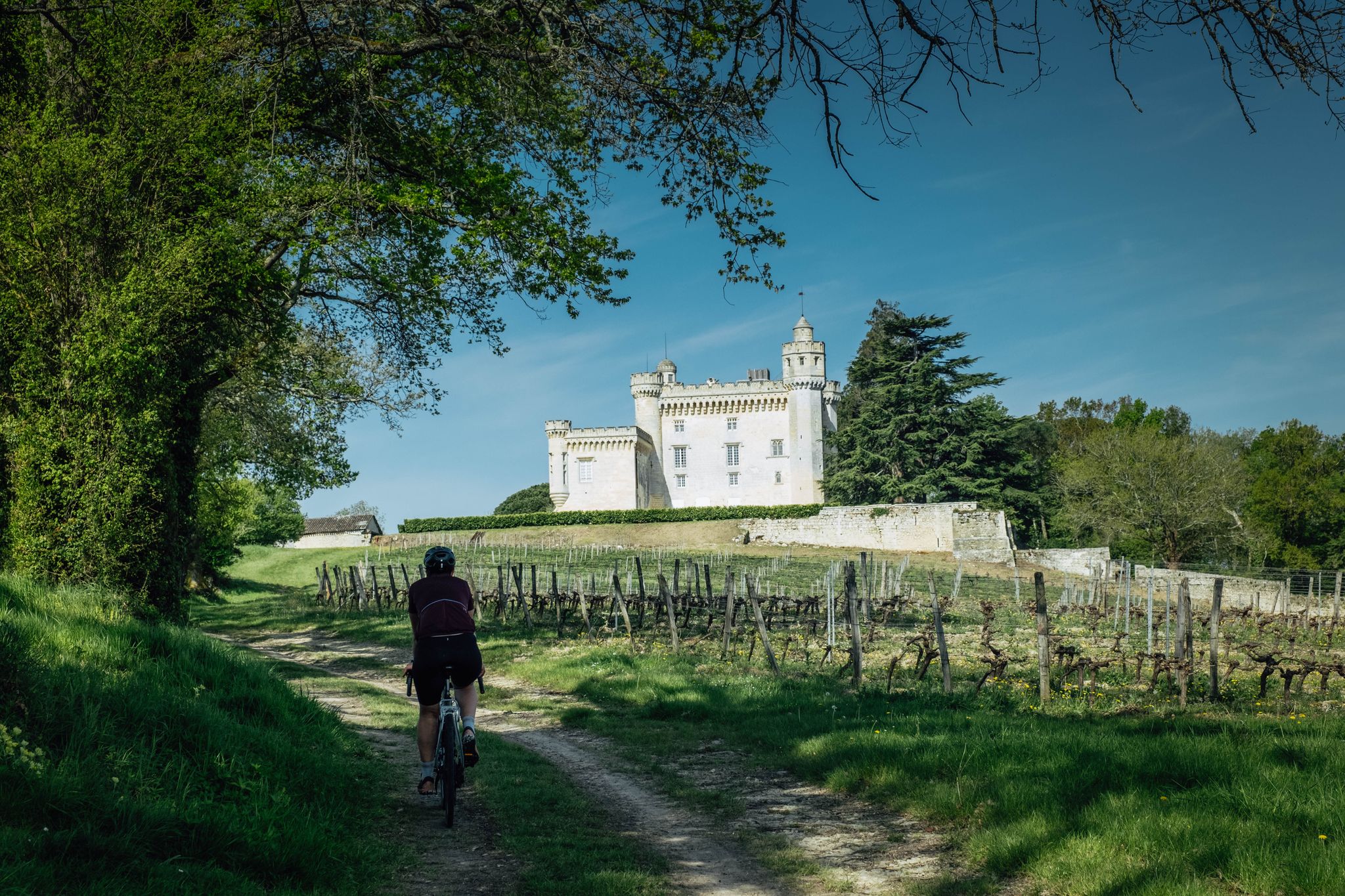
Charming manor house among the vines. Private access, but nice owners. Worth seeing with winery.
0
0

The Church of Saint-André-du-Nom-de-Dieu includes sections whose construction dates from the 12th to the 19th centuries. It was built by the Benedictines of the Abbey of La Sauve-Majeure and was once used by a priory founded after 1115, dependent on the abbey. The dominant style of this fortified church is Romanesque. Its massive, square-based bell tower is imposing. The building boasts beautiful stained-glass windows and a remarkable organ case. The church was last restored in 1977. The Virgin of Mercy is an alabaster sculpture dating from the 16th century and is a listed historic monument.
1
0
The Pair-non-Pair Cave is a decorated cave, discovered in 1881, containing artistic representations dating back more than 32,000 years before the present, attributed to the Aurignacian culture. Listed as a historical monument since 1900, the cave is the third decorated cave discovered, after Altamira and Chabot Cave. Its study established the antiquity of the parietal engravings and officially recognized the prehistoric art. The cave, located in the commune of Prignac-et-Marcamps, is open only for guided tours. Booking a tour time online is required. The reception area, museum space, and shop are open from June 1st to September 30th, 9:30 a.m. to 12:30 p.m. and 2:00 p.m. to 6:30 p.m. From October 1st to May 31st, 9:30 a.m. to 12:30 p.m. and 2:00 p.m. to 5:30 p.m. Closed on Mondays, January 1st, May 1st, and December 25th. Individual admission: €13 Free: Under 18s and 18-25s (European Union nationals and non-European legal residents in France)
1
0
The commune is the result of the merger of three parishes: Prignac (on the road to Blaye), Marcamps (further north, on the hillsides above the Moron Valley), and Cazelle (further south, descending towards the Dordogne). The three churches still exist. In addition, there is the former chapel of the priory of Lurzine, not far from the village of Prignac. During the French Revolution, the parish of Saint-Pierre de Prignac formed the commune of Prignac, and its annex, Saint-Michel de Marcamps, formed the commune of Marcamps. The parish of Saint-Félix de Cazelles and its annex, Sainte-Quitterie de Magrigne, formed the commune of Cazelles. In the year 12, the commune of Cazelles was annexed to that of Prignac, which became Prignac-et-Cazelles. In 1965, the commune of Marcamps was annexed to that of Prignac-et-Cazelles, which became Prignac-et-Marcamps.
1
0
The commune takes its name from its Latin name, Blacciacum. A Gallo-Roman settlement is attested by the discovery of the remains of three Gallo-Roman villas, dating from the 1st to the 5th century AD. These remains were found near the current site of the church, not far from the Gironde. During the medieval period, the village's center of activity seems to have shifted to the heights overlooking the river. This is evidenced in particular by a hoard of Merovingian coins discovered around 1850 at a place called Montuzet (Mont des Yeuses). The lower Plassac region, around the port, was heavily involved in river and maritime activity in the 17th, 18th, and 19th centuries. Merchants and ocean-going captains settled in beautiful stone residences. This river activity gradually declined in the 20th century.
2
0

Superb property of great classified growths.
1
1
Frequently Asked Questions
How many no-traffic road cycling routes are available around Saint-André-De-Cubzac?
There are over 70 dedicated no-traffic road cycling routes around Saint-André-De-Cubzac, offering a wide variety of options for different skill levels and preferences. These routes allow you to explore the diverse landscapes of the region, from riverbanks to vineyards, without the distraction of heavy vehicle traffic.
What are the typical difficulty levels for no-traffic road cycling routes in this area?
The routes around Saint-André-De-Cubzac cater to various fitness levels. You'll find a good mix of easy and moderate options, with over 20 easy routes and nearly 50 moderate ones. There are also a few more challenging routes for experienced cyclists, some with up to 500 meters of climbing. For an easy ride, consider the Roadbike loop from Saint-Gervais.
Are there any circular no-traffic road cycling routes near Saint-André-De-Cubzac?
Yes, many of the no-traffic road cycling routes in the area are circular, allowing you to start and end at the same point. For example, the Saint-André de Cubzac – Moulin du Grand Puy, Lansac loop from Saint-André-de-Cubzac offers a scenic circular ride.
What kind of landscapes and natural features can I expect to see on these routes?
The no-traffic routes often traverse picturesque landscapes along the Garonne and Dordogne Riverbanks, winding through vineyards, wetlands (palus), and charming ancient villages. You can also find routes that offer panoramic views from points like Montalon, the highest point in Haute Gironde, or explore peaceful natural settings like the Port de Plagne by the Dordogne.
What historical landmarks or attractions can I visit while cycling?
Many routes pass by or near significant historical sites. You could cycle past the Eiffel Bridge of Cubzac-les-Ponts, a notable landmark over the Dordogne. Other attractions include the Romanesque fortified Saint-André de Cubzac church, or even the Bourg-sur-Gironde Citadel. Some routes also offer views of local châteaux like Château Reynaud 🏰.
What is the best time of year for no-traffic road cycling in Saint-André-De-Cubzac?
The region is generally pleasant for cycling from spring through autumn. The mild climate allows for comfortable rides, with spring offering blooming landscapes and autumn providing vibrant colors. Summer can be warm, so early morning or late afternoon rides are often preferred. Winter cycling is possible, but check local conditions.
Are there family-friendly no-traffic road cycling options?
Yes, many of the easier and moderate routes are suitable for families, especially those with dedicated cycle paths or quiet country roads. The minimal traffic on these routes makes them safer and more enjoyable for cyclists of all ages. Look for routes with lower elevation gain for a more relaxed family outing.
Where can I find parking for these no-traffic road cycling routes?
Many routes start from or pass through villages and towns where public parking is available. It's advisable to check the starting point of your chosen route on komoot for specific parking recommendations. For example, routes starting from Saint-André-de-Cubzac or Aubie - Saint-Antoine will typically have local parking options.
Can I access these routes using public transport?
Saint-André-De-Cubzac has public transport connections, including train services, which can facilitate access to the region. While direct access to every route starting point by public transport might vary, you can often reach a central location and cycle from there. Consider checking local bus or train schedules for the most convenient options to reach your desired starting point.
What do other road cyclists enjoy most about cycling in Saint-André-De-Cubzac?
The area is highly rated by the komoot community, with an average score of 4.1 stars. Reviewers often praise the region's diverse scenery, the quiet roads perfect for no-traffic cycling, and the blend of natural beauty with historical points of interest. The varied terrain, from flat riverbanks to rolling vineyards, also receives positive feedback for offering engaging rides.
Are there any longer, more challenging no-traffic road cycling routes for advanced riders?
Yes, for advanced riders seeking a longer and more challenging experience, routes like the Château Angélus – Sauve Majeure tunnel loop from Aubie - Saint-Antoine offer significant distance (over 160 km) and elevation gain (over 900 meters), providing a demanding yet rewarding ride through varied terrain.
Most popular routes around Saint-André-De-Cubzac
Most popular attractions around Saint-André-De-Cubzac

Get inspired with the komoot mobile app


Explore more
Browse the best Road cycling routes in other regions.
