The best traffic-free bike rides around Rigny-Ussé
4.6
(970)
6,217
riders
120
rides
No traffic touring cycling routes around Rigny-Ussé are characterized by the gentle terrain of the Loire Valley, making it accessible for various fitness levels. The region features a riverine environment with paths along the Loire and Indre rivers, often with views of vineyards and atmospheric islands. The landscape is generally flat, offering scenic panoramas, and includes nearby forests like the Forêt de Chinon for additional cycling opportunities. These touring bike routes Rigny-Ussé car-free provide a harmonious blend of natural beauty…
Last updated: May 22, 2026
5.0
(6)
30
riders
41.5km
02:30
210m
210m
Moderate bike ride. Good fitness required. Mostly paved surfaces. Suitable for all skill levels.
5.0
(2)
27
riders
53.4km
03:12
190m
190m
Moderate bike ride. Good fitness required. Mostly paved surfaces. Suitable for all skill levels.

Sign up for free
5.0
(4)
25
riders
60.5km
03:40
260m
260m
Moderate bike ride. Good fitness required. Mostly paved surfaces. Suitable for all skill levels.
4.7
(6)
27
riders
11.6km
00:56
10m
10m
Easy bike ride. Great for any fitness level. Mostly paved surfaces. Suitable for all skill levels.
20
riders
Easy bike ride. Great for any fitness level. Mostly paved surfaces. Suitable for all skill levels.
Get access to more routes and recommendations from other explorers.
Sign up for free
Already have an account?
Our route recommendations are based on thousands of hikes, rides, and runs completed by other people on komoot.
Start today with a free account
Your next adventure awaits.
Login or Signup

Other adventures around Rigny-Ussé

Tips from the Community

Perfect for gravel riding, or for family outings
0
0

This impressive suspension bridge spans the Loire between La Chapelle-aux-Naux and Langeais and was originally completed in 1849. The bridge has been repaired and rebuilt many times and has a two-lane road over the Loire. On the Langeais side, a walk along the banks of the Loire, on both sides of the bridge, is highly recommended. The Langeais bridge is a stubborn bridge. It has been rebuilt five times! The story begins in 1848, the year in which King Louis Philippe authorised the construction of a "wire bridge", as it was then called (bridge 1). But wires are excellent lightning conductors! And 10 years after its opening in 1859, the bridge collapsed into the Loire after a heavy storm, its deck and suspension elements. Two years later in 1861, the bridge was repaired and operational again as a toll bridge (bridge 2). But shortly afterwards, in 1870, war broke out and the advance of the Prussian enemy had to be slowed down. Boom! Bridge was blown up (bridge 3) The fourth was completed in 1914, but then came the... car! They were heavy, they came and went! The bridge therefore had to be extensively rebuilt to bear the weight of modernity. This happened in the 1930s, and the opportunity was taken to decorate the bridge with its very special Gothic pillars, which reflected the Gothic style of the castle; the two form a mirror image. Bridge 4 was built! All is well, all is well... but then it is June 1940. And this time it is the Germans who have to be stopped. To stop the invader, the bridge was blown up again. After first using a ferry and then a temporary footbridge, the inhabitants waited until 1949 for a bridge over the Loire (bridge 5). The bridge of Langeais is the only bridge between Tours and Port Boulet. It is now a rather imposing bridge with a turbulent history.
2
0
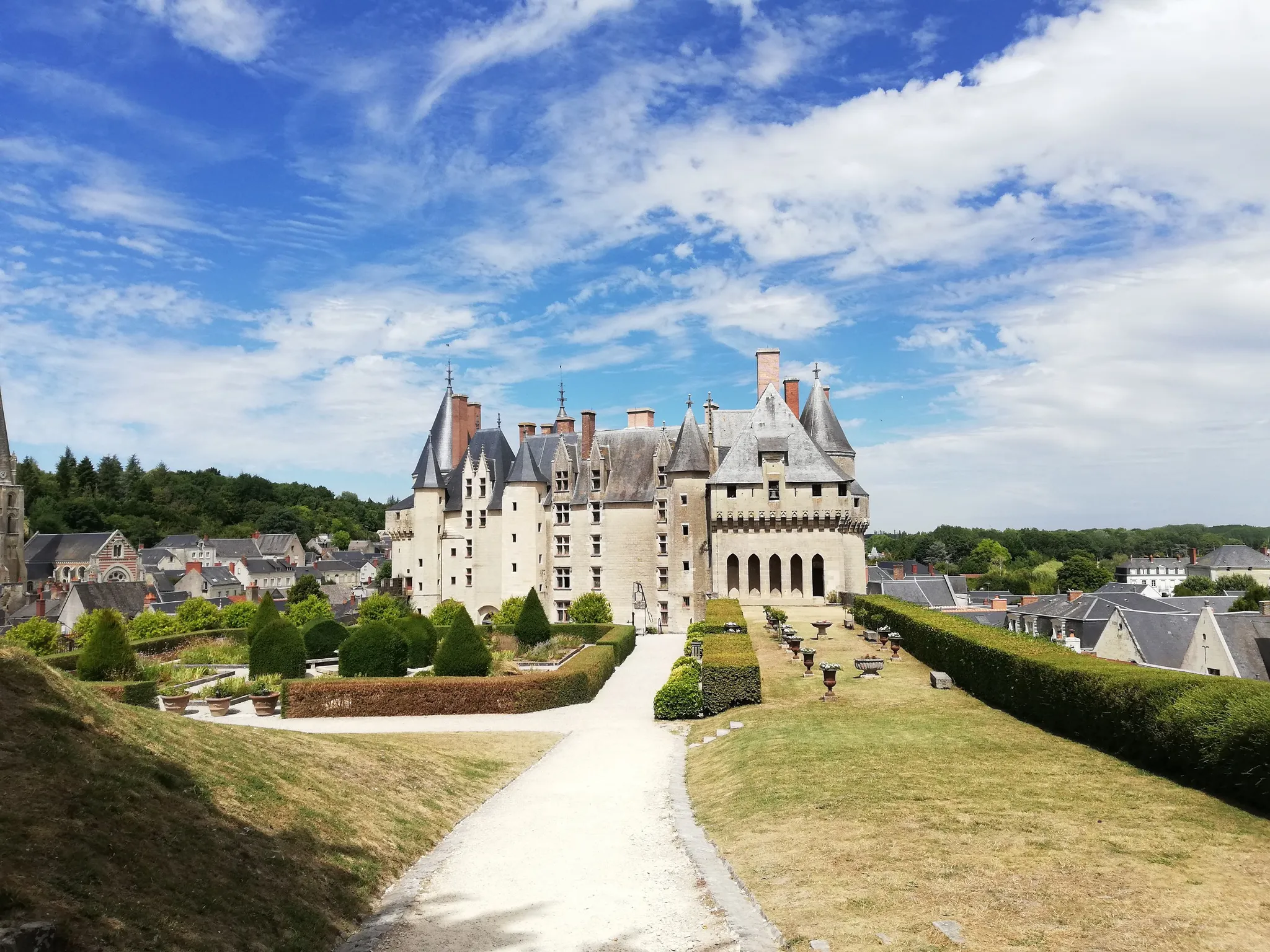
The Château de Langeais , a former royal estate and property of the Institut de France, is one of the major sites in the Loire Valley . Near Tours , in the heart of the Loire Valley , it offers a guided tour of fifteen rooms, decorated with richly carved medieval furniture . You will discover a collection of tapestries and the reconstruction of the royal wedding of Anne of Brittany, told by Stéphane Bern . Langeais, a Renaissance Loire castle, will surprise you with its park planted with cedars and sequoias and its playful elements. More information on https://chateau-de-langeais.com/
2
0
The striking thing about this church is the spire. The white covering reflects in the sunlight. Literally a highlight to look up to.
1
0
Small community among the vineyards
3
0
WARNING For safety reasons, the bridge may only be crossed by hand! Enjoy the great current at walking pace.
5
0
Bréhémont, a former annex of the parish church of Rivarennes, only became a parish in 1789. The church was built in 1843 in the neo-Gothic style. Three years later, five stained glass windows for the choir and the side chapels (bays 0, 1, 2, 3, 4) were ordered by the Parisian Émile Laurent, who had ties with Auguste Galimard and who had designed the plans. Source: https://patrimoine.centre-valdeloire.fr/gertrude-diffusion/dossier/IM37003094
6
0
Situated on the banks of the Indre, from the bridge you have a beautiful view of the site and the beautiful 16th century mill.
5
0
Frequently Asked Questions
How many no-traffic touring cycling routes are available in Rigny-Ussé?
Rigny-Ussé offers a wide selection of no-traffic touring cycling routes, with over 120 options available. These routes cater to various skill levels, including 54 easy and 53 moderate trails, ensuring a suitable ride for most cyclists.
Are there easy, no-traffic touring routes suitable for beginners or families in Rigny-Ussé?
Yes, Rigny-Ussé is ideal for beginners and families, with 54 easy no-traffic touring routes. A great option is The banks of the Indre – L'Indre by Bike loop from Rigny-Ussé, an 11.6 km path following the tranquil Indre River, offering a flat and scenic ride perfect for all ages.
What historical sites and attractions can I visit along the no-traffic touring routes?
The no-traffic routes in Rigny-Ussé are rich with historical attractions. You can cycle past the iconic Ussé Castle, often called the 'Sleeping Beauty Castle.' Other notable sites include L'Islette Castle, known for hosting Camille Claudel and Auguste Rodin, and the historic Langeais Bridge. The region is part of the 'Garden of France,' offering a blend of natural beauty and cultural heritage.
Do the no-traffic touring routes in Rigny-Ussé connect to major cycling networks like La Loire à Vélo?
Yes, Rigny-Ussé is strategically positioned along major cycling routes. It is part of the renowned "La Loire à Vélo" route, France's number one cycling route, and also benefits from the "L'Indre à Vélo," now known as the "Cyclo Bohème." These well-signposted networks offer a variety of routes, many of which are car-free or low-traffic.
Where can I find parking when starting a no-traffic touring cycling route in Rigny-Ussé?
Parking is generally available in and around Rigny-Ussé, particularly near major attractions like Château d'Ussé or in the villages along the Loire and Indre rivers. Many starting points for routes, especially those connected to the larger cycling networks, have designated parking areas for cyclists. It's advisable to check specific route details for the most convenient parking spots.
Is public transport available to access the no-traffic cycling routes, especially with a bike?
Yes, the region facilitates bike travel with accessible train stations like Port-Boulet and Langeais. These stations allow cyclists to connect to larger networks and explore further afield. While direct bus services specifically for bikes might be limited, train services are a viable option for reaching starting points or returning from longer tours.
What is the best season for no-traffic touring cycling in Rigny-Ussé?
The best season for no-traffic touring cycling in Rigny-Ussé is typically spring (April-May) and early autumn (September-October). During these months, the weather is pleasant, the landscapes are vibrant, and the routes are less crowded than in peak summer. Summer can also be enjoyable, but be prepared for warmer temperatures and more visitors.
Are there any circular no-traffic bike routes in Rigny-Ussé that offer castle views?
Absolutely. Many routes are designed as loops, offering scenic views of the region's châteaux. For instance, the Château de Langeais – Langeais Bridge loop from Rivarennes is a moderate 57.2 km trail that provides excellent views of historic châteaux and the Loire River. Another option is the Bridge over the Indre – Pont du Néman über den L'Indre loop from Château d'Ussé, an easy 20.6 km route with picturesque scenery.
What do other touring cyclists enjoy most about touring cycling in Rigny-Ussé?
The area is highly rated by the komoot community, with an average score of 4.59 stars. Reviewers often praise the gentle terrain, the rich historical landscape, and the well-developed cycling routes. The harmonious blend of natural beauty and cultural heritage, particularly the châteaux and riverine environments, are frequently highlighted as major draws.
Are there cafes or restaurants along the no-traffic bike routes in Rigny-Ussé?
Yes, the Loire Valley is known for its charming villages and culinary delights. Many no-traffic routes pass through or near towns and villages where you can find cafes, bakeries, and restaurants to refuel. Candes-St-Martin, a member of "Les Plus Beaux Villages de France," is one such village offering amenities and magnificent views.
Can I find routes that explore the natural features like rivers and forests?
Definitely. The region's charm largely stems from its riverine environment. Cyclists can explore paths along the Loire and Indre rivers, frequently featuring raised levées and expansive views. For those seeking more diverse natural experiences, nearby forests such as the Forêt de Chinon provide additional cycling opportunities and are home to a variety of flora and fauna.
Most popular attractions around Rigny-Ussé

Get inspired with the komoot mobile app


Explore more
Browse the best Cycling routes in other regions.
