The best traffic-free bike rides around Alcalá De Gurrea
108
riders
15
rides
No traffic touring cycling routes around Alcalá De Gurrea traverse a landscape characterized by the Violada plains and the prominent La Sotonera reservoir. The municipality is situated on a layered chalk hill, offering views over the surrounding plains and water body. The region features diverse terrain suitable for cycling, from flat plains to routes with moderate elevation changes. The Sotón river also flows nearby, adding to the natural features of the area.
Best no traffic touring cycling routes around Alcalá…
Last updated: May 21, 2026
22.3km
01:50
150m
150m
Easy bike ride. Great for any fitness level. Mostly paved surfaces. Suitable for all skill levels.
17
riders
47.7km
03:33
370m
370m
Moderate bike ride. Good fitness required. Mostly paved surfaces. Suitable for all skill levels.

Sign up for free
16
riders
62.3km
05:36
520m
520m
Hard bike ride. Very good fitness required. Mostly paved surfaces. Suitable for all skill levels.
7
riders
67.5km
05:47
500m
500m
Hard bike ride. Very good fitness required. Mostly paved surfaces. Suitable for all skill levels.
5
riders
29.1km
02:34
240m
240m
Moderate bike ride. Good fitness required. Mostly paved surfaces. Suitable for all skill levels.
Get access to more routes and recommendations from other explorers.
Sign up for free
Already have an account?
Our route recommendations are based on thousands of hikes, rides, and runs completed by other people on komoot.
Start today with a free account
Your next adventure awaits.
Login or Signup
Popular around Alcalá De Gurrea
Other adventures around Alcalá De Gurrea

Tips from the Community

In the centre of Lupiñén, very close to the church, there is the fountain with eight spouts. It is clear why it is called that. It is well-kept and the surroundings are well-maintained, making it a pleasant place to stop and cool off.
1
0

The church of San José is the parish church of the Tormos neighborhood, a town belonging to the municipality of Alcalá de Gurrea, built to house the workers of the Sotonera dam and reservoir. The church, inaugurated in 1926, has a rectangular plan and a polygonal head facing southwest. The free-standing bell tower is separate from the main building and is built of brick. Its construction does not correspond to a defined style, and mixes different styles, with the Romanesque predominating.
1
0
This town in the region of Hoya de Huesca in the community of Aragón appears mentioned for the first time in 1104, in a concord between the bishop of Huesca and the abbot of Montearagón. Its origin is Roman, a link that still survives in the tradition of the "vote", which unites Alerre with six other towns that surround Huesca and form the "Seven Places". This historical community was united by the promise of a vote destined to ask for the holy protection of a saint, Lorenzo, son of two Roman subjects who lived in a Roman settlement near present-day Huesca, and who was martyred in Rome. Alerre has an interesting costume and footwear museum, located in the keep, next to the town hall, and which collects more than 3,000 pieces from all over the world, donated by the Scottish diplomat of Spanish origin Tomás Moyano.
1
0
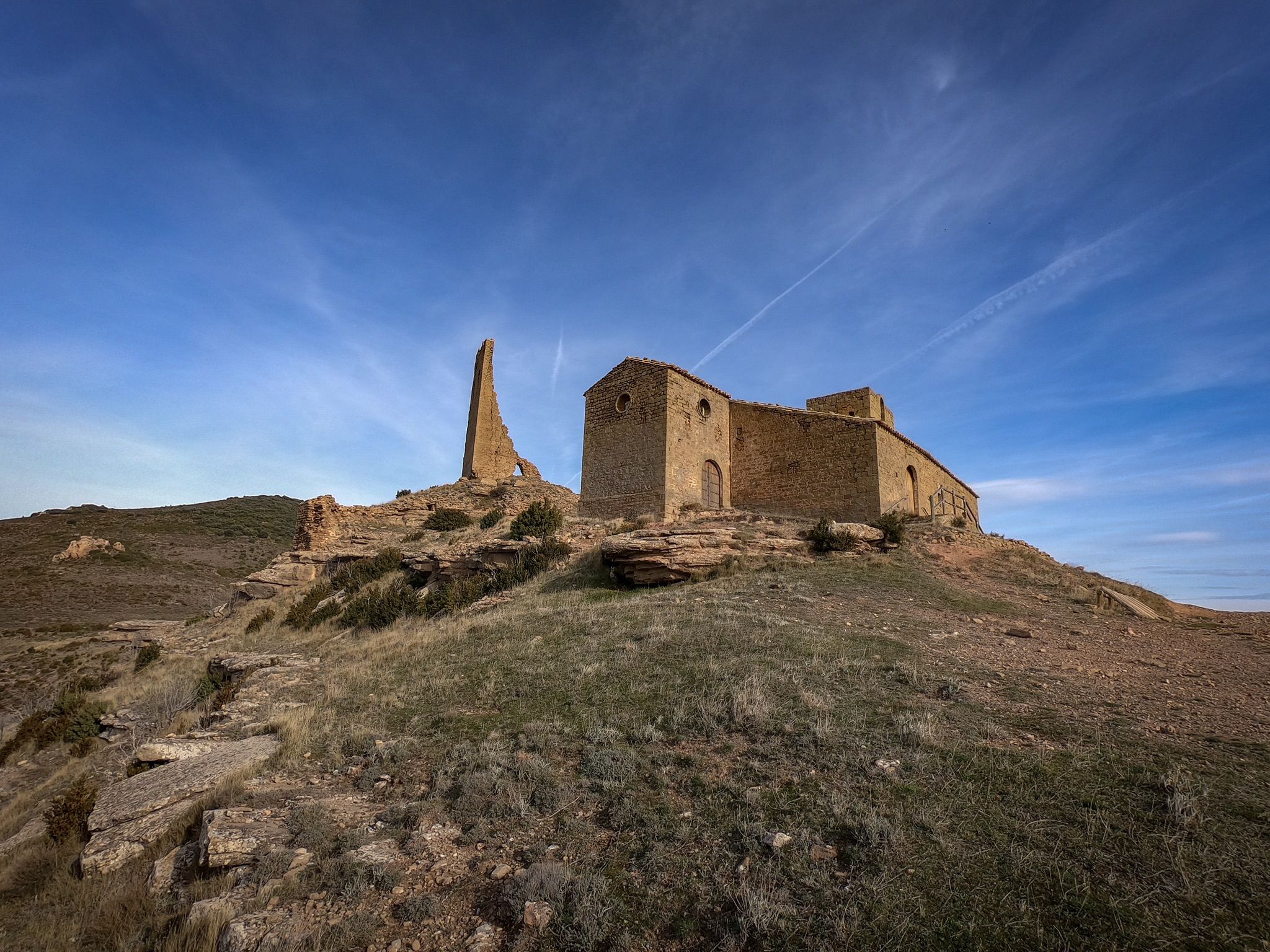
The ruins of the Watchtower tower, probably built between the 9th and 10th centuries, are of Islamic origin. The tower, with a square plan, preserves only three walls, since the south wall collapsed. It is also known as the Four Corners Tower. It is located in a privileged place, on a hill that overlooks the Sotonera reservoir. Its elevated position allowed visual communication with the Tower of San Mitiel or the Bolea castle.
1
0
Montmesa is a municipality in Huesca in the Hoya de Huesca region, in the community of Aragón. Since 1845 it belongs to the municipality of Lupiñén-Ortilla. Located between the Sotón and Astón rivers and close to the Sotonera reservoir, Montmesa is characterized by its traditional stone and rammed earth buildings, some dating back to the 18th century. The church of San Miguel Arcángel that crowns the town is a Romanesque temple from the 12th century modified centuries later (16th-18th century), whose Mudejar tower is unique in the area.
0
0
Almudévar is a town in Huesca in the Hoya de Huesca region, in the community of Aragón. The origins of Almudévar date back to pre-Roman times, when Basques lived there. Since Romanization it acquired great importance, being located in the heart of Vía Lata, the Roman road that linked Zaragoza with Lérida. After the Muslim domination it acquired the current toponym, which means "round", referring to the outline of the castle, a Muslim fortress known as Castle of the Crown. Among its heritage, the parish church of the Assumption stands out, whose construction began in 1757, as the old church, located within the castle grounds, threatened ruin.
0
0
Located on the Gállego River, the Ardisa reservoir is shared by the municipalities of Ardisa and Biscarrués. However, both most of the layout of the dam and all the buildings reviewed are located in the municipality of Biscarrués, which is why they have been included in the catalog of this municipality. The reservoir has an area of 2100 km2, with a total capacity of 5 Hm3 and a useful capacity of 3 Hm3. The dam is made of cyclopean concrete. It presents the type of gravity dam, with a height of 31.14 m and a crest length of 450 m. It has a curved layout and a front arranged in a stepped slope. On the right bank there is a large trapezoidal tank delimited by concrete walls (called a "surface spillway" in the reservoir project) which, through a four-span spillway, connects to a long drainage channel arranged in slope that flows into the river Gállego. The set also consists of several buildings, all of them located on the left bank of the river: the gate house, through which the discharge to the canal that leads water to the Sotonera reservoir is regulated, the dam guard's house , a warehouse and a water tank.
1
0
The Parish Church of San José was inaugurated in 1926, in the so-called Church neighborhood. Its dedication to San José Obrero Obrero is defined because Tormos was destined to house the workers of the La Sotonera dam and their families. It is mainly characterized by the separation between the temple and the bell tower, reminiscent of the Italian custom in the construction of this type of buildings. It consists of a single nave with three sections and a polygonal main chapel and its façade, completely whitewashed, is decorated with a gable. It still stands today, presiding over with its beauty the remains of what was Tormos in its greatest moment of splendor.
1
0
Frequently Asked Questions
How many no-traffic touring cycling routes are available in Alcalá de Gurrea?
There are 15 dedicated no-traffic touring cycling routes around Alcalá de Gurrea, offering a variety of experiences for cyclists seeking quiet roads and paths.
What are the difficulty levels of the no-traffic touring cycling routes in this area?
The routes cater to various skill levels. You'll find 1 easy route, 8 moderate routes, and 6 more challenging routes, ensuring there's something for everyone from beginners to experienced touring cyclists.
When is the best time of year to go touring cycling in Alcalá de Gurrea?
Alcalá de Gurrea experiences a Mediterranean climate. The best times for touring cycling are typically spring and autumn, when temperatures are mild and the landscape is vibrant. Winters are dry and cold, while summers can be quite hot, making early mornings or late afternoons preferable during those months.
Are there any family-friendly no-traffic touring cycling routes?
Yes, there is at least one easy route suitable for families, such as the Sotonera Reservoir Loop. The region's multi-use trails and quiet country roads also offer a safe and enjoyable environment for family outings, especially around the La Sotonera reservoir.
What kind of natural features and landmarks can I expect to see along these routes?
The routes offer diverse scenery, including views over the Violada plains and the impressive La Sotonera reservoir. You might also glimpse the Sierra de Guara and the Mallos de Riglos from certain viewpoints. Notable natural features include the Aguarales de Valdemilaz and the expansive La Sotonera Reservoir itself, which is also a significant birdwatching area.
Are there any circular no-traffic touring cycling routes available?
Yes, many of the routes are designed as loops. For example, the Sotonera Reservoir Loop is a popular option, and you can also find longer circular tours like the Sotonera Reservoir – La Sotonera Reservoir loop from Puendeluna.
What cultural or historical sites can I explore by bike in Alcalá de Gurrea?
The village of Alcalá de Gurrea itself has historical charm, including the Parish Church of San Jorge with its Mudejar-style tower. You can also find scattered cave homes and underground cellars. Nearby, you might pass through settlements like Almudévar, which offers its own historical points of interest.
Can I combine cycling with birdwatching in this region?
Absolutely! Alcalá de Gurrea is part of the "La Sotonera birdwatching route." Cycling around the La Sotonera Reservoir offers excellent opportunities to observe various bird species, including kites, great blue herons, and migrating cranes seasonally.
What is the typical terrain like on these no-traffic routes?
The terrain varies, ranging from quiet paved country roads to multi-use trails that can include unpaved surfaces or gravel. The region's landscape, including the Violada plains, generally offers a mix of flat sections and gentle ascents, especially as you approach the elevated position of Alcalá de Gurrea.
Are there any longer, more challenging no-traffic touring routes for experienced cyclists?
Yes, for those seeking a greater challenge, routes like the Almudévar – Alcalá de Gurrea loop from Almudévar or the Camino de Loreto – Sotonera Reservoir loop from Alcalá de Gurrea offer significant distances and elevation gains, providing a rewarding experience on quiet roads.
What kind of accommodation and services are available for cyclists in Alcalá de Gurrea?
While specific cycling-focused accommodations are not widely detailed, the area offers local guesthouses and pensions. For services, you'll find cafes and restaurants within Alcalá de Gurrea and surrounding villages, providing places to refuel during your touring adventures.
Most popular routes around Alcalá De Gurrea
Most popular attractions around Alcalá De Gurrea

Get inspired with the komoot mobile app


Explore more
Browse the best Cycling routes in other regions.
