The best traffic-free bike rides around Borzonasca
4.4
(109)
1,143
riders
11
rides
No traffic touring cycling routes around Borzonasca are found within the Ligurian Apennines, a region characterized by diverse landscapes. This area, nestled in Italy's Genoa province, features mountainous terrain with prominent peaks, picturesque valleys, and significant passes. The Aveto Natural Regional Park encompasses much of the region, offering a network of routes that traverse forests, high-altitude lakes, and natural wetlands. These routes provide varied elevations and surfaces, catering to touring cyclists seeking challenging terrain.
Best no traffic touring cycling routes…
Last updated: July 28, 2026
4.3
(4)
81
riders
42.5km
03:47
1,200m
1,200m
Hard bike ride. Very good fitness required. Mostly paved surfaces. Suitable for all skill levels.
4.0
(2)
44
riders
41.4km
04:14
1,240m
1,240m
Hard bike ride. Very good fitness required. You may need to push your bike for some segments of this route.

Sign up for free
4.7
(3)
32
riders
16.8km
01:47
450m
450m
Hard bike ride. Very good fitness required. You may need to push your bike for some segments of this route.
31
riders
51.1km
05:08
1,680m
1,680m
Hard bike ride. Very good fitness required. Mostly paved surfaces. Suitable for all skill levels.
20
riders
39.6km
03:51
1,330m
1,330m
Hard bike ride. Very good fitness required. Mostly paved surfaces. Suitable for all skill levels.
Get access to more routes and recommendations from other explorers.
Sign up for free
Already have an account?
Our route recommendations are based on thousands of hikes, rides, and runs completed by other people on komoot.
Start today with a free account
Your next adventure awaits.
Login or Signup

Other adventures around Borzonasca


Tips from the Community

Good spot for a stop. Easy to reach
0
0
It is easily well marked along the forest road.
0
0
Beautiful hiking structure located at 1,400 meters, surrounded by beech trees and positioned on the border with the municipalities of Bedonia and Tornolo for the province of Parma, and Santo Stefano d'Aveto for the metropolitan city of Genoa. Too bad it is never open despite the structure being recent and in good condition.
0
0
Beautiful pass of the Ligurian Apennines located at 1,468 meters. Strategic point that offers various alternatives to start a walk or a long hike.
0
0
Pass of the Ligurian Apennines located at an altitude of 1,452 m, it is reachable by car and is a crossroads where various hiking trails branch off.
0
0
Born from the recovery of old barracks, it is a beautiful refuge where you can both eat and stay overnight. The location is stunning and makes it a must-stop when visiting these areas.
0
0

Pria Burgheisa (Pietra Borghese) is a massive outcrop of mantle peridotites, among the best-known and most significant in the area. It lies on the southwestern edge of the Prato Mollo plateau, on the southern slopes of Mount Aiona, at an altitude of 1,465 m. It is a geosite of considerable petrographic, mineralogical, and regional geological interest, allowing us to study the evolution of a portion of the lithospheric mantle subsequently involved in the Apennine orogeny. The outcrop has a highly irregular shape: 30 m long, 10 m wide at its maximum, and 7–8 m high. The rocks are dark in color, ranging from blackish to brownish; the mass is affected by three main fracture systems, more or less orthogonal to each other, which fragment it into numerous square-shaped blocks. The surface of the blocks has a pitted appearance, as the pyroxene crystals, more resistant to erosion than olivine, remain prominent. At the outcrop, mantle foliation is evident, due to the presence of frequent pyroxenite bands. Source: Liguria Geosite Registry.
0
0

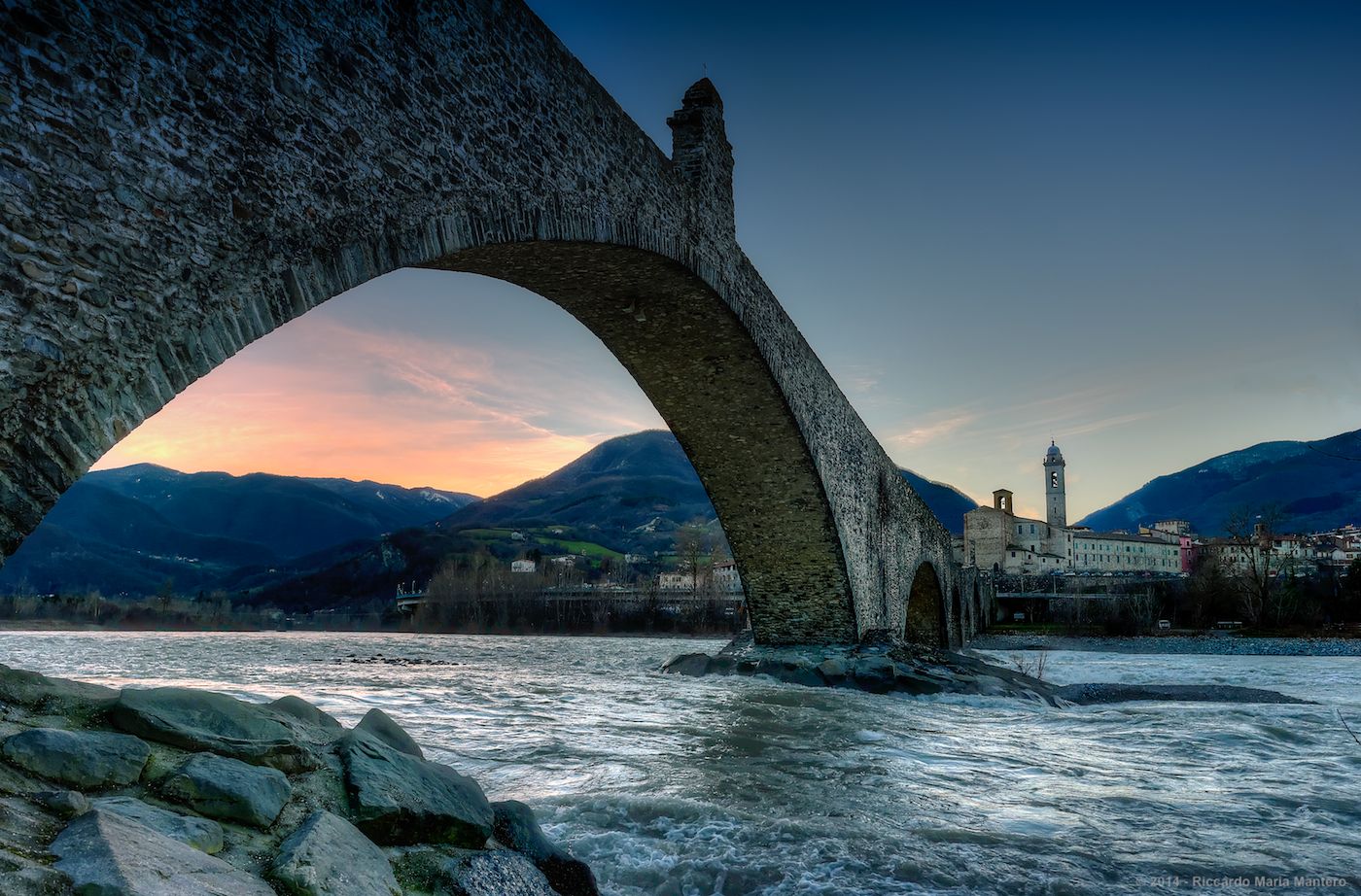
Situated at 717 meters above sea level, Santa Maria del Taro is a hamlet in the municipality of Tornolo (province of Parma), nestled in the heart of the Northern Apennines, near the border between Emilia and Liguria. Since the early Middle Ages, its strategic position along the ancient ridge road connecting the sea to the Po Valley has made it a transit and trade center, as well as a military and commercial control point. The name itself recalls the religious devotion that has permeated the town for centuries: the church-sanctuary dedicated to the Nativity of Mary, rebuilt in neoclassical style between 1807 and 1834, stands on an older structure and has been the spiritual center of the upper Taro Valley for centuries. The building, with its broad façade and stone bell tower, preserves a deep devotional tradition that is still alive. A short walk from the center is the Ponte dei Priori, a medieval humpbacked stone structure that once served as the only permanent access to the valley and symbolically marked the passage between the lands of the Malaspina and Fieschi families, two powerful feudal families of the Apennines. Over the centuries, Santa Maria del Taro has maintained an identity suspended between Emilian and Ligurian culture, evident in the features of its rural architecture, local dialects, and popular customs.
0
0
Frequently Asked Questions
How many no-traffic touring cycling routes are available in Borzonasca?
Borzonasca offers a significant network of routes, with 11 dedicated no-traffic touring cycling routes listed in this guide. The wider region boasts over 35 cycle routes catering to various disciplines.
What is the general difficulty level of no-traffic touring routes in Borzonasca?
The no-traffic touring cycling routes around Borzonasca are generally considered difficult. They often involve significant elevation changes and cover diverse terrain, making them suitable for experienced cyclists looking for a challenge.
What kind of terrain can I expect on these no-traffic routes?
You can expect a mix of terrain. While some routes may feature paved surfaces, many will include unpaved segments, winding through picturesque valleys and ascending mountain passes. The region's mountainous character means you'll encounter varied surfaces and gradients.
Are there any circular no-traffic touring routes in the area?
Yes, several routes are designed as loops, allowing you to start and finish in the same location. For example, consider the challenging Rifugio Monte Penna – View of Lago delle Lame loop from Monte Penna or the Passo del Chiodo – Incisa Pass loop from Tornolo.
What natural features can I see along these routes?
The routes often traverse the Aveto Natural Regional Park, offering stunning natural beauty. You might encounter high-altitude artificial lakes like Lake Giacopiane, or natural wetlands such as Bargone Lake. The mountainous landscape provides views of peaks like Monte Bue and Monte Aiona, with diverse flora and fauna.
Are there any historical or cultural sights near the no-traffic cycling paths?
Absolutely. Borzonasca is rich in history. You can visit the ancient Benedictine Abbey of Borzone, founded in the 7th century, or marvel at the enigmatic Borzone Face (Volto Megalitico) carved into a rock. The Oratorio di San Rocco in the town center also houses valuable ancient wooden statues.
Where can I find scenic viewpoints on these routes?
Many routes offer breathtaking views. The Margherita Mountain Hut on Mount Pegge provides spectacular panoramic views stretching across Liguria. You'll also find expansive vistas from summits like Monte Bue, overlooking the Val d'Aveto and Val Nure.
What is the best time of year to cycle these routes?
The Ligurian Apennines, where Borzonasca is located, are best enjoyed for touring cycling during the spring and autumn months. The weather is typically milder, and the natural scenery is vibrant. Summer can be warm, especially at lower elevations, while winter may bring snow to higher passes.
What do other touring cyclists enjoy most about the no-traffic routes in Borzonasca?
The no-traffic touring routes in Borzonasca are highly rated by the komoot community, with an average score of 4.6 stars from 86 ratings. Reviewers often praise the challenging yet rewarding climbs, the stunning natural beauty of the Aveto Natural Regional Park, and the tranquility of cycling away from vehicle traffic.
Are there places to park near the trailheads for these routes?
While specific parking information for each trailhead isn't detailed here, Borzonasca and its surrounding villages typically offer public parking areas. It's advisable to check local maps or online resources for designated parking spots near your chosen route's starting point, especially in smaller hamlets or near popular mountain passes like Forcella Pass or Bocco Pass.
Are there cafes or places to rest along the no-traffic routes?
Given the remote nature of many no-traffic routes in the mountainous region, dedicated cafes directly on the paths may be sparse. However, you will find small villages and mountain huts, such as the Margherita Mountain Hut, that offer refreshments and rest stops. It's always recommended to carry sufficient water and snacks, especially on longer tours like the Passo del Chiodo – Monte Penna Forest loop.
Most popular attractions around Borzonasca

Get inspired with the komoot mobile app


Explore more
Browse the best Cycling routes in other regions.
