The best hikes from bus stations around Laatzen
4.4
(1009)
4,024
hikers
92
hikes
Hiking around Laatzen offers diverse landscapes, from the serene river meadows of the Leineaue to the picturesque Koldinger Seenplatte. The region is characterized by the Leine River, which provides riverside trails, and renaturalized gravel pits forming significant lake districts. Accessible urban forests and nearby gentle hills also contribute to the varied terrain, providing options for different hiking experiences.
Best bus station hiking trails around Laatzen
- The most popular bus station hiking route is Koldingen Lakes – Bergmannscher Pond loop from…
Last updated: October 1, 2026
4.3
(117)
340
hikers
Moderate hike. Good fitness required. Easily-accessible paths. Suitable for all skill levels.
4.4
(9)
51
hikers
Easy hike. Great for any fitness level. Easily-accessible paths. Suitable for all skill levels.

4.6
(13)
78
hikers
Easy hike. Great for any fitness level. Easily-accessible paths. Suitable for all skill levels.
4.7
(19)
50
hikers
Moderate hike. Good fitness required. Easily-accessible paths. Suitable for all skill levels.
5.0
(16)
37
hikers
7.06km
01:49
40m
40m
Easy hike. Great for any fitness level. Easily-accessible paths. Suitable for all skill levels.
Get access to more routes and recommendations from other explorers.
Already have an account?
Our route recommendations are based on thousands of hikes, rides, and runs completed by other people on komoot.
Start today with a free account
Your next adventure awaits.
Popular around Laatzen
Other adventures around Laatzen

Tips from the Community


Great for a relaxing break
0
0

The Alte Feuerwache Nature Conservation Centre in Laatzen is an important hub for environmental education and nature conservation in the Hannover region. In the listed building, a former fire station, visitors of all ages are made aware of the local nature. Through exhibitions, workshops, and excursions, the centre promotes awareness of biodiversity and sustainable living – right in the middle of the city. The Nature Conservation Centre is open from Monday to Friday from 9 am to 5 pm. Admission is free for NABU members. More information can also be found here: https://www.nabu.de/natur-und-landschaft/natur-erleben/nabu-zentren/niedersachsen/24179.html
1
0

The area is primarily characterized by the Leine River, flanked by near-natural willow gallery forests and tall herbaceous meadows, as well as its partially near-natural and richly structured adjacent floodplains. In the north, there are extensive areas of agriculturally used grassland with varying levels of moisture and intensity of use. Smaller areas include scattered arable land, forest and shrub stands with varying soil moisture levels, and natural flood channels. The woody course of the meandering and heavily silted Old Leine River, with occurrences of, among others, the silt locust, is also characteristic. The southern part of the nature reserve, in contrast, is largely characterized by former marl and gravel mining waters. Riparian woody plants and small shrubs with varying levels of moisture and succession stages have developed along the banks. Agriculturally used grassland and arable land are only present in small areas here. Many landscape elements, such as oxbow lakes, remnants of floodplain forests, or even open gravel areas and steep cliffs, which occasionally form due to flooding, are valuable remnants of the former floodplain dynamics, which continue to naturally develop new habitats in the floodplain between the terrace edges on both sides of the lower terrace. The Leine River is of national importance as a supra-regional fish migration route and as a spawning and nursery water for migratory fish. Species such as brown trout, sea trout, and Atlantic salmon find habitat here. Otters and beavers also occur here. The area is also of great importance for bats, such as the greater mouse-eared bat and the pond bat. Also worth emphasizing is the national and state importance of the nature reserve as a resting area for numerous migratory bird species and as a breeding ground for various water and meadow bird species. These include, for example, the great egret, white-fronted goose, great crested grebe, gadwall, tufted duck, goldeneye, and smew. In addition to its significant importance for species and habitat conservation, the nature reserve also plays a significant role in providing environmentally friendly, peaceful recreational opportunities due to its proximity to the city, its unique diversity, uniqueness, and beauty. Source: NLWKN
0
0

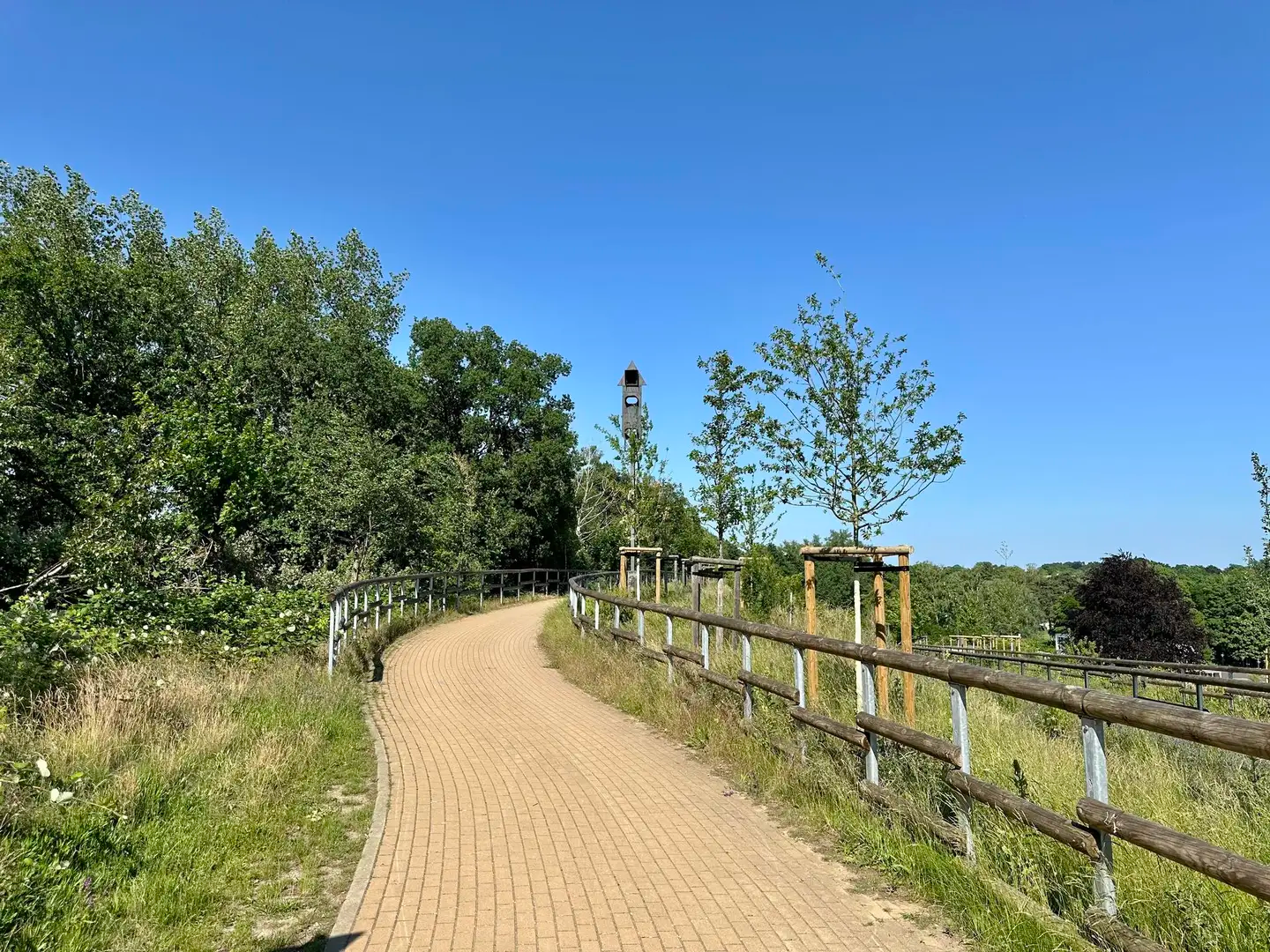
The Kronsberg hill covers an area of approximately 2,000 hectares. The mountain originally had an elevation of 106 m above sea level. The artificially created, twelve-meter-high observation hill at the original summit raised its elevation to 118 m above sea level. A second hill was built on the southern shoulder, reaching a height of 107.3 m above sea level. It is located approximately 2.3 km south-southwest of the summit. The observation points offer a sweeping view of Hanover and the surrounding mountain ranges, such as the Deister. The observation hills were created in the late 1990s and also serve as a design element. Trees are planted along the edges of their summits. Their soil consists of limestone marl, which was excavated during the construction work on the Kronsberg. The slopes of the oval-shaped hills are unplanted and serve as a habitat for warm- and lime-loving plants. The viewing hills are about 80 meters wide and, in an east-west direction, about 250 meters long, and the southern hill about 200 meters long. Their summits are also oval and about one-fifth of the dimensions mentioned. Source: https://de.wikipedia.org/wiki/Kronsberg
1
0
At 107 m, the South Hill is slightly lower than the North Hill (118 m). But the climb up is steeper!
1
0

idyllic view of the lake, including the Swan Lake ballet if you're lucky.
0
0
Frequently Asked Questions
How many bus-accessible hiking trails are available around Laatzen?
There are over 90 hiking trails around Laatzen that are easily accessible from various bus stations. These routes offer a diverse range of experiences, from leisurely strolls along river meadows to more engaging paths through nature reserves.
What kind of terrain can I expect on bus-accessible hikes in Laatzen?
The bus-accessible trails around Laatzen feature varied terrain. You can expect flat paths along the Leine River and through the serene Alte Leine Nature Reserve, as well as paths winding through the picturesque Koldinger Seenplatte (Kolding Lake District). Some routes, like those near Kronsberg Hill, offer gentle inclines, providing a bit more elevation.
Are there easy hiking trails accessible by bus from Laatzen suitable for beginners or casual walkers?
Yes, a significant number of trails are rated as easy, perfect for beginners or those seeking a relaxed walk. For instance, the Alte Leine Nature Reserve – View of the Alte Leine river loop from Laatzen is an easy option, offering pleasant riverside views without significant elevation changes.
Can I find circular hiking routes that start and end at a bus station in Laatzen?
Absolutely. Many routes are designed as circular tours, allowing you to start and finish at the same point, often conveniently located near a bus stop. An example is the Koldingen Lakes – Bergmannscher Pond loop from Leineaue zwischen Ruthe und Koldingen, which explores the beautiful lake district.
What natural attractions can I see along the bus-accessible hiking trails in Laatzen?
You'll encounter several natural highlights. The Leine River and its floodplains are central, offering tranquil waterscapes. The Koldinger Seenplatte is a significant birdwatching area, and the West Shore of the Maschsee (though in nearby Hanover, easily accessible) provides a large urban lake experience. The Eilenriede, Europe's largest inner-city urban forest, is also within easy reach.
Are there any historical or cultural landmarks accessible via bus-friendly hikes?
While the focus is on natural landscapes, you can find historical elements. The Historic Leine Crossing – Alte Leine Nature Reserve loop from Laatzen hints at the region's past. Further afield, but still accessible, are impressive structures like Herrenhausen Palace and Leineschloss in Hanover, which can be combined with a hike or walk.
What is the best time of year to go hiking from Laatzen's bus stations?
Laatzen offers enjoyable hiking year-round. Spring brings blooming nature, while autumn transforms the Eilenriede and other forested areas into a spectacle of colors. Summer is ideal for enjoying the lakes and river, and even winter walks can be beautiful, especially around the Koldinger Seenplatte for birdwatching.
Are the bus-accessible hiking trails around Laatzen suitable for families with children?
Many trails are family-friendly, especially the easier, flatter routes along the Leine River and around the Koldinger Seen. The West Shore of the Maschsee area (accessible from Hanover) also features an 'Adventure Path' with interactive stations, making it engaging for children.
Are there dog-friendly hiking options accessible by bus in Laatzen?
Most hiking trails in the Laatzen region are dog-friendly, provided your dog is kept on a leash, especially in nature reserves like the Koldinger Seenplatte to protect wildlife. The riverside paths and forest trails offer ample space for you and your canine companion to enjoy the outdoors.
What do other hikers enjoy the most about hiking in Laatzen?
The area is highly rated by the komoot community, with an average score of 4.3 stars. Reviewers often praise the peaceful natural settings, the well-maintained paths, and the excellent accessibility by public transport, making it easy to explore diverse landscapes like the Leine floodplains and the Kolding Lake District.
Are there any specific bus lines that provide good access to hiking areas in Laatzen?
While specific bus lines can vary, the local bus network in Laatzen is designed to connect residential areas with key points of interest, including access points to nature. Look for routes that serve areas like the Südliche Leineaue, Koldingen, or the vicinity of the Kronsberg, as these often have stops conveniently located near trailheads. Always check local transport schedules for the most up-to-date information.
Most popular routes around Laatzen
Most popular attractions around Laatzen

Get inspired with the komoot mobile app


Explore more
Browse the best Hikes in other regions.
