The best traffic-free bike rides around Leinsweiler
4.6
(619)
8,968
riders
10
rides
No traffic road cycling routes around Leinsweiler traverse a landscape characterized by gently rolling hills and expansive vineyards, set against the backdrop of the Palatinate Forest. This region offers varied terrain, ideal for road cyclists seeking both challenging ascents and leisurely rides. The area features numerous routes winding through forests and alongside historical landmarks. Cyclists can explore the natural beauty of the Southern Wine Route, encountering diverse physical features throughout their rides.
Best no traffic road cycling routes around Leinsweiler
…Last updated: May 14, 2026
5.0
(3)
44
riders
36.9km
02:19
1,020m
1,020m
Hard road ride. Very good fitness required. Some segments of this route may be unpaved and difficult to ride.
4.8
(30)
320
riders
50.1km
02:44
970m
970m
Hard road ride. Very good fitness required. Mostly well-paved surfaces and easy to ride.

Sign up for free
5.0
(1)
14
riders
Moderate road ride. Good fitness required. Mostly well-paved surfaces and easy to ride.
10
riders
Easy road ride. Great for any fitness level. Mostly well-paved surfaces and easy to ride.
9
riders
30.1km
01:32
500m
500m
Moderate road ride. Good fitness required. Mostly well-paved surfaces and easy to ride.
Get access to more routes and recommendations from other explorers.
Sign up for free
Already have an account?
Our route recommendations are based on thousands of hikes, rides, and runs completed by other people on komoot.
Start today with a free account
Your next adventure awaits.
Login or Signup

Other adventures around Leinsweiler

Tips from the Community

Beautiful little castle, which a Bavarian king, fond of the Palatinate, had built as a summer residence in the vineyards above Roth near Riedburg. Great eye-catcher and a popular photo motif.
3
0

1
0

Knight Stefan von Mörlheim, co-founder of the Cistercian monastery of Eußerthal, donated his manor, including a chapel, to the monastery in Mörlheim around 1148. After a turbulent history, the dilapidated St. Martin's Church in Mörlheim passed into Catholic ownership in 1705. The monastery church in Eußerthal and the church in Mörlheim still display a mitre and abbot's staff alongside the cross on their steeples – ecclesiastical symbols that Heinrich Wilhelm, Baron von und zu Sickingen, was permitted to wear as a layman. In 1754, Heinrich Wilhelm, Baron von und zu Sickingen, had the Mörlheim church rebuilt. It was consecrated on September 14, 1754. One hundred and fifty years later, at the beginning of the 20th century, the church had once again fallen into disrepair. The swinging of the bells in the bell tower had weakened the church ceiling, and the cramped space was no longer sufficient for the congregation. One hundred years ago, on July 1, 1912, the reconstruction of the church into the present one began, based on plans by the architect Johannes Albert Boßlet. It was extended to the west, and the existing beamed ceiling was replaced by a Baroque-style lath and plaster ceiling suspended from the roof truss, visually resting on newly added wall piers. Finally, a church tower nearly 30 meters high was erected. Two bells call the faithful to prayer, and the city of Landau owns the clock and its large clock faces. The reconstruction of the church, and especially the construction of the new church tower, was made possible by the Bavarian Church Community Ordinance of 1912. According to this ordinance, even landowners outside the parish could be assessed for the construction and maintenance of religious buildings. A good 75 percent of the land in Mörlheim subject to these assessments formerly belonged to outsiders, the so-called "outsiders." The extensive renovation of the church in 2008 has given the Mörlheim church a great splendor. (Egon Ehmer)
0
0

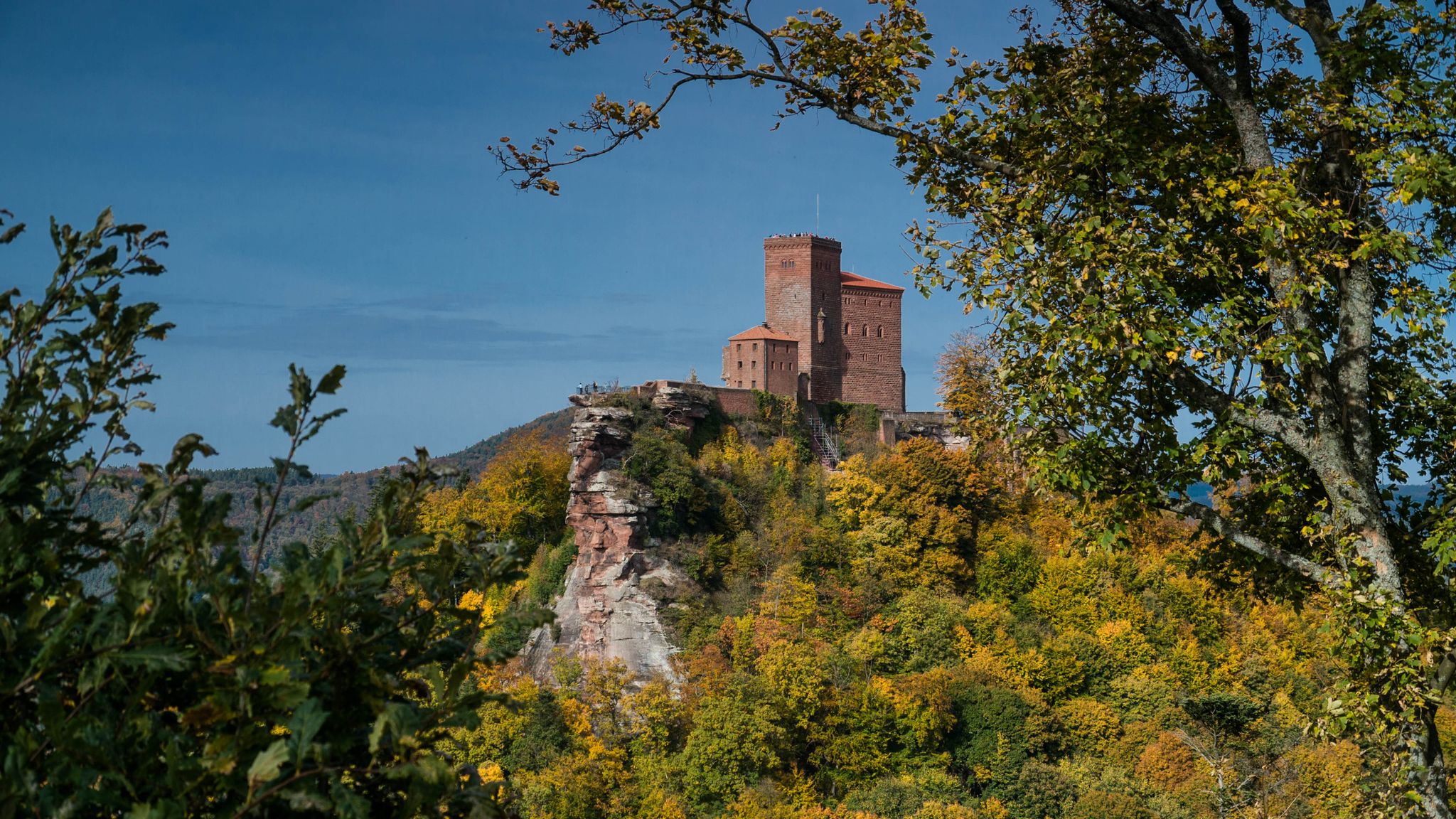
The view of the Trifels is omnipresent in Annweiler.
0
0

The Dreiherrenstein (Knight's Stone No. 57), located in a saddle south of the Weißenberg towards Hermersbergerhof, is a historical border marker. It is somewhat hidden in the forest near County Road 56 and a hiking trail marked with a "blue cross." It is a flat boulder that documents the border situation in 1773 between the converging estates of the Wittelsbach Dukes of Palatinate-Zweibrücken, the Leiningen Counts (Leiningen-Hardenburg-Dagsburg line), and the Gräfenstein Lordship, which belonged to the Margraviate of Baden. For this purpose, not only the coats of arms of these estates but also the boundaries of the historical forest districts were carved into the surface of the rock. The Baden coat of arms with the letters "MB" (Margraviate of Baden), as well as the coat of arms of Palatinate-Zweibrücken with its diamond structure and the suffix "PZ" (Palatinate-Zweibrücken), are still clearly visible. The letters "KW" (Royal Forest) were added after 1831 during the Bavarian period of the Palatinate and served to mark the Bavarian state forest. Furthermore, during the development of the rock into the Ritterstein (Knight's Stone) by the Palatinate Forest Association, the inscription "Dreiherrenstein" (Three Gentlemen's Stone) and the abbreviation "PWV" were engraved on its front—as is customary in such cases. Source: https://de.wikipedia.org/wiki/Dreiherrenstein_(Frankenweide)
0
0

Unfortunately, it was no longer in operation. As of June 22, 2025, at 35°C 🥵😅 So I wouldn't rely on it.
0
0

Frequently Asked Questions
How many traffic-free road cycling routes are available around Leinsweiler?
There are 9 dedicated traffic-free road cycling routes around Leinsweiler featured in this guide. These routes offer a variety of experiences, from easy vineyard rides to more challenging climbs through the Palatinate Forest.
What are the difficulty levels of the no traffic road cycling routes in Leinsweiler?
The routes cater to various fitness levels. You'll find 3 easy routes, 4 moderate routes, and 2 difficult routes. This ensures there's a suitable option whether you're looking for a leisurely ride or a more demanding challenge.
What kind of terrain and elevation can I expect on these routes?
The region around Leinsweiler is characterized by gently rolling hills, vast vineyards, and the dense Palatinate Forest. You can expect varied terrain, with some routes offering significant elevation gains, such as the challenging Drei Buchen Pass (403 m) – Lolosruhe Pass loop from Ramberg with over 1000m of ascent, while others like the Spirkelbach village center – Queich Wet Meadows Cycle Path loop from Lug are relatively flat.
When is the best time of year to enjoy traffic-free road cycling in Leinsweiler?
The most popular months for road cycling in Leinsweiler are June and August, when the weather is generally warm and sunny, perfect for exploring the vineyards and forests. However, the region offers beautiful scenery throughout the spring and autumn as well, with vibrant colors and pleasant temperatures.
Are there any family-friendly no traffic road cycling routes in Leinsweiler?
Yes, there are 3 easy routes that are well-suited for families or those looking for a relaxed ride. These typically feature less elevation and are often on paved surfaces, allowing for a comfortable experience through the picturesque landscapes.
What scenic viewpoints or historical landmarks can I discover along these routes?
Leinsweiler and its surroundings are rich in natural beauty and history. You can encounter stunning panoramic views from spots like the Orensfels Viewpoint. Historical sites include the impressive Trifels Castle, Landeck Castle, and the Neuscharfeneck Castle Ruins. Many routes, such as the View of Trifels Castle – Hermersbergerhof climb loop from Annweiler am Trifels, offer direct views of these landmarks.
Are there any loop road bike routes without traffic around Leinsweiler?
Yes, many of the routes are designed as loops, allowing you to start and end at the same point. Examples include the Drei Buchen Pass (403 m) – Lolosruhe Pass loop from Ramberg and the Lolosruhe Pass – Modenbach Valley loop from Landau (Pfalz) Godramstein, providing convenient circular journeys.
What do other road cyclists enjoy the most about road cycling in Leinsweiler?
The area is highly rated by the komoot community, with an average score of 4.6 stars. Reviewers often praise the quiet, well-maintained roads that wind through picturesque vineyards and dense forests, offering a true escape from traffic. The combination of challenging climbs and scenic descents, along with the charming villages and historical castles, makes for a highly enjoyable cycling experience.
Are there places to stop for refreshments or food along these routes?
Yes, the region is known for its wine culture, and many routes pass through charming villages with traditional "Straußwirtschaften" (seasonal wine taverns) and local eateries. You'll also find several huts and forest houses, such as the Waldhaus Drei Buchen, which are perfect for a break and a meal.
Can I find accommodation that caters to cyclists in Leinsweiler?
Leinsweiler is a popular destination for cyclists, and several hotels in the area, such as the Leinsweiler Hof, specifically cater to their needs. They often offer secure bike storage, curated route suggestions, and sometimes even bike and e-bike rentals, making it easy to plan your cycling holiday.
How can I find parking for these traffic-free road cycling routes?
While specific parking details vary by route, many routes start from or pass through villages like Ramberg, Landau (Pfalz) Godramstein, Annweiler am Trifels, Wilgartswiesen, or Lug, where public parking is generally available. It's always a good idea to check the individual route details on komoot for suggested starting points and parking options.
Most popular routes around Leinsweiler
Most popular attractions around Leinsweiler

Get inspired with the komoot mobile app


Explore more
Browse the best Road cycling routes in other regions.
