The best traffic-free bike rides in Nieuwe Heide
4.4
(2207)
27,636
riders
552
rides
Nieuwe Heide car-free cycling routes traverse a landscape primarily characterized by dense pine forests, remnants of heathland, and fens. The area is situated on the Central Brabant sand ridge, offering generally flat terrain ideal for touring cycling. A section of the Wilhelminakanaal intersects the region, providing linear routes often accompanied by scenic paths. This natural area offers a mix of shaded routes and open heathland sections.
Best no traffic touring cycling routes in Nieuwe Heide
- The most popular no traffic…
Last updated: May 12, 2026
5.0
(4)
94
riders
7.10km
00:36
10m
10m
Easy bike ride. Great for any fitness level. Mostly paved surfaces. Suitable for all skill levels.
5.0
(1)
50
riders
35.1km
02:36
40m
40m
Hard bike ride. Good fitness required. You may need to push your bike for some segments of this route.

Sign up for free
4.0
(2)
26
riders
26.1km
01:31
30m
30m
Easy bike ride. Great for any fitness level. Mostly paved surfaces. Suitable for all skill levels.
4.0
(3)
268
riders
49.4km
03:42
50m
50m
Moderate bike ride. Good fitness required. Mostly paved surfaces. Suitable for all skill levels.
4.6
(40)
150
riders
Moderate bike ride. Good fitness required. Mostly paved surfaces. Suitable for all skill levels.
Get access to more routes and recommendations from other explorers.
Sign up for free
Already have an account?
Our route recommendations are based on thousands of hikes, rides, and runs completed by other people on komoot.
Start today with a free account
Your next adventure awaits.
Login or Signup


Other adventures in Nieuwe Heide

Tips from the Community

Lovely resting spot during a bike tour through the Brabant landscape.
1
0

Beautiful heathland that blooms from mid-August to mid-September. Definitely worth cycling here, but that also applies to other seasons.
0
0
Nice bike ride through the woods
2
0

More than 4,500 paratroopers dropped from the sky in this area within 45 minutes on Sunday afternoon, September 17th. This farm, Paulushoef, served as a prime landmark for the pilots, with its name written in large letters on the roof. Following the paratroopers, 53 gliders carrying equipment and troops also landed. Paul van Overveld, a 15-year-old boy, witnessed it all. This farm was located in the heart of the area designated by the Allies as one of the drop and landing zones for the largest airborne operation ever on Sunday, September 17th, 1944. Pilots easily recognized the farm from the air because the name "Paulushoef" was written in large white letters on the roof. Besides some 4,500 paratroopers, 53 Waco gliders also landed there, suspended by a cable behind the Skytrain transport aircraft and released above the landing zone. These gliders transported jeeps, other rolling stock, and troops. The residents of the farms in the Sonnius district assisted the Americans in every possible way. In the days that followed, the area was used even more frequently for landings and the unloading of reinforcements, heavy equipment, and supplies.
0
0
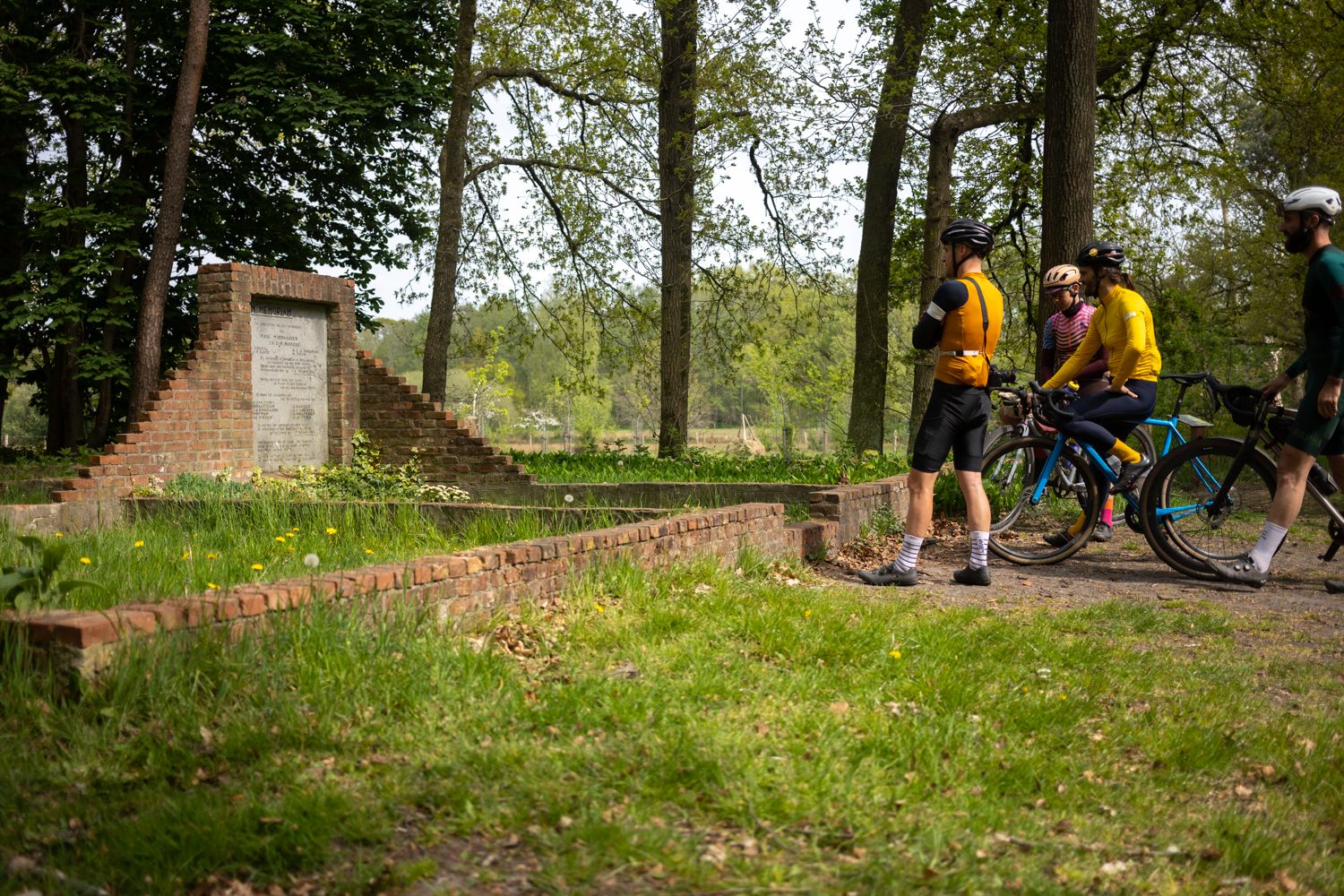
The monument consists of four concrete columns, topped with a statue of a pelican on its nest, with its young. The pelican is the Christian symbol of total self-sacrifice. According to legend, the bird feeds its young with its own blood. Around the columns is a relief of soldiers mourning a soldier on the ground. The columns are 6.5 meters high. Joe Mann This monument is a tribute to American paratrooper Joe Eugene Mann and all who fought to liberate Best. Joe Mann was an American soldier in World War II. He served with the 101st Airborne Division of the US Army during Operation Market-Garden and was killed in the battle in Best for the bridge over the Wilhelmina Canal on September 19, 1944, sacrificing himself for his fellow soldiers. He absorbed the explosion of a grenade with his back, thereby saving the lives of his comrades. For this act, he was posthumously awarded the highest American military decoration: the Medal of Honor. He is buried at Greenwood Memorial Terrace in Spokane, Washington State. The story of Joe E. Mann only became known in the region later, through a publication by Cees Wittebrood in the Bata Courier on October 22, 1954. This led to the construction of the Joe Mann Theater and the Joe Mann War Memorial. Reliefs on the Monument The reliefs on the monument depict Joe Mann's heroic act. Sergeant Bertras is depicted on the far left of the front, throwing a hand grenade from the shelter where Joe Mann lay with several wounded men. On the far right is Private Laino, who was severely wounded in the face when a grenade exploded on the barrel of his machine gun. The main motif on the front of the monument is Lieutenant Edward Wierszbowski, bending over the dying Joe Mann. The images on the front extend into the relief to the right of the monument, which depicts the wounded Joe Mann in his shelter. This part of the monument bears the United States coat of arms (eagle with coat of arms). The small relief on the back depicts Saint Odulphus, which appears in the coat of arms of the municipality of Best. The left section depicts Private L. Koller, who was killed by a bullet while he slept. The eagle, which appears in the coat of arms of the 101st Airborne Division, is also depicted there. The foot of the monument bears the inscription, which also appears on the Medal of Honor: "His extraordinary courtesy and magnificent conduct were an everlasting inspiration to his comrades, for whom he gave his life." The statue was designed by Nijmegen artist Ad Berntsen and unveiled by Joe Mann's parents on September 17, 1956, in the presence of Mayor Notermans, the military attaché of the American embassy in The Hague, and 13 Americans from the 101st Airborne Division, among many others.
0
0
Robert Cole and Joe Mann On September 18 and 19, 1944, these woods witnessed unprecedented fierce fighting. German troops attempted to prevent the breakthrough of American paratroopers who had landed the previous day and the British troops advancing from the south. Two exceptionally brave men were killed in this battle. Lieutenant Colonel Robert Cole and Private Joe Mann were both posthumously awarded the highest American military decoration: the Medal of Honor. Listen to their stories here. On Monday, September 18 and Tuesday, September 19, the woods between Son and Best witnessed extremely fierce fighting between units of the German 59th Division and the 502nd Regiment of the US 101st Airborne Division, which was later supported by the 327th Glider Infantry Regiment and the British 15/19 Hussars. The Germans attempted, among other things, to recapture the drop and landing zones at Son and advanced from Boxtel and Best. They wanted to prevent the Americans and British from breaking through. Many soldiers were killed in these battles. Among them were Lieutenant Colonel Robert Cole and Private Joe Mann. Both were awarded the highest American military decoration, the Medal of Honor, for their exceptional courage. Here's a listen to their stories.
0
0
From September 18, 1944, the area around Son en Breugel was unsettled. American soldiers advanced from Eindhoven. German soldiers entrenched themselves in the tall church tower of Son en Breugel. Everyone hoped for a quick liberation, but instead, it became more dangerous by the day: one day the village was in American hands, the next back in German hands. On American orders, many people, especially children, were evacuated from the area. Eight-year-old Mariet van Kronenburg lives with her parents and eight siblings in the hamlet of De Vleut, which lies directly in the line of fire. One day, at the end of September 1944, an American commander decides that it is irresponsible to let the children live on the farmhouse. Father Jan and mother Tonia are allowed to stay because the livestock needed to be cared for. And son Johan, who has a mental disability, is also allowed to stay, along with a brother or sister. But the other children have to leave. Mariet included. Pears Father Jan van Kronenburg puts his children in the cart – a bucket of pears is also included – and takes them to visit good friends in Sint-Oedenrode. At the Van Schijndel family farmhouse, Mariet sleeps in the attic with her sisters and a few other female evacuees. The boys and men sleep in the hayloft. From the windows, Mariet can see the Sonniuswijk airstrips, where American gliders and paratroopers land. The Van Kronenburg children are allowed to play in the area around the farmhouse. But the Van Schijndel family doesn't allow them onto the airstrips. Only under supervision. On October 20, 1944, Janus, one of the Van Schijndel sons, is working in the fields near the airstrips. Mariet, her sister Jo, brother Kees, and sister Sjaantje, along with two other children, go to call him for lunch. They're allowed to walk back across the runways – after all, 21-year-old Janus is with them now. Mariet and Jo linger, along with their friend. Who knows, maybe one of the American soldiers has some chocolate left… It's not allowed, because Janus is already walking on, but they do it anyway: they walk towards the planes. Green Jacket Then Mariet hears a bang. She looks up and sees a cloud. She runs towards it. Something has exploded; the children who were walking there a moment ago are no longer standing. "I still see my little sister lying there. In a green jacket with a white stripe." Mariet runs away in panic. She stops at the corner of the field, in tears, with her sister and friend. The priest from Sint Oedenrode takes the three girls back to the farm where they are staying. For three days, father and mother Van Kronenburg search for their children. Thirteen-year-old Kees is killed instantly by the force of the explosion. They find him in the convent of Sint Oedenrode. Six-year-old Sjaantje is harder to find. She appears to have been seriously injured and transported from emergency hospital to emergency hospital, but she doesn't survive. Finally, her parents find her in Zeelst. They take her body, wrapped in a blanket, back to her home. The children are buried in Sint Oedenrode, in small coffins made of glider wood. What exactly exploded is unclear. Janus also died and cannot tell the story. One boy, eleven-year-old Ties, survives the impact. He describes the projectile as a small, shiny box. Kees picked it up and opened it.
0
0

Nice route, easy to do on an e-bike. A bit narrow though.
0
0
Frequently Asked Questions
How many no-traffic touring cycling routes are available in Nieuwe Heide?
Nieuwe Heide offers a wide selection of traffic-free touring cycling routes, with over 500 options to explore. These include more than 240 easy routes, over 270 moderate routes, and around 50 more challenging tours, ensuring there's something for every cyclist.
What is the typical terrain like for no-traffic touring cycling in Nieuwe Heide?
The terrain in Nieuwe Heide is generally flat, characterized by dense pine forests, remnants of heathland, and the tranquil Langven fens complex. Many routes follow well-maintained, paved cycling paths, but some may include unpaved or gravel sections, especially through the more natural areas. Hybrid bikes are well-suited for this varied landscape.
Are there easy no-traffic touring cycling routes suitable for beginners or families?
Yes, Nieuwe Heide is very family-friendly, offering over 240 easy, traffic-free touring cycling routes. These routes typically feature flat terrain and well-maintained paths. A great option for a relaxed ride is the Joe Mann Memorial – Red MTB Route Best loop from Best, which is just over 7 km long and has minimal elevation gain.
What do other touring cyclists say about the routes in Nieuwe Heide?
The touring cycling routes in Nieuwe Heide are highly regarded by the komoot community, boasting an average rating of 4.45 out of 5 stars from over 2,000 reviews. Cyclists frequently praise the quiet, natural surroundings, the well-marked paths, and the diverse scenery ranging from forests to heathland.
What interesting landmarks or attractions can I see along the no-traffic touring cycling routes?
Several points of interest enhance the cycling experience in Nieuwe Heide. You can visit the historic Joe Mann Pavilion, explore the Sonse Heide forest, or delve into history at the Wings of Liberation Museum. The Lt. Col. Robert G. Cole Memorial and the Liberation Route: Robert Cole and Joe Mann also offer historical insights.
Are there any longer, more challenging no-traffic touring cycling routes in the area?
For those seeking a longer adventure, Nieuwe Heide offers around 50 difficult-rated routes. These often cover greater distances and might include more varied surfaces. Consider the Dommel River – Small monument loop from Best, a challenging 34 km route that takes you through diverse landscapes.
Are there any circular no-traffic touring cycling routes in Nieuwe Heide?
Yes, many of the no-traffic touring cycling routes in Nieuwe Heide are designed as circular loops, allowing you to start and end at the same point. An example of a moderate circular route is the Miekoeksebrug – Gravel path loop from Best, which is nearly 50 km long and offers a mix of terrain.
What is the best time of year to go touring cycling in Nieuwe Heide?
The best time for touring cycling in Nieuwe Heide is generally from spring to early autumn (April to October). During late summer, the heathland areas can turn a vibrant purple, offering particularly scenic views. The flat terrain makes it enjoyable in most weather conditions, though checking the forecast is always recommended.
Are there options for food and drink along the no-traffic cycling routes?
While the routes themselves focus on natural and traffic-free paths, you'll find cafes and restaurants in nearby towns like Best, or at specific points of interest. The Joe Mann Pavilion, for instance, is a known spot for refreshments within the forest area.
Can I reach the no-traffic cycling routes in Nieuwe Heide using public transport?
Nieuwe Heide is accessible by public transport, with train stations in nearby towns like Best. From there, local buses or a short cycle can connect you to various starting points for the routes. The region's extensive cycling network also integrates well with public transport hubs, making it easy to combine modes of travel.
Are there any routes that pass through other nature reserves or notable areas?
Yes, some routes extend beyond the immediate Nieuwe Heide area, connecting to other beautiful natural spaces. For example, the Kampina Nature Reserve – Bike path through the woods loop from Best is a moderate 50 km route that takes you through the scenic Kampina Nature Reserve, offering diverse landscapes and wildlife viewing opportunities.
What kind of surfaces can I expect on the no-traffic touring routes?
You can expect a mix of surfaces. Many routes are on smooth, paved cycling paths, ideal for touring bikes. However, some sections, particularly those venturing deeper into the forests or heathland, may feature hard-packed dirt or gravel. Routes like the Old Town Hall Liempde – Donderdonksedijk Gravel Path loop from Sonse Heide specifically highlight gravel sections, offering a varied riding experience.
Most popular routes in Nieuwe Heide
Most popular attractions in Nieuwe Heide

Get inspired with the komoot mobile app


Explore more
Browse the best Cycling routes in other regions.
