Top 13 Natural Monuments in Nacionalni Park Djerdap
Best natural monuments in Nacionalni Park Djerdap are situated along the Danube River, forming a natural border between Serbia and Romania. This region, also known as the Iron Gate, features dramatic gorges and unique geological formations. The park is recognized for its ecological significance and rich biodiversity, with the Danube carving a series of narrow canyons through the Carpathian Mountains. It offers a landscape of impressive natural features.
Best natural monuments in Nacionalni Park Djerdap
- The most popular natural monuments…
Last updated: May 15, 2026
Danube Gorge Between Donji Milanovac and Tekija
Highlight • Gorge
While on the Romanian side the mass tourism prevails and high traffic, it is quiet on the Serbian side, …
Translated by Google •
Tip by

Boletinska Reka Gorge
Highlight • Gorge
In the Cretaceous sediments, fossils of new ammonite species and fossils …
Translated by Google •
Tip by
Sign up now to discover places like this
Get recommendations on the best single tracks, peaks, & plenty of other exciting outdoor places.
Sign up for free
View of the Rock Sculpture of Decebalus and the Danube
Highlight • Viewpoint
Translated by Google •
Tip by

View of the Iron Gates Gorge on the Danube
Highlight • Viewpoint
Translated by Google •
Tip by
View of the Danube Gorge from Donji Milanovac, Đerdap National Park
Highlight • Viewpoint
Translated by Google •
Tip by
Sign up for free to discover even more natural monuments in Nacionalni Park Djerdap.
Sign up for free
Already have an account?
Start today with a free account
Your next adventure awaits.
Login or Signup
Popular around Nacionalni Park Djerdap
Tips from the Community

The 55 m high statue of the Dacian king Decebalus has unfortunately not been completed to this day.
0
0

Here lie smaller gorges separated by the Dubova Gulf. Their names date back to the Ottoman Empire, when the Danube waters were swift and full of whirlpools resembling a "pot." In Mali Kazan, the Danube is at its narrowest (150-180 m) and deepest. The steep flanks of Mt. Miro, formed from Jurassic limestone, rise above the Danube. The highest peaks, Veliki Strbac (768 m) and Mali Strbac (626 m), are already integrated into the hiking trail as viewpoints towards Mali Kazan and Veliki Kazan, respectively. The Hajducka Vodenica archaeological site and the submerged karst spring of the same name are located at the foot of the hill. Before the construction of the dam in the Djerdap area, traces of prehistoric necropolises and settlements from the Roman and medieval periods were discovered at this site.
0
0
The statue of the Dacian king Decebalus is a 55-meter-tall statue and the tallest rock sculpture in Europe. It is located on a rock formation in the Almăj Mountains on the banks of the Danube near the village of Dubova, southwest of the city of Orșova (Romania), in the Iron Gates Nature Park. Source: https://de.wikipedia.org/wiki/Statue_des_Decebalus
0
0

Amazing view of the iron gates and nice road without too much traffic
0
0

The statue of the Dacian king Decebalus is a 55-meter-high statue and also the highest rock sculpture in Europe. It is located on a rock formation in the Almăj Mountains on the banks of the Danube near the village of Dubova, southwest of the city of Orșova (Romania), in the Iron Gates Nature Park (Romanian: Parcul Natural Porțile de Fier).
0
0
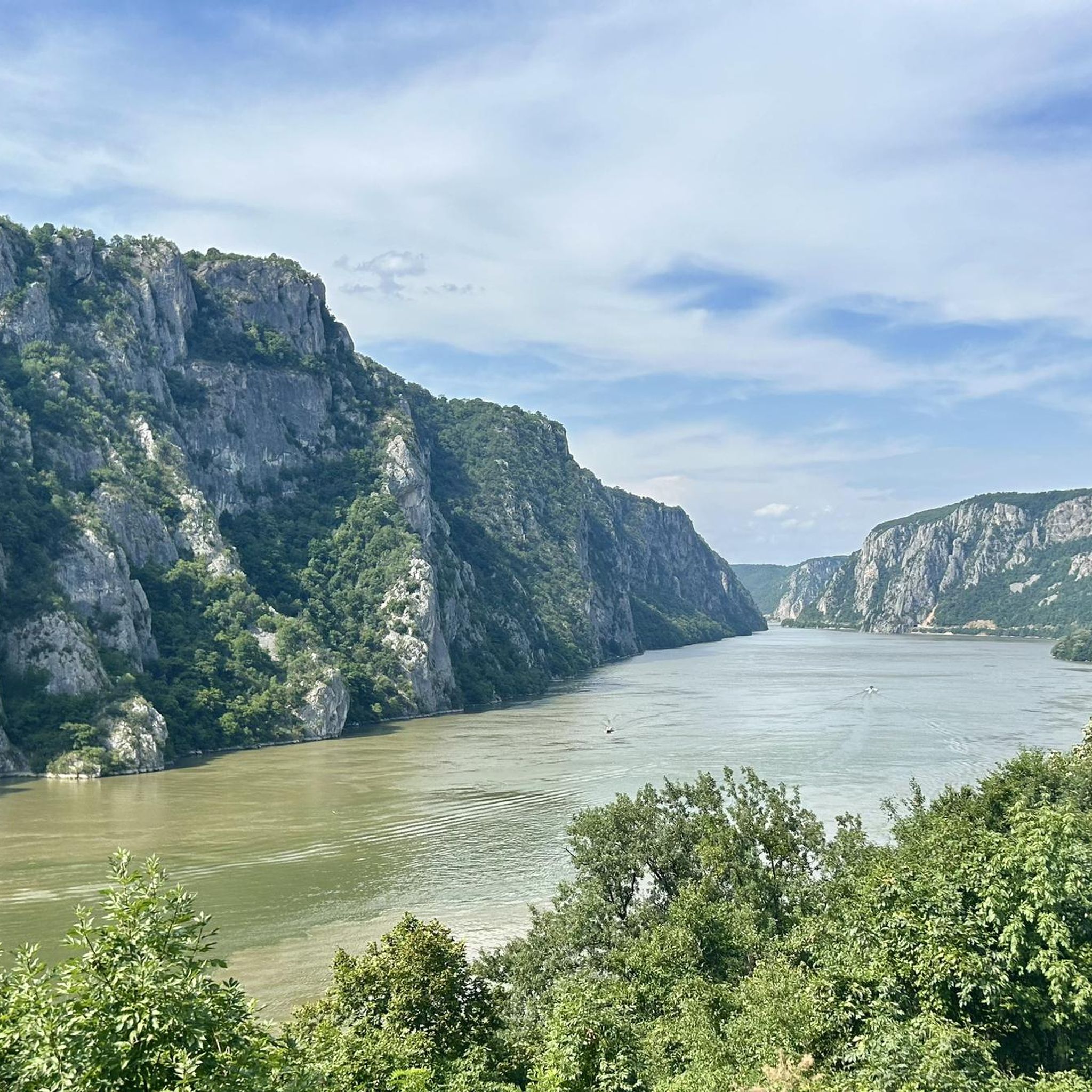
The Iron Gate (Romanian Porțile de Fier; Serbian Ђердап, Đerdap) is a gorge of the Danube. It is located in the southern Carpathians, more precisely between the Serbian Carpathians and the Banat Mountains, on the border of Serbia and Romania. Until it was defused in 1972 in connection with the Iron Gate 1 power plant, it was considered the most dangerous section of the Danube for shipping, which could not be passed without local pilots. For decades, the ships were towed upstream with locomotives. The Iron Gate is considered one of the most impressive gorges in Europe.[1] At the Cazan or Kazan (German: Cauldron) between the towns of Orșova and Donji Milanovac, the Danube is narrowed to 200 meters wide; In this section it was already 50 m deep before the dam was built, so that the bottom of the river is 15 m below sea level. Because of the steep walls of the gorge, the current reservoir is not much wider than the natural riverbed in some places, despite the water level being raised (at the dam by 20 m to 62 m above sea level). Protected areas have been established on both sides of the Danube - in Serbia the Đerdap National Park, on the Romanian side the Iron Gate Nature Park (Parcul Natural Porțile de Fier).
0
0

Steep climb but some shade half way with the nice view. Very rewarding :)
0
0

Probably the best view of the Danube bottleneck: quite high, exactly as an extension of the "iron gate", which offers a great view. In addition, it is a fairly well-developed rest area with a few benches and enough space to park several vehicles. There is also an interesting table explaining the geology of the mountains on the Serbian side.
2
0
Frequently Asked Questions
What are the most impressive natural features to see in Nacionalni Park Djerdap?
The most impressive natural feature is the Đerdap Gorge, also known as the Iron Gate, which is Europe's longest and largest breakthrough gorge. Within this, the Veliki Kazan and Mali Kazan gorges are particularly dramatic, featuring towering cliffs and deep river sections. You can experience breathtaking views from spots like View of the Iron Gates Gorge on the Danube.
Are there family-friendly natural monuments in Nacionalni Park Djerdap?
Yes, several natural monuments in Nacionalni Park Djerdap are suitable for families. Viewpoints like View of the Rock Sculpture of Decebalus and the Danube and View of the Iron Gates Gorge on the Danube are easily accessible and offer spectacular scenery for all ages. The park also offers easy hiking routes that are suitable for families, allowing you to explore the natural beauty without strenuous effort.
What outdoor activities can I do near the natural monuments in Nacionalni Park Djerdap?
Nacionalni Park Djerdap offers a variety of outdoor activities. You can enjoy scenic drives along the Danube, take boat tours through the gorges, or explore numerous hiking trails. For more specific routes, you can find options for hiking and mountain biking within the park.
What is the best way to experience the dramatic gorges of the Iron Gate?
To truly appreciate the dramatic scale of the Iron Gate, especially the Veliki Kazan and Mali Kazan gorges, boat cruises are highly recommended. These allow you to witness the towering cliffs and the narrowness of the Danube from the water. Alternatively, viewpoints like View of the Danube Gorge from Donji Milanovac offer panoramic vistas from above.
What kind of wildlife and flora can I expect to see in Djerdap National Park?
Djerdap National Park is a significant ecological treasure, home to over 1,000 herbal species, many of which are relict species from the Tertiary period. The diverse fauna includes over 55 mammal species such as lynx, wolf, and jackal, and around 170 bird species, including golden eagles and black storks. The park's varied habitats, from dense forests to riverine ecosystems, support this rich biodiversity.
Are there any historical landmarks associated with the natural monuments?
Yes, while primarily a natural monument, the Đerdap Gorge is inextricably linked with historical landmarks. Most notably, Trajan's Table (Tabula Traiana), an ancient Roman inscription, is carved into a rock face high above the Danube. It commemorates Emperor Trajan's construction efforts in the 2nd century AD and can only be seen from the Danube River, typically during boat tours.
What do visitors enjoy most about the natural monuments in Nacionalni Park Djerdap?
Visitors frequently highlight the breathtaking views and the sheer scale of the Danube Gorge. Many appreciate the tranquility on the Serbian side compared to the busier Romanian side, making it ideal for cycling and scenic drives. The impressive rock formations and the unique experience of seeing the Danube carve its way through the mountains are often mentioned as highlights, as seen in tips for Danube Gorge Between Donji Milanovac and Tekija.
Are there easy walks or beginner hikes to natural landmarks in Đerdap National Park?
Yes, the park offers easy hiking options suitable for beginners. You can find several easy routes, such as the Hiking loop from Svinița or the Wooden Shelter and Rest Area – View of Dubova and the Danube loop. These trails allow you to enjoy the natural beauty without requiring extensive hiking experience.
What is the Boletinska Reka Gorge, and is it worth visiting?
The Boletinska Reka Gorge is a small canyon near the archaeological site of Lepenski Vir. It's known for its unique geological formations and Cretaceous sediments where fossils have been found. While the creek bed can be dry at certain times of the year, the gorge offers a shaded, tranquil experience and impressive rock formations, making it a worthwhile stop for those interested in geology and natural history.
What is the best time of year to visit Nacionalni Park Djerdap for its natural monuments?
The best time to visit Nacionalni Park Djerdap is generally during the spring (April-June) and autumn (September-October) months. During these periods, the weather is pleasant for outdoor activities like hiking and boat tours, and the natural scenery is particularly vibrant with spring blooms or autumn foliage. Summer can also be enjoyable, but it can be quite warm.
Can I find accommodation or cafes near the natural monuments in Nacionalni Park Djerdap?
Yes, towns like Donji Milanovac, located within the park, offer accommodation options such as hostels and hotels, as well as cafes and restaurants. Donji Milanovac is a good base for exploring the surrounding natural monuments and offers amenities for visitors, including places to eat fresh Danube fish.
How long does it typically take to explore the main natural monuments in Djerdap National Park?
To adequately experience the main natural monuments like the Đerdap Gorge, Veliki Kazan, Mali Kazan, and various viewpoints, it's recommended to dedicate at least 2-3 days. This allows time for scenic drives, boat tours, and some hiking to fully appreciate the scale and beauty of the park's diverse natural features.
Most popular attractions in Nacionalni Park Djerdap

Get inspired with the komoot mobile app


