The 20 Most Amazing Peaks in Chko Lužické Hory
Best mountain peaks in Chko Lužické Hory are found within a Protected Landscape Area in the Czech Republic, bordering Germany. This region features a landscape of volcanic and sandstone formations, dense forests, and picturesque views. The peaks, while generally not exceeding 800 meters above sea level, rise dramatically from the surrounding terrain. The area is also historically significant for Czech glassmaking and mining.
Best mountain peaks in Chko Lužické Hory
- The most popular mountain peaks is Lausche Summit and Observation…
Last updated: September 25, 2026
Lausche Summit and Observation Tower
Highlight • Summit
Translated by Google •
Tip by

Hochwald Summit and Lookout Tower
Highlight • Summit
Translated by Google •
Tip by

Sign up now to discover places like this
Get recommendations on the best single tracks, peaks, & plenty of other exciting outdoor places.
Jedlová (Tannenberg) with Observation Tower
Highlight • Viewpoint
Translated by Google •
Tip by

Exaltation of the Holy Cross
Highlight • Religious Site
Showing Translation
Tip by
Johannisstein summit and rock formations
Highlight • Summit
Translated by Google •
Tip by
Sign up for free to discover even more peaks in Chko Lužické Hory.
Already have an account?
Start today with a free account
Your next adventure awaits.
Popular around Chko Lužické Hory
Other adventures in Chko Lužické Hory

Tips from the Community

Nice to see the foliage in the sun, we are surrounded by meadows. Let's briefly look up at the Kreuzberg. The path, like an avenue, with the pilgrimage church at the end, its tower crowns everything. Is this a Way of the Cross. We go up, there are 11 niche chapels here. Let's consider each one individually, they tell the Passion of Jesus. Designed in the Rococo style, built in 1759, they are truly remarkable. The Chapel of the Holy Cross and the Tomb Chapel house stations 12 to 14. We reach the Chapel of the Holy Cross, built in 1796, let's look back, deep down into the town, the path we have walked. We enter the church. A grille separates us, but we still get a glimpse, let's continue to the Tomb Chapel. https://youtu.be/SWy51bMcY8k
0
0


Unfortunately, the viewing point on the Johannesstein can now only be used by hotel guests.
0
0

This church is located on the summit of the St. Georgenthaler Kreuzberg (Jiřetín pod Jedlovou) or at the upper end of the Way of the Cross from 1759, which runs up the mountain. Impressive images and figures and sometimes martial depictions of the ordeal can be seen at the stations. The anteroom of the chapel is open.
0
0

Easy to reach by bus or from Jedlova stanice via the E3/E10
0
0

Jánské kamy (German: Johannisstein) is a 604 m high hill, on the summit of which there is a formation of basalt rocks, the Johannissteine. It is located in the Lusatian Mountains on the Saxon-Bohemian border in the Hain district of the health resort Oybin and northeast of the Krompach district of Valy. Since the cession of Upper Lusatia in 1635, the border between Saxony and Bohemia has run over the Johannisstein, the summit of which belongs to Bohemia. In 1880, an inn was built on the hill on the Bohemian side, and a viewing platform was built one year. When the inn became too small due to the popularity, additional buildings were built, the Johannissteinbaude. The hut developed into a popular excursion site and was also used as a rest stop for hikes in the neighboring high forest. Since 1927 it has been operated as a mountain hotel with an event hall. Other smaller buildings, such as the Bohemian Josefshöhe or the German Schönfeldbaude, were built on the northern slope.
1
0

May 2023: Ascent to the Johannisstein not possible (according to the notice for technical reasons).
1
1

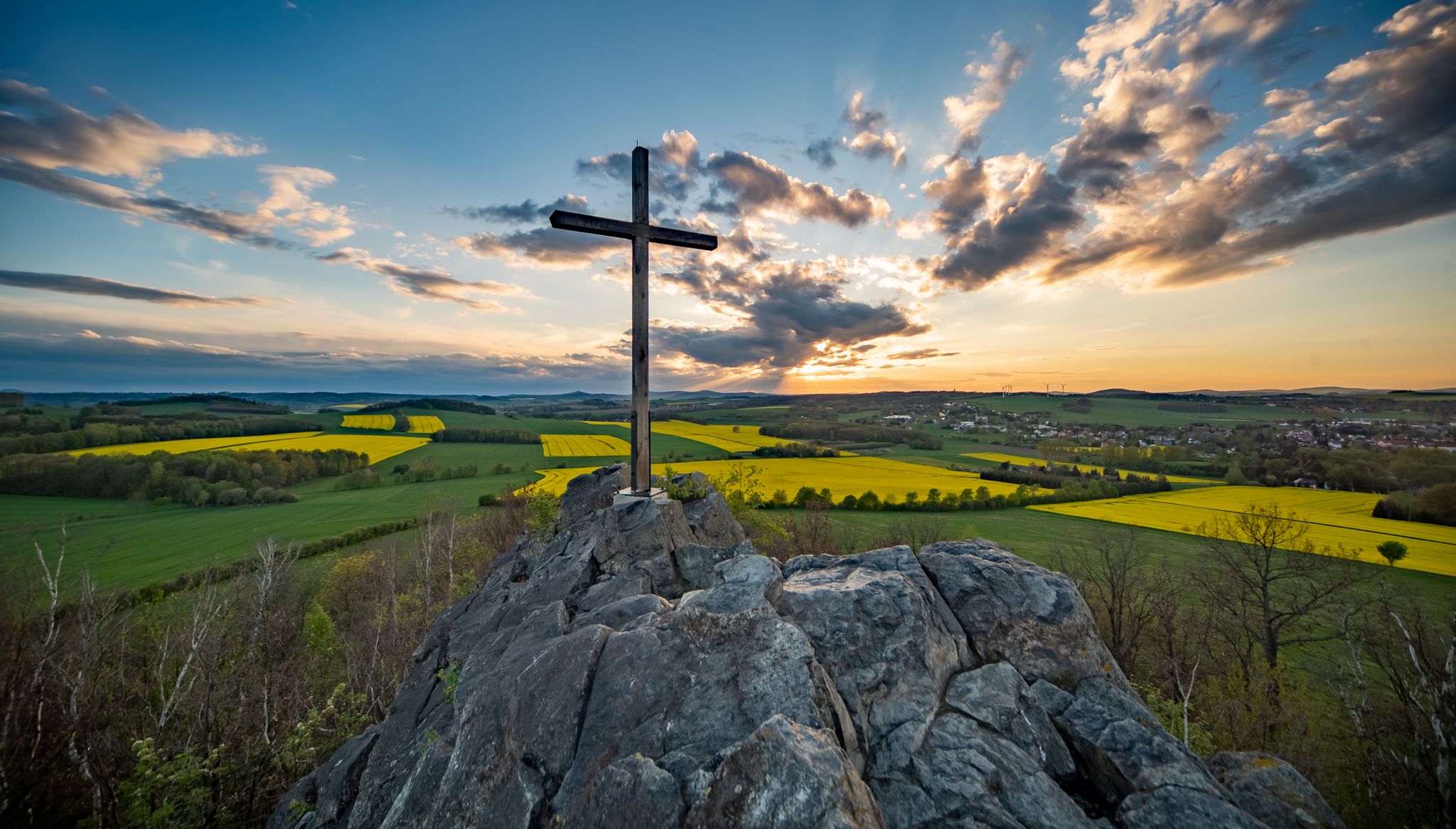
Křížová hora (562.7 m.a.s.l.) is a prominent ridge extending from Jedlová to Jiřetín. It is here that you will find probably the most photographed Stations of the Cross in Šluknovsko. The origins of the pilgrimage site on Křížová hora are connected with rumors about the miraculous cross. Prayer at the cross restored health to Anton Donth in the mid-17th century. The first cross was allegedly erected on Křížová hora in 1699 by Michael Gürtler, a parish priest from Jiřetín. Pastor Gottfried Liessner, who in 1759 had eleven brick Stations of the Cross, a wooden chapel with the 12th and 13th Stations, and the Rococo Chapel of the Holy Sepulcher built here. The Way of the Cross begins at the foot of the slope with a monumental staircase with stone columns. The original wooden chapel of St. The cross on top of the hill was replaced by a stone structure in the 18th century. It was completed in 1796. Since the 1990s, the entire pilgrimage site, including the Stations of the Cross and the Garden of Gethsemane, has been gradually renovated.
1
0
Frequently Asked Questions
What are the most popular mountain peaks to visit in Chko Lužické Hory?
Among the most popular peaks in Chko Lužické Hory is Lausche Summit and Observation Tower, which is the highest peak in the Lusatian Mountains at 793 meters and offers magnificent panoramic views. Another favorite is Jedlová (Tannenberg) with Observation Tower, known for its historic stone observation tower and extensive circular views. Visitors also appreciate Klíč, a distinctive conical mountain offering exceptional panoramic vistas, and Hvozd, another border peak with an observation tower and restaurant.
Are there mountain peaks with observation towers in Chko Lužické Hory?
Yes, several peaks in Chko Lužické Hory feature observation towers. Lausche Summit and Observation Tower has a new tower built in 2020. Jedlová (Tannenberg) with Observation Tower boasts a 29-meter high stone tower from 1891. Studenec is home to one of the oldest iron lookout towers in the Czech Republic, dating back to 1888. Hvozd also has an old lookout tower on its German side.
What natural features can I expect to see on the mountain peaks in Chko Lužické Hory?
The region is characterized by a captivating landscape of volcanic and sandstone formations. You'll encounter distinctive basalt cones with columnar jointing, such as Panská skála, and unique sandstone formations like Bílé kameny. Peaks like Klíč are nature preserves, known for their unique botanical and geological significance, including rare oak forests at higher altitudes. Dense forests and dramatic rises from the surrounding terrain are common.
What is the highest mountain peak in Chko Lužické Hory?
The highest peak in Chko Lužické Hory is Luž (Lausche), standing at 793 meters (2,602 ft) above sea level. It is situated directly on the Czech-German border and offers magnificent panoramic views from its observation tower.
Are there any historical or cultural sites on or near the mountain peaks?
Yes, the region has historical significance. For instance, Exaltation of the Holy Cross on Křížová hora is a pilgrimage site with a chapel dating back to 1759. Nearby Jedlová, you can find the ruins of Tolštejn Castle. On the German side near Hvozd, the romantic ruins of Oybin Castle and its rock town are accessible. The region also has a history of Czech glassmaking and mining.
What are the best times to hike the mountain peaks in Chko Lužické Hory?
The Lusatian Mountains offer rewarding experiences throughout the year. Spring and autumn provide pleasant temperatures and vibrant scenery, ideal for hiking. Summer is also popular, though some trails can be busier. In winter, peaks like Jedlová are known for skiing, and the area can be beautiful for winter hiking, with ice cascades forming on peaks like Klíč.
Are there family-friendly mountain walks in Chko Lužické Hory?
Many trails in Chko Lužické Hory are suitable for families. For example, some ascents to Lausche Summit and Observation Tower are considered moderately easy, particularly from the Czech side. The observation towers on peaks like Jedlová and Studenec are popular destinations for scenic outings that can be enjoyed by families. You can find easy hikes in the region, such as the 'Lausche trig point – Lausche Lookout Tower loop from New Brasil Hillside Bog' or the 'Studenec Saddle – Studenec Observation Tower loop from NPP Zlatý vrch', which are listed in the Easy hikes in Chko Lužické Hory guide.
What outdoor activities can I do near the mountain peaks?
Beyond hiking, Chko Lužické Hory offers various outdoor activities. You can explore numerous running trails, with options like the 'View from Lausche – Lužická Hut loop from New Brasil Hillside Bog' found in the Running Trails in Chko Lužické Hory guide. Cycling is also popular, with routes such as the 'Khaa Valley – Krásná Lípa Town Square loop from Sněžná' detailed in the Cycling in Chko Lužické Hory guide.
What are the hiking difficulty levels for the mountain peaks in Chko Lužické Hory?
The hiking difficulty varies across the peaks. While some ascents, like to Luž, are considered moderately easy, others can be more challenging. The region offers a range of trails from easy to difficult. For instance, the 'Kaisergrund Rock Formations loop from Rynoltice' is a difficult running route, while the 'Oybin Rock and Castle Ruins – Kelchstein (Chalice Rock) loop from Oybin' is an easy hike. Always check specific route details for elevation and terrain.
Are there cafes or restaurants available on or near the mountain peaks?
Yes, some popular peaks offer amenities. Jedlová has a restaurant at its summit, and Hvozd features the Hochwaldturmbaude restaurant. Historically, Luž has also had restaurants and inns on its summit. Additionally, many villages and towns surrounding the peaks offer cafes, pubs, and accommodation options for visitors.
Can I bring my dog on the hiking routes in Chko Lužické Hory?
Generally, Chko Lužické Hory is a dog-friendly region, and many hiking routes are suitable for dogs. However, it's always advisable to keep dogs on a leash, especially in nature reserves or areas with wildlife, and to check specific trail regulations or protected areas for any restrictions before your visit.
What makes Klíč (Kleis) a unique mountain peak to visit?
Klíč, meaning 'Key,' is a distinctive, isolated conical mountain with a sharp phonolite cone. It's unique for its western side, which features a huge rock wall where ice cascades and icicles form in winter. The summit is a nature preserve, recognized for its unique botanical and geological significance, including a rare oak forest at its altitude. Its bare summit provides exceptional panoramic views that can stretch across several distant mountain ranges.
Most popular routes in Chko Lužické Hory
Most popular attractions in Chko Lužické Hory

Get inspired with the komoot mobile app


Explore more
See even more amazing summits in Chko Lužické Hory with these guides:
