Top 15 Castles around Seebenstein
Best castles around Seebenstein offer a glimpse into Austrian history, situated in a region known for its forest settings and historical significance. The area features several castles, including the prominent Burg Seebenstein, a dual-part hilltop castle with sections dating back to the 13th century. This region provides a blend of historical architecture and natural landscapes, with castles often nestled in scenic locations. Visitors can explore various historical sites that have played roles in significant events, such as the romantic revival…
Last updated: July 21, 2026
Türkensturz Ruins
Highlight • Castle
Translated by Google •
Tip by

Seebenstein Castle
Highlight • Castle
Translated by Google •
Tip by

Sign up now to discover places like this
Get recommendations on the best single tracks, peaks, & plenty of other exciting outdoor places.
Sign up for free
Grimmenstein Castle
Highlight • Castle
Translated by Google •
Tip by
Eichbüchl Castle
Highlight • Castle
Translated by Google •
Tip by

Linsberg Castle
Highlight • Castle
Translated by Google •
Tip by

Sign up for free to discover even more castles around Seebenstein.
Sign up for free
Already have an account?
Start today with a free account
Your next adventure awaits.
Login or Signup
Other adventures around Seebenstein

Tips from the Community

Schloss Eichbüchl (Aichbüchl) was probably built in the 14th century by the Lords of Vierdung. According to other sources in Wiener Neustadt, it was supposedly only built between 1558 and 1566. It is possible that a first castle was destroyed during the First Turkish Siege in 1529 and that the current castle was rebuilt slightly off to the side.
1
0
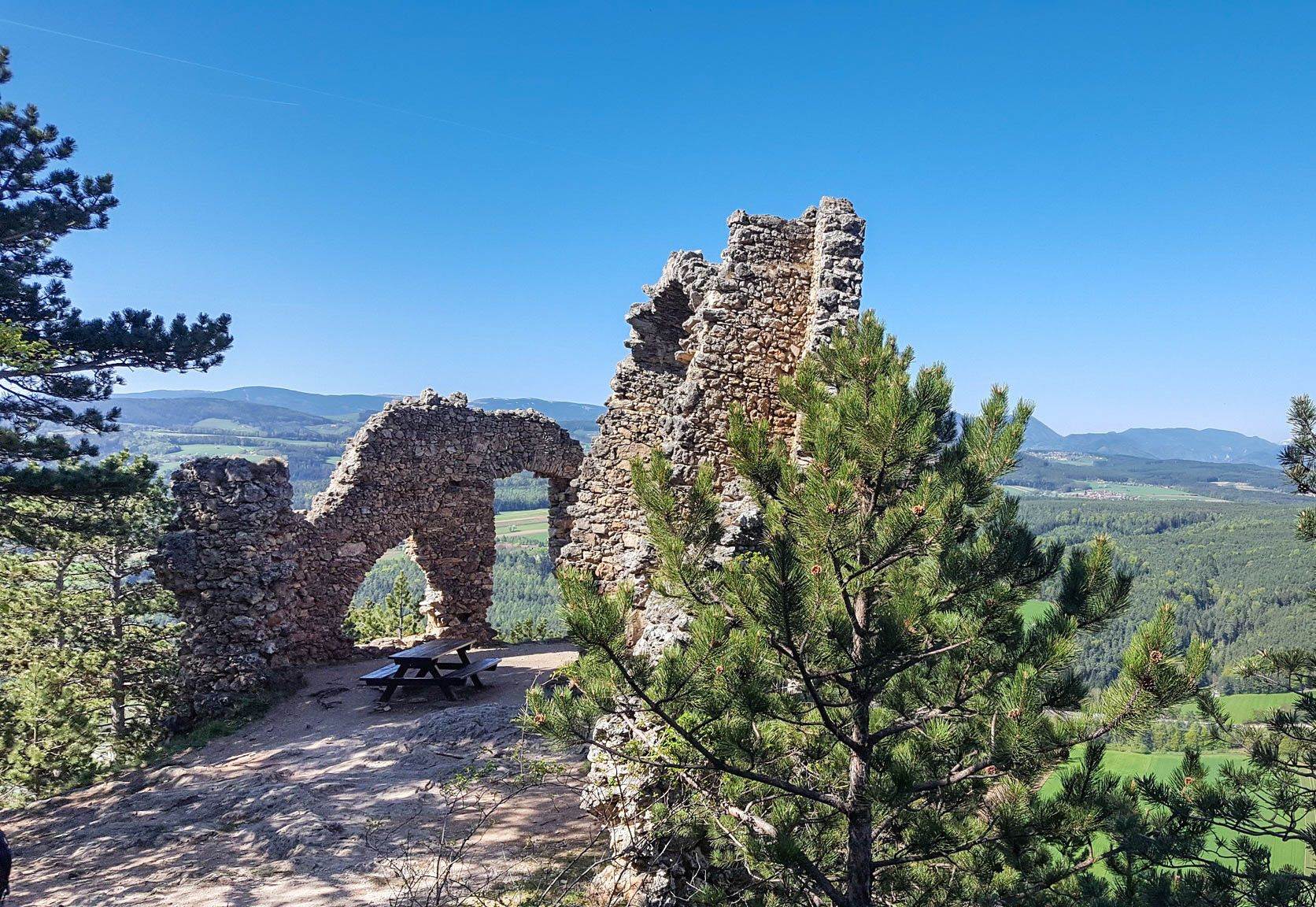
In September 1532, a Turkish army was decisively defeated near Enzesfeld-Fischau. Light Turkish horsemen (Akıncıs) were scattered into the Pittental valley. They are said to have been chased by enraged peasants over the rocks near Gleißenfeld and driven to their deaths - the "Türkensturz" (Turk's Fall). To commemorate this, Prince von und zu Liechtenstein had an artificial ruin erected here in 1824/25.
2
0
The castle, sometimes called Burg Vordergrimmenstein since the 19th century, while the former castle on the summit of the 758 m high Kulmriegel was also called Burg Hochgrimmenstein and a former castle southwest of the Kulmriegel at the end of the Kunzgraben were designated as Hintergrimmenstein.
2
0

The castle's history dates back to the 14th century, but it is shaped by the fateful days of April 1945. Commissioned by Stalin, Dr. Karl Renner spent twelve busy days at Eichbüchl Castle developing the basic structures of the Second Republic. At the same time, he prepared the formation of a provisional government, and as its Chancellor, he finally announced Austria's declaration of independence in Vienna on April 27, 1945. Eichbüchl Castle thus found its indelible place in the history books as the birthplace of the Second Republic. More on the history: https://de.wikipedia.org/wiki/Schloss_Eichb%C3%BCchl
0
1
The complex is a medieval foundation that was expanded in the 15th and 16th centuries. In the first half of the 18th century, it was in poor structural condition. Its then owner, a court master of the Bishop of Wiener Neustadt, had it repaired and converted into a castle. He also gave it a uniform, baroque appearance. In the 19th century, various changes in the historicist style followed on both the main house and the complex of outbuildings. The castle and the associated castle park are privately owned. More on the history: https://de.wikipedia.org/wiki/Schloss_Linsberg
0
0

The tower of the Turk's fall collapsed. With it, the crescent moon at the top also fell into the depths (the district papers reported). Now the crescent could be found. GLEISSENFELD (ts/e_peinsipp). The Turk's Fall is a landmark that can be seen from afar for the nature park and the hiking area with historical significance. But recently part of the ruin, which was artificially created over 200 years ago, collapsed. Parts of the boulders rolled through the forest to the hiking trails that began in the valley. Now the long-lost crescent that sat at the top of the Turk's Fall Tower could be handed over to the community again. Source: www.meinkreis.at/neunkirchen/c-lokales/tuerkenjagd-ruine-brueder-retteten-halbmond_a5996874
26
3
Open on weekends and really worth seeing! https://www.burg-grimmenstein.at/ The castle is one of three former fortifications on the Kulmriegel, which dominates the Pittental. Like the other two weir systems, it was left to decay due to the roof tax and largely removed as building material. In the 1960s, it was repaired and partially rebuilt in the neo-romantic style using the walls that were still in ruins. After further deterioration, the new owner Markus Albero Grimmenstein has been restoring 90% of the facility himself since July 2014 without public funds/funds and has been opening it to the public since April 2016.
0
0

Built in the 14th century, the castle acquired its current appearance in 1906 when a Chinese silk importer had it completely remodeled in a confectioner's style. It is also often referred to as the birthplace of the Republic of Austria. In this house in April 1945 after the invasion of the Red Army Dr. Karl Renner, who later became Chancellor and Federal President, was entrusted with the reestablishment of the Second Republic of Austria. The current lord of the castle, Mag. Dietmar Machold, acquired the building in 1997, which he has since regularly made available for concerts and cultural events.
0
1
Frequently Asked Questions
What is the historical significance of castles in the Seebenstein region?
The castles around Seebenstein offer a deep dive into Austrian history. For example, Burg Seebenstein, founded around 1045, has been owned by several noble families and withstood a Turkish siege in 1683. It also played a role in the romantic revival of chivalry. Eichbüchl Castle is notable as the birthplace of the Second Republic of Austria.
Are there guided tours available at the castles around Seebenstein?
Yes, guided tours are available at some castles. At Seebenstein Castle, visitors can explore its intriguing past and architecture through tours that typically last about an hour, including a visit to the basement torture chamber. Grimmenstein Castle also offers guided tours on weekends from March to October.
What unique architectural features can be found in the castles around Seebenstein?
Burg Seebenstein is a dual-part castle, featuring an older section with a round keep and a partially ruined palace from the 13th and 14th centuries, alongside a 'high castle' built between the 15th and 17th centuries. This blend of older and newer sections, including its 23-meter-tall keep, is a significant draw. Linsberg Castle, while a medieval foundation, was later converted into a baroque palace, showcasing a different architectural style.
Are there art collections or museums within the castles?
Yes, Burg Seebenstein houses significant collections. Around 40 rooms are set up as a museum, displaying artworks, paintings, a valuable tapestry, and a small weapon collection. It once housed the famous Seebenstein Madonna and features a Marian sculpture by Veit Stoss.
Are there hiking trails near the castles in Seebenstein?
Absolutely. The region offers several hiking opportunities that often include castle views. You can find routes like the 'Seebenstein Castle – Türkensturz Ruins loop' or the 'View of Rax and Schneeberg – Türkensturz Ruins loop'. For more details on hiking routes, visit the Hiking around Seebenstein guide.
What kind of views can I expect from the castles?
Many castles offer picturesque views. Seebenstein Castle is situated 453 meters above sea level in a beautiful forest setting, providing scenic vistas. The Türkensturz Ruins are known as a wonderful vantage point, rewarding visitors with expansive views after a steep ascent.
Are there cycling routes that pass by the castles?
Yes, there are cycling routes in the area that offer views of the castles. For instance, the 'View of Burg Seebenstein – Türkensturz Ruins loop' is a moderate cycling route. You can explore more options in the Cycling around Seebenstein guide or the Road Cycling Routes around Seebenstein guide.
Are the castles around Seebenstein family-friendly?
Yes, Seebenstein Castle is considered family-friendly. Its guided tours offer an engaging way for all ages to learn about history, and the various paths to reach the castle, including the 'Donkey Path' (Eselsteig), can be an adventure for children.
What is the best time of year to visit the castles in Seebenstein?
The period from spring to autumn is generally ideal. Grimmenstein Castle, for example, offers guided tours from March to October. The scenic forest settings around Burg Seebenstein are particularly beautiful during these seasons, making for pleasant walks and tours.
Are there any hidden gem castles in the Seebenstein area?
Burg Seebenstein itself is often considered a hidden gem, offering an enriching experience away from mass tourism due to its serene beauty and secluded location. Its extensive history and collections make it a worthwhile discovery.
Can I visit castles that are privately owned?
Some castles in the region are privately owned and not publicly accessible, such as Eichbüchl Castle and Linsberg Castle. While you cannot enter these, Linsberg Castle can still be admired from the street, and it's located near the Schwarzatal cycle path.
What do visitors enjoy most about the castles in Seebenstein?
Visitors frequently praise the impressive exteriors and well-appointed interiors of castles like Seebenstein Castle, especially during guided tours. The scenic locations and the historical significance of sites like the Türkensturz Ruins, which offer rewarding views, are also highly appreciated by the community.
Most popular routes around Seebenstein
Most popular attractions around Seebenstein

Get inspired with the komoot mobile app


Explore more
Looking for the best castles somewhere else? Discover other guides around Seebenstein:
