The best walks and hikes around Casillas De Coria
4.1
(9)
75
hikers
20
hikes
Hiking around Casillas De Coria offers routes through the flat, agricultural landscapes of the region, often following river courses and irrigation canals. The terrain is generally level, with minimal elevation changes, making it suitable for various activity levels. Trails frequently connect local towns with historical or cultural sites, providing insight into the area's heritage. The network of paths navigates through open fields and along waterways, characteristic of the Extremaduran plains.
Best hiking trails around Casillas De Coria
- The most popular…
Last updated: November 16, 2026
4.0
(1)
5
hikers
17.2km
04:23
50m
50m
3.0
(1)
9
hikers
10.6km
02:46
80m
80m
Moderate hike. Good fitness required. Easily walkable paths.

4
hikers
8.40km
02:14
90m
90m
3
hikers
10.8km
02:47
50m
50m
1
hikers
12.5km
03:21
150m
150m
Get access to more routes and recommendations from other explorers.
Already have an account?
Our route recommendations are based on thousands of hikes, rides, and runs completed by other people on komoot.
Start today with a free account
Your next adventure awaits.

Tips from the Community

The bridge..... ...... eye
1
0

Located outside the city of Coria, in the natural area of the ancient Dehesa de Malpartida, the sanctuary is close to the edge of the cliff formed by the Alagón River. According to the Coria Charter from the 13th century, it stands in the same place where a small medieval chapel probably existed. Part of the remains of the extensions carried out in the 16th century are still preserved. These extensions were carried out to house the venerated Romanesque-Gothic Marian carving, possibly made in Leonese workshops. The image of the Virgin rests in her dressing room (added in 1880) and is framed by a beautiful Rococo altarpiece from 1774. A visit to this sanctuary will allow you to appreciate its uniqueness, beauty and devotion to the Patroness of Coria! 🙏🌟
3
0
The Iron Bridge in Coria is a beautiful civil work of metal architecture and nineteenth-century modernist design. It was built by the Asturian engineers D. Salvador and D. Próspero Ardura. The bridge stands over the Alagón River, connecting both banks in the City of Coria. Its total length is 178.30 meters, and its deck has a width of 7.78 meters, with a two-way road flanked by two sidewalks.
9
0
The Medieval Bridge of Coria is a historical structure that is located next to the main façade of the Monastery of San Juan Bautista or Corias. Its construction had the objective of connecting the monastery with the town of Corias. Although its foundations are believed to be of Roman origin, the bridge was rebuilt in 1571, as indicated by an inscription preserved on one of the stones of its parapet.
8
0
Founded before the Romans occupied the Iberian Peninsula, Coria was known as Cauria or Caurus. The Romans gave it its current Latin name, CAVRIUM. Later, he was granted Roman citizenship. In the Visigothic era, the Diocese of Coria was created, which maintained Coria as an episcopal see until the 20th century. After the Reconquista, Coria became the capital of a manor to which towns that still bear the name of Coria belonged, such as Guijo de Coria or Casillas de Coria.
8
0
Moraleja is a Spanish municipality, located in the province of Cáceres, autonomous community of Extremadura. It includes the town of the same name and an extensive municipal area in which there are several small hamlets and colonization towns such as Cañadas and Rozacorderos.
8
0

Moraleja is a small town in the Sierra de Gata region on the Gata river. Here there are natural pools, shady walks and beautiful areas to explore.
1
0
This natural viewpoint is located about 9 kilometers from Coria. From here you can see the beautiful Valle del Alagón, the Sierra de Gata, where the Pico Jálama stands out, and even the Sierra de la Estrella in Portugal.
1
1
Frequently Asked Questions
What kind of terrain can I expect on hiking trails around Casillas De Coria?
The hiking trails in Casillas De Coria are characterized by flat, agricultural landscapes, often following river courses and irrigation canals. The terrain is generally level, with minimal elevation changes, making it suitable for various activity levels across the Extremaduran plains.
Are there easy hiking options suitable for beginners or those seeking a relaxed walk?
Yes, Casillas De Coria offers a good selection of easy hikes. Approximately half of the 18 available routes are classified as easy, providing gentle paths through the region's flat terrain and along waterways.
Are there any trails that feature waterfalls or interesting water features?
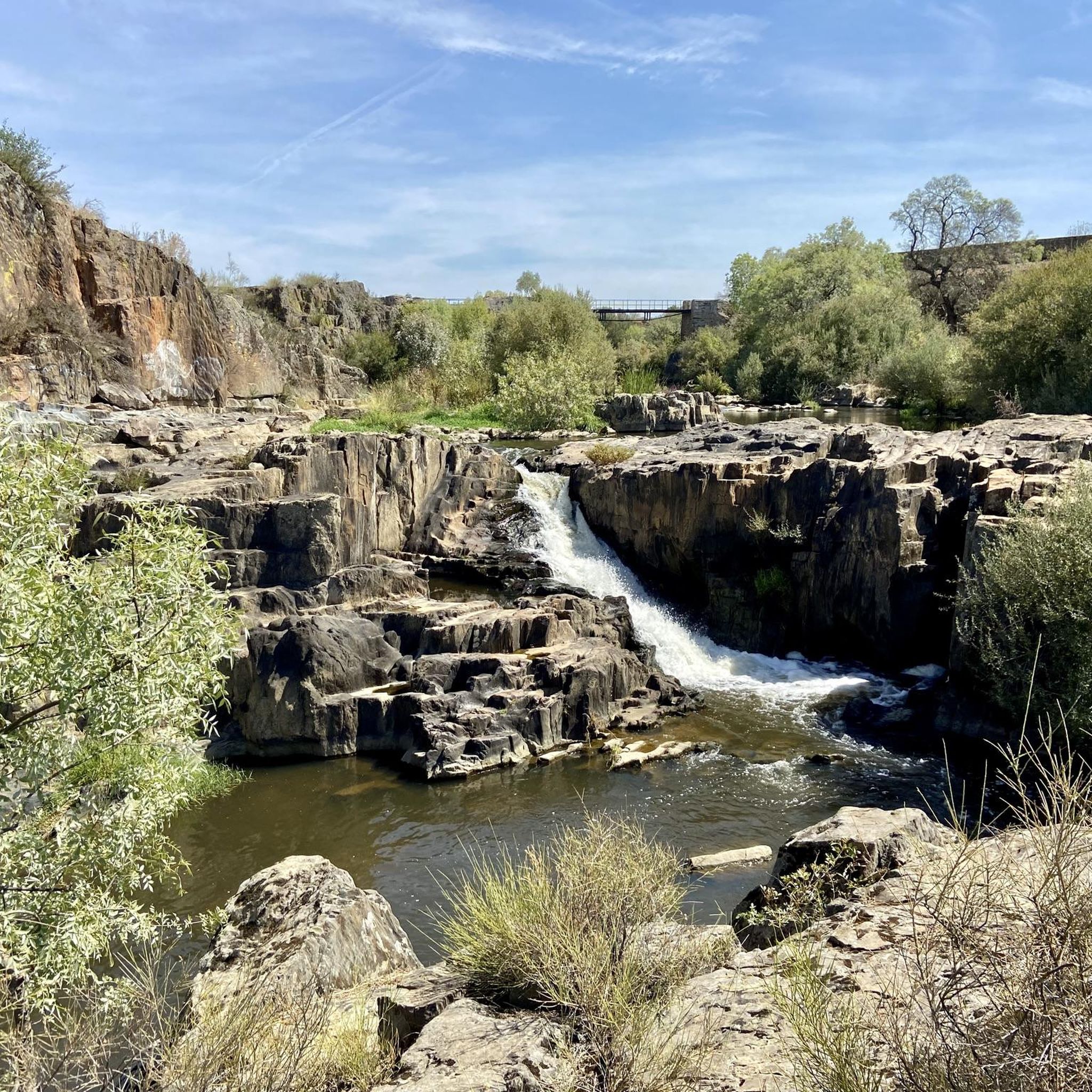
Yes, the region has notable water features. The Trail to El Chorrerón leads to a significant water feature, and you can also visit the El Chorrerón Waterfall and Stone Bridge, which is a highlight in the area.
What are some notable landmarks or historical sites I can see while hiking?
Many trails connect local towns with historical or cultural sites. For example, the Coria to Ermita Virgen de Argeme route connects the town of Coria with a local hermitage. Other highlights include the Iron Bridge of Coria and the Medieval Bridge of Coria.
Are there any circular hiking routes available in Casillas De Coria?
While specific circular routes are not detailed in the general overview, many trails in the region are designed to explore local areas and return to their starting points, especially those connecting towns or following canals. You can filter for circular routes on komoot to find options like the Route of the Canals, which offers a loop-like experience through agricultural areas.
What do other hikers enjoy most about the trails in Casillas De Coria?
The trails in Casillas De Coria are highly rated by the komoot community, with an average score of 4.4 stars from 9 reviews. Hikers often praise the peaceful rural paths, the ease of access to local landmarks, and the generally flat terrain suitable for a relaxed outdoor experience.
Is it possible to reach hiking trails in Casillas De Coria using public transport?
Public transport options to specific trailheads might be limited in this rural region. It's advisable to check local bus schedules for connections to nearby towns like Coria, from where some trails may be accessible, but direct access to all trailheads via public transport is not guaranteed.
Are there any less crowded hiking trails for a more tranquil experience?
Given the region's rural nature and the focus on agricultural and riverine paths, many trails offer a tranquil experience away from large crowds. Routes like the Rincón del Obispo Trail or the Vía Dalmacia Trail traverse open fields and quiet areas, providing a peaceful escape.
What is the best time of year to go hiking in Casillas De Coria?
The region experiences hot summers, so spring (March to May) and autumn (September to November) are generally the most pleasant times for hiking, offering milder temperatures. Winter can also be suitable, though some paths might be muddy after rain.
What kind of flora and fauna can I expect to see on the trails?
Hiking through the agricultural landscapes and along river courses, you can expect to see typical Extremaduran flora, including olive groves, cork oaks, and riverside vegetation. The area is also home to various bird species, making it interesting for birdwatching, especially near water sources.
Are there opportunities for wild swimming after a hike in Casillas De Coria?
While the trails often follow river courses and irrigation canals, specific designated or safe wild swimming spots are not explicitly highlighted in the guide data. It's important to exercise caution and check local regulations regarding swimming in natural waters.
What should I bring for hiking in Casillas De Coria, especially during summer?
During summer, essential items include plenty of water, sun protection (hat, sunscreen), and lightweight, breathable clothing. Even in other seasons, comfortable walking shoes, a map or GPS device, and snacks are recommended for any hike in the region.
Most popular attractions around Casillas De Coria

Get inspired with the komoot mobile app


Explore more
Browse the best Hikes in other regions.
