The best road cycling routes around Amilly
4.4
(166)
3,939
riders
43
rides
Road cycling routes around Amilly traverse a landscape characterized by the Eure River and its banks, offering varied terrain for cyclists. The region features a mix of open countryside, small villages, and historical points of interest. Elevation changes are generally moderate, with some routes including gentle climbs and descents. The area provides a network of paths suitable for exploring the local environment by road bike.
Best road cycling routes around Amilly
- The most popular road cycling route is Eure Riverside…
Last updated: July 29, 2026
5.0
(2)
38
riders
66.3km
02:43
300m
290m
Moderate road ride. Good fitness required. Mostly well-paved surfaces and easy to ride.
9
riders
92.8km
03:52
310m
310m
Moderate road ride. Good fitness required. Some segments of this route may be unpaved and difficult to ride.

Sign up for free
5
riders
58.7km
02:20
250m
250m
Moderate road ride. Good fitness required. Mostly well-paved surfaces and easy to ride.
6
riders
46.6km
01:50
170m
170m
Easy road ride. Great for any fitness level. Mostly well-paved surfaces and easy to ride.
5
riders
40.7km
01:37
140m
130m
Easy road ride. Great for any fitness level. Mostly well-paved surfaces and easy to ride.
Get access to more routes and recommendations from other explorers.
Sign up for free
Already have an account?
Our route recommendations are based on thousands of hikes, rides, and runs completed by other people on komoot.
Start today with a free account
Your next adventure awaits.
Login or Signup


Tips from the Community

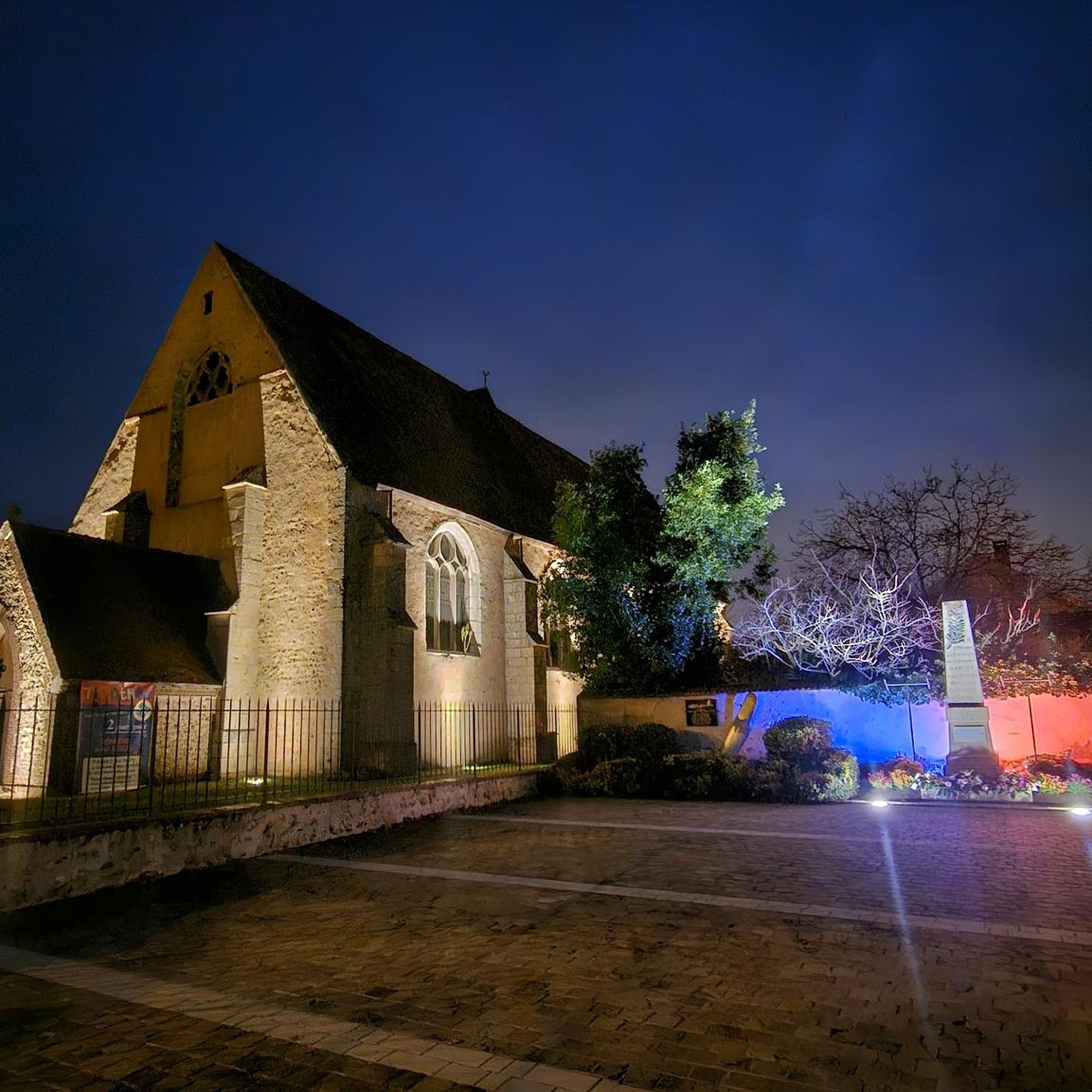
The main nave, ending in a semicircular apse, is preceded by a timber-framed porch and opens to the north onto a chapel through a wide archway. The timber-framed bell tower, clearly from the same period as the 17th-century wainscoting, rests on a base spanning the nave. A second nave is covered with quadripartite masonry vaults from different periods. Of a dressed stone tower, only the spiral staircase and the first level remain, built between the 11th and 13th centuries. The side aisle was built in the 14th century and enlarged in the 16th. 1660: Supposed collapse of the tower attached to the nave, of which only the first level remains. 1679: Paneling on the nave and probable construction of the small timber-framed spire. 19th century: Supposed construction of the timber-framed chapel. The church was under the jurisdiction of the chapter of Notre-Dame de Chartres (the chapter's name can be seen on the lock of the small door on the right and is painted on the walls of the capital with stars and the date 1733 L.M.M.P.).
0
0
Of Romanesque origin, the church, surrounded by a cemetery, has a curious bell tower supported by machicolations and uprights of sandstone, making it one of the most unique in the region. Perhaps it was originally a bell gable, later augmented by a platform supported by these machicolations? In front of the entrance, a small building called a "caquetoire" (a small meeting place) allows the faithful to gather and converse. Inside the church, the furnishings date from the 18th and 19th centuries: a marble high altar and its gray-painted wooden altarpiece (18th century) – a painted wooden altarpiece of St. Joseph (late 18th or early 19th century) an altarpiece for the altar of the Virgin Mary (19th century) a baptismal font in red-veined marble (19th century) a waxed wooden pew (18th century) a waxed wooden choir stall upholstered in velvet paintings: the Assumption of the Virgin Mary by Octave Hauser (1839) and the Annunciation (18th century) The stained-glass windows date from 1874. The church and the eclipse A bit of history: The parish, established in the 13th century, was part of the deanery of Courville. The church's patron saint, Luperche or Luperchius, gave his name to the village. We must go back to the 4th century to find the first trace of this saint: At that time, Dacius, governor of the part of Spain that included Catalonia, Aragon, and the Kingdom of Valencia, was one of the most cruel ministers of persecution. Incited by the emperors Diocletian and Maximilian, he had eighteen confessors of Jesus Christ executed in the city of Zaragoza. In their honor, the poet Prudentius wrote hymns, and among these confessors, a certain martyr named Luperche became the patron saint of our church.
0
0
The church of Cernay is a small rectangular building standing in the middle of its cemetery, surrounded by fields. It consists of a single nave, the chancel of which was demolished at an undetermined time and replaced by a sacristy attached to the east. A small, round-arched window on the south facade, though quite wide and only slightly splayed, might suggest an earlier Romanesque origin. The other pointed-arch openings are likely later additions. The nave has a pointed barrel vault made of wood. The timber frame, independent of the masonry, reveals the tie beams and rests on a series of posts. The numerous mortise marks on the longitudinal beams support the hypothesis that a barn frame was reused, without reinforcement after the original frame burned down. The most charming part of the chancel before its restoration is undoubtedly the west gable surmounted by a bell gable pierced by two semicircular arched openings, an architectural form of which only three or four examples are known in the Eure-et-Loir department. The building is entered through a portal whose basket-handle arch structure is surrounded by a rood screen. Buttresses with sloping sides reinforce the structure and are doubled at the corners of the bell gable. Inside, a rood beam separates the chancel from the rest of the nave; the furnishings and altars appear to be part of the 19th-century alterations. A first campaign of work concerning the repair of the exterior masonry was supported by the Sauvegarde de l’Art Français with a contribution of 25,000 F in 1993. To preserve its originality to the vaulting, a second campaign was undertaken to restore the framework, an operation to which the Sauvegarde de l’Art Français contributed with a sum of 100,000 F also in 1993.
0
0
According to tradition, the church choir covers the remains of an older building, possibly dating back to the 6th century, which was built to house the saint's body. According to current knowledge, the commune of Saint-Piat (Sanctus Piatus in Latin) officially appeared in 1087, mentioned in a charter of the Nottonville Priory (Eure-et-Loir), on which it depended. The current building was rebuilt during the time of Francis I, as suggested by the date 1535 engraved on two buttresses of the apse and the date 1542 engraved on a piece of wood from the vault. This is according to a study by the SAEL (Eure-et-Loir Archaeological Society). The three-sided apses, the dripstone towers (horizontal members projecting from a wall), and the sculpted roof structures are a testament to the importance of the reconstructions carried out in the department during the 16th century. The church of Saint-Piat is one of them. While the church has not been officially recognized, it nevertheless contains objects that have attracted attention both for their antiquity and quality, but not always for good reason. Their artistic value, far from attracting only religious or aesthetic interest, has also aroused a covetousness that, unfortunately, remains for some of them. Fortunately, those still in place are carefully cared for and offer the curious a story to discover, a beauty to slowly ponder as they progress toward the choir.
0
0


Unfortunately, the church was not accessible when I visited (mid-September 2024). You could only look in through a gate and the dance of death depictions on the left side were not really visible. In front of them were transparencies with skeleton drawings. Maybe those were the depictions...
0
0
A modest place of worship, built in the middle of a tiny village, the Favril church was there as early as 1250. Under the reign of Saint Louis, Saint-Pierre du Favril was already there. This is confirmed by a register of the diocese of Chartres, drawn up in 1250, which mentions a parish church dedicated to Saint-Pierre au Favril (Faverilium). The text adds that there was a priest and 56 parishioners.
0
0
This church has Saint Martin as patron or rather protector, chosen for his holiness, example of charity, faith and mercy. This charity he showed by offering half of his coat to a shivering poor man to warm him. His radiant faith as a hermit and monk, founder in Ligugé in 460 of the first monastic community in Gaul...
0
0
Frequently Asked Questions
How many road cycling routes are available around Amilly?
There are over 40 road cycling routes around Amilly, offering a variety of options for different skill levels and preferences. The komoot community has explored nearly 3,000 of these routes.
Are there easy road cycling routes suitable for beginners in Amilly?
Yes, Amilly offers 11 easy road cycling routes perfect for beginners or those looking for a relaxed ride. One popular option is The banks of the Eure – Saint Peter's Church loop from Amilly Ouerray, which is 24.8 miles (39.9 km) long and offers scenic views along the Eure River.
What kind of terrain can I expect on road cycling routes around Amilly?
Road cycling routes around Amilly feature a diverse landscape, characterized by the Eure River and its banks. You'll encounter a mix of open countryside, charming small villages, and historical points of interest. Elevation changes are generally moderate, with gentle climbs and descents.
Are there any challenging road cycling routes for experienced cyclists?
While Amilly's routes are generally moderate, with 31 routes classified as such, there are no routes specifically rated as 'difficult'. The longer moderate routes, such as Eure Riverside Walk – Lavoir de Soulaires loop from Amilly Ouerray, which is 57.8 miles (93.0 km) with over 330 meters of elevation gain, can provide a good workout for experienced riders.
What do other road cyclists enjoy the most about road cycling in Amilly?
The area is highly rated by the komoot community, with an average score of 4.4 stars from over 100 reviews. Reviewers often praise the varied terrain, including riverside paths, open countryside, and passages through picturesque villages, making for an engaging cycling experience.
Are there circular road cycling routes around Amilly?
Yes, many of the road cycling routes around Amilly are loops, allowing you to start and end at the same point. Examples include Eure Riverside Walk – Lavoir de Soulaires loop from Amilly Ouerray and Fontaine-la-Guyon – Saint Martin Church loop from Amilly Ouerray.
What are some scenic highlights or viewpoints along the road cycling routes?
Many routes follow the Eure River, offering picturesque riverside views. You can also pass by historical landmarks such as the Chartres Cathedral or the Guillaume Gate. The routes often traverse open countryside, providing expansive views of the region.
Are there any family-friendly road cycling options in Amilly?
For families, the easier routes with less traffic and flatter sections along the Eure River are ideal. The The banks of the Eure – Saint Peter's Church loop from Amilly Ouerray is an easy 24.8-mile (39.9 km) path that could be suitable for families looking for a moderate distance.
What is the best time of year for road cycling in Amilly?
The region's moderate climate generally makes spring through early autumn the most pleasant seasons for road cycling, with comfortable temperatures and vibrant landscapes. Always check local weather forecasts before heading out.
Are there places to stop for refreshments or cafe stops along the routes?
The routes often pass through small villages, which may offer opportunities for cafe stops or local shops to grab refreshments. Planning your route in advance and checking for services in villages like Fontaine-la-Guyon can help ensure you have convenient breaks.
What are some notable attractions I can explore near the road cycling routes?
Beyond the cycling, you can explore historical sites like the magnificent Chartres Cathedral, or visit the city of Chartres itself, which is often a point of interest on longer routes.
Where can I find parking near the starting points of road cycling routes in Amilly?
Many routes, such as those starting from Amilly Ouerray, are designed to be accessible. While specific parking details for every route are not provided, starting points in or near villages typically offer public parking facilities. It's advisable to check maps for designated parking areas in the vicinity of your chosen route's start.
How long do road cycling routes around Amilly typically take to complete?
Route durations vary significantly based on distance and your cycling speed. For instance, an easy route like The banks of the Eure – Saint Peter's Church loop from Amilly Ouerray (24.8 miles / 39.9 km) takes about 1 hour 35 minutes, while a longer moderate route such as Eure Riverside Walk – Lavoir de Soulaires loop from Amilly Ouerray (57.8 miles / 93.0 km) can take around 3 hours 44 minutes.
Most popular attractions around Amilly

Get inspired with the komoot mobile app


Explore more
Browse the best Road cycling routes in other regions.
