Attractions and Places To See around Pern - Top 20
Best attractions and places to see around Pern are found in the Lot department of south-western France, a region known for its natural beauty and historical significance. The area, including the former commune of Pern, is situated near the Lot river, offering a landscape of river valleys and charming villages. Visitors can explore a variety of historical sites, architectural marvels, and scenic viewpoints that reflect the rich heritage of the Quercy Blanc area.
Best attractions and places to see around…
Last updated: November 15, 2026
Valentré Bridge
Highlight • Monument
Showing Translation
Tip by

Saint Stephen's Cathedral
Highlight • Religious Site
Construction began in the late 11th century, but it is said to have taken another 400 years to complete.
Translated by Google •
Tip by

Sign up now to discover places like this
Get recommendations on the best single tracks, peaks, & plenty of other exciting outdoor places.
Mont Saint-Cyr viewpoint overlooking Cahors
Highlight • Viewpoint
Translated by Google •
Tip by

Cahors Railway Bridge
Highlight • Bridge
Translated by Google •
Tip by

water clock
Highlight • Other
Translated by Google •
Tip by

Sign up for free to discover even more attractions around Pern.
Already have an account?
Start today with a free account
Your next adventure awaits.

Tips from the Community

An essential monument of the Occitanie region, it is distinguished by its large domes on pendentives, among the largest in France. The cathedral is doubly classified: as a Historic Monument in France and as a UNESCO World Heritage Site as part of the Routes of Santiago de Compostela.
0
0
In Cahors, there isn't strictly a water clock (or clepsydra), but the city is home to a famous and unusual monumental ball clock. Located on Place Saint-Urcisse, in the heart of the old town, this kinetic work of art is often associated with water as it sits in the middle of a U-shaped fountain. It is a monumental mechanical clock weighing 2 tons and standing 3.5 meters high. It operates without electricity for its pendulum movement: its energy comes exclusively from the weight of 54 steel pinball balls (weighing 80 grams each) descending along metal rails. An unusual performance: The mechanism consumes 640 grams of balls per minute, or nearly 921 kg per day. The balls travel approximately 18,000 km per year within the structure. Once they reach the bottom, the balls are automatically rewound thanks to a small mechanical system.
0
0

Two large domes dominate the Romanesque nave. They represent the most extraordinary example of the so-called "Aquitanian" architectural style: 16 meters in diameter and 32 meters high; only the Hagia Sophia in Istanbul has a taller dome. Also noteworthy is the small, golden church of Saint-Svair, with its large statue of Emperor Charlemagne, who presented it to the church of Cahors.
2
0

Worth seeing cathedral in Cahors.
0
0

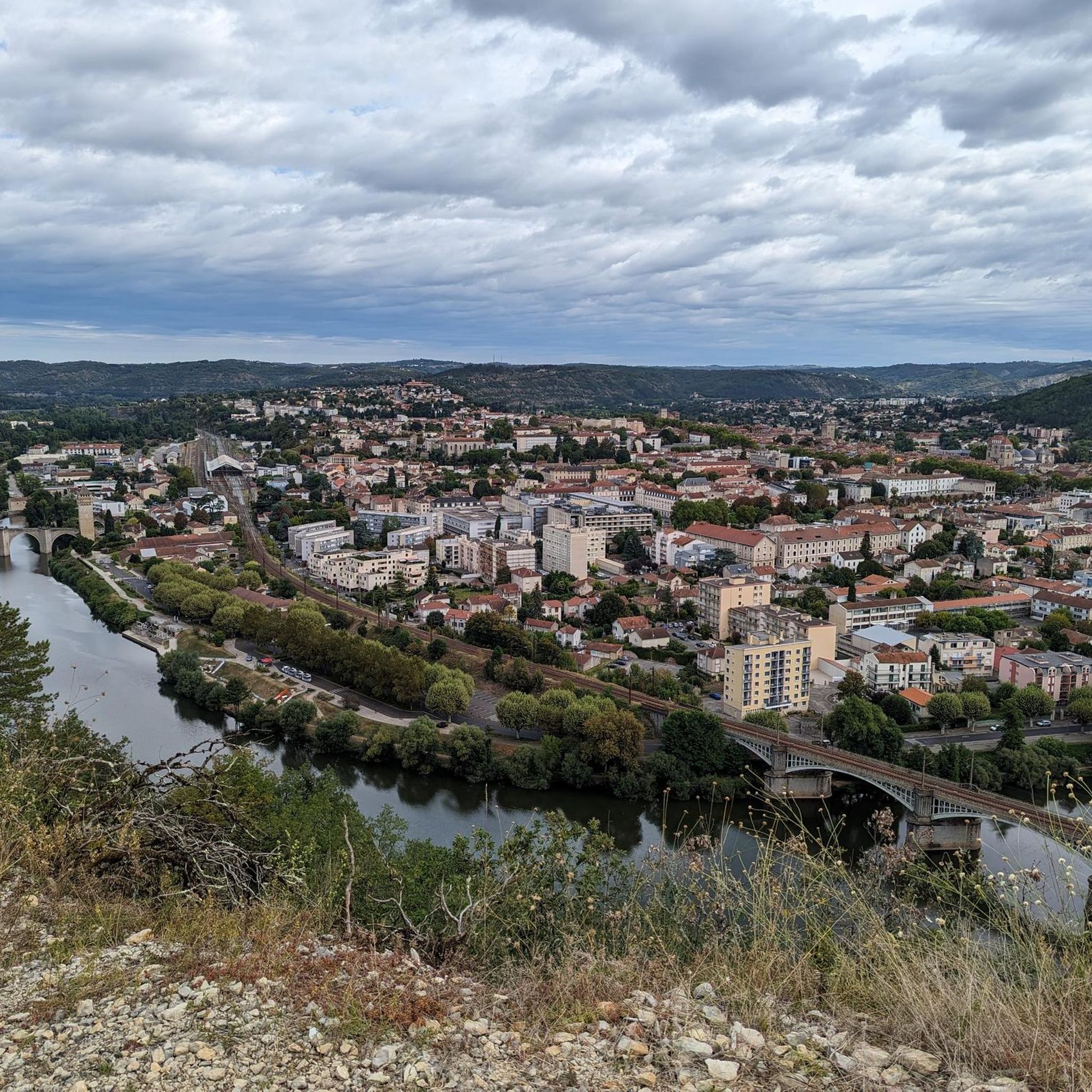
Here the hiker or pilgrim has the town of Cahors and the river Lot at his feet, a truly picture-book view.
1
0

This St. Etienne Cathedral impressed us deeply again! The building dates back to the 11th century and is very unique with its two domes. Only in Perigeux is there a cathedral with similar architecture. The special feature is the Saint Coiffe, a fabric relic in which the veil of Jesus from the tomb is venerated. In one dome you can see frescoes of saints, in the middle of St. Stephen, the first martyr of the Christians in Jerusalem. During our visit (September 2024), pictures by the late impressionist painter Henri Martin were projected onto the other gray dome. It is worth spending some time in the cathedral!
1
0

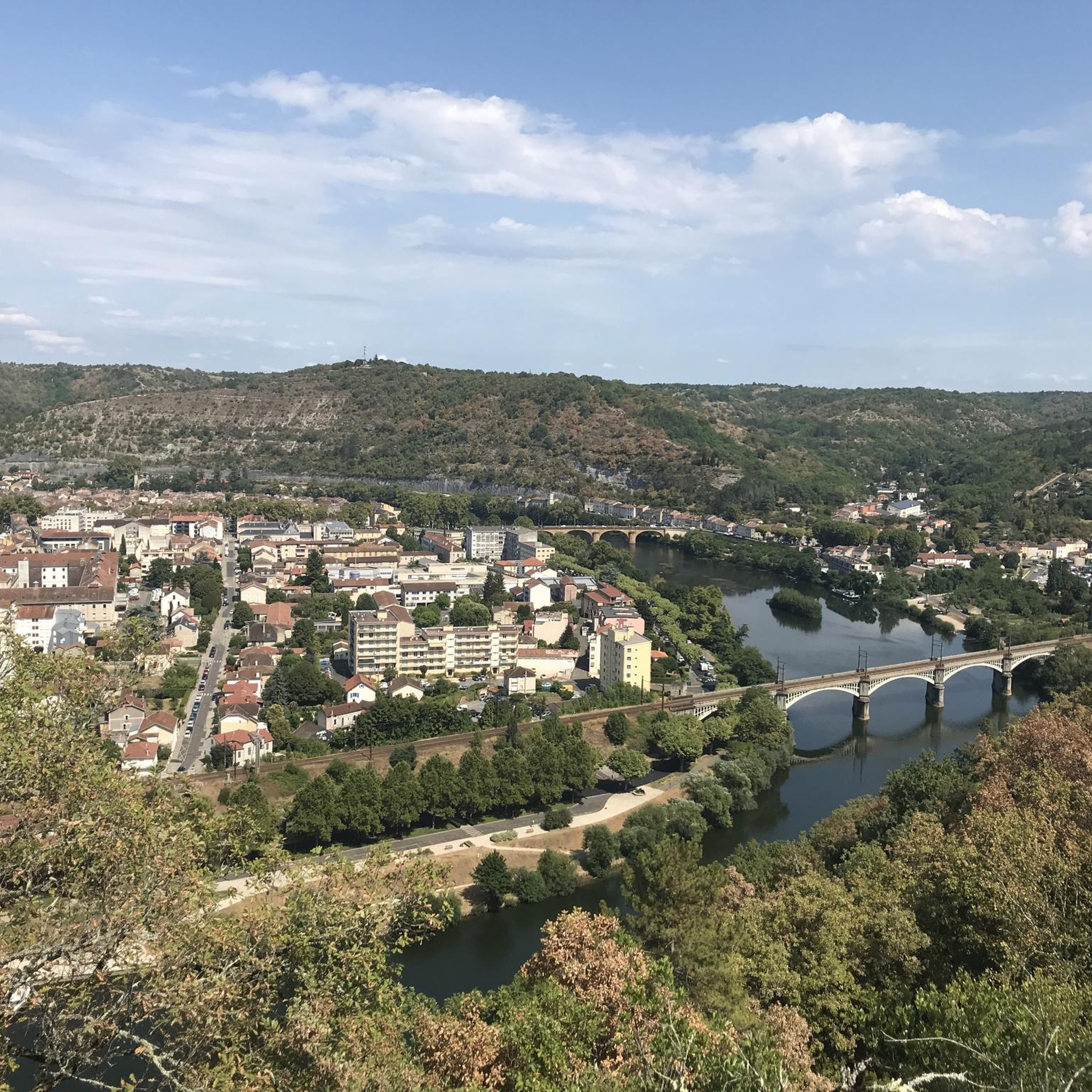
This railway bridge was built on the Montauban-Brive line, an axis declared of public interest because it corresponded to the shortest route between Toulouse and Paris. Built at an angle to the riverbed, it combines traditional techniques and implementations typical of industrial architecture. The structure was built between 1880 and 1883 by the engineers Jean LANTEREIS and Jean-Louis LACAZE, employed by the Fives-Lille company. It consists of 5 arches with an opening of 36 meters. The pillars decorated with pilasters are made of hewn Cantal granite. The industrially manufactured metal trusses were melted down in the Fourchambault workshops on behalf of the Orléans company and transported to the location by rail.
1
0
This monumental ball-bearing clock was donated to the city of Cahors in 1997. Designed by Michel Zachariou, it took two years of work. A total of 54 pinball machines, each weighing 80 grams, keep the clock ticking. According to the designer, it can last forever as long as it is maintained.
0
0
Frequently Asked Questions
What types of attractions can I expect to find around Pern?
The area around Pern, located in the Lot department of south-western France, is rich in historical sites, architectural marvels, and scenic viewpoints. You'll discover medieval bridges, religious buildings with unique styles, and natural vistas, particularly concentrated in and around the nearby city of Cahors.
Are there any notable historical sites or monuments near Pern?
Yes, the region boasts significant historical sites. The most popular is the Valentré Bridge in Cahors, a defensive medieval bridge built from 1308. Another is Saint Stephen's Cathedral, also in Cahors, which showcases a blend of Romanesque and Gothic architecture dating back to the late 11th century.
Where can I find the best panoramic views of the area?
For breathtaking panoramic views, visit the Mont Saint-Cyr viewpoint overlooking Cahors. From this elevated position, you can clearly see Cahors nestled within a large bend of the Lot river and the surrounding valley. It's also a great spot for a picnic.
Are there family-friendly attractions around Pern?
Many attractions in the area are suitable for families. The Valentré Bridge and Saint Stephen's Cathedral offer historical exploration, while the Mont Saint-Cyr viewpoint provides open space and scenic beauty for all ages.
What do visitors particularly enjoy about the Valentré Bridge?
Visitors are often impressed by its immaculate condition and unique defensive architecture, including its three towers. The bridge is also known for the legend of the 'Devil's Bridge,' with a carved stone depicting the devil, adding a fascinating story to its history.
What makes Saint Stephen's Cathedral unique?
The cathedral is notable for its unique architectural blend, featuring Byzantine cupolas, Romanesque-style portals, and Gothic arches. Its facade resembles a medieval castle, reflecting the multiple modifications and extensions it underwent from its late 11th-century origins.
Are there opportunities for cycling or gravel biking near Pern?
Yes, the region offers various routes for cycling enthusiasts. You can explore routes like the 'Boisse Mill – Boisse windmill loop' for touring bicycles or the 'Cazelle de Trespoux – Labastide-Marnhac loop' for gravel biking. For more details, check out the Cycling around Pern and Gravel biking around Pern guides.
Are there any hiking or walking trails around Pern?
While specific hiking trails directly from Pern are not detailed, the Lot department is known for its natural beauty, offering many walking opportunities. The Mont Saint-Cyr viewpoint is located along the Way of Saint-Jacques, indicating walking paths in the area. For road cycling, there are routes like the 'Molieres loop' which can also be explored on foot. Refer to the Road Cycling Routes around Pern guide for more ideas.
What is the best time to visit the attractions around Pern?
The Lot department is known for its natural beauty, suggesting that spring and autumn offer pleasant weather for exploring historical sites and enjoying scenic viewpoints without the peak summer heat. These seasons are ideal for outdoor activities like walking and cycling.
Are there any natural monuments or unique natural features to see?
Yes, you can visit The Chartreux Fountain in Cahors. This natural monument has historical significance, serving as a center of worship in Celtic times and later providing drinking water to the town. It's a unique Vauclusian spring with a depth of 137 meters.
What is the significance of the Cahors Railway Bridge?
The Cahors Railway Bridge is an impressive example of 19th-century industrial architecture. Built between 1880 and 1883, it was a crucial part of the Montauban-Brive line, providing the shortest route between Toulouse and Paris. Its construction combined traditional techniques with industrial implementations, featuring five arches and pillars made of hewn Cantal granite.

Get inspired with the komoot mobile app


Explore more
Still not found the Highlight you’re looking for? See guides of the top attractions in other regions:
