The best road cycling routes around Écurat
4.3
(82)
2,477
riders
451
rides
Road cycling around Écurat, a rural commune in Charente-Maritime, France, offers access to a network of quiet country roads and varied terrain. The area features gentle hills, river valleys, and vineyards, with altitudes ranging from 14m to 69m. Its proximity to Saintes provides opportunities to combine rides with visits to historic sites. The region is known for its cycling-friendly landscape, including sections of the Flow Vélo route.
Best road cycling routes around Écurat
- The most popular road cycling route is…
Last updated: November 1, 2026
30
riders
Easy road ride. Mostly well-paved surfaces and easy to ride.
21
riders
42.9km
01:48
230m
230m
Easy road ride. Mostly well-paved surfaces and easy to ride.

17
riders
72.3km
02:55
360m
360m
Moderate road ride. Good fitness required. Mostly well-paved surfaces and easy to ride.
15
riders
43.3km
01:49
320m
320m
Moderate road ride. Good fitness required. Mostly well-paved surfaces and easy to ride.
1.0
(1)
13
riders
57.7km
02:21
290m
290m
Moderate road ride. Good fitness required. Mostly well-paved surfaces and easy to ride.
Get access to more routes and recommendations from other explorers.
Already have an account?
Our route recommendations are based on thousands of hikes, rides, and runs completed by other people on komoot.
Start today with a free account
Your next adventure awaits.



Tips from the Community


This building has three distinctive phases which illustrate the medieval transformations. From a first Romanesque construction there remains a section of wall with a small blocked bay and vestiges of the cornice with cornices on the first bay to the north of the nave as well as an arch and two bases of leaning columns on the facade. The beginning of the Gothic is visible to the north and east. On the north side, a very beautiful twin bay, with narrow lancets, still has semicircular arches inherited from the Roman Its foliage decoration evokes the beginning of the 18th century. The apse bay, in third point, already has tracery and testifies to a later phase. In the attic, traces of arches on the walls prove that the 13th century vaults were higher than those of today. In the 15th century, the building was taken over, retaining only these few sections of walls. The new construction, more homogeneous, appears as a rectangle supported, on each corner and on the long sides, by powerful buttresses. It is covered with ribbed vaults with prismatic ribs and emblazoned keys. The facade opens with a flamboyant Gothic portal, with an archivolt with hooks and fleurons, and its gable is crowned by a small quadrangular bell tower. Pointed arch bays, with flamboyant tracery. The north wall is representative of the three stages of construction of the building: the west bay is partly Romanesque, the east bay dates from the 13th century and the middle from the 15th century, while to the south the wall is consolidated by powerful buttresses. At the very end of the 15th century or the beginning of the 16th century, they wanted to open a side chapel on the first bay which was never continued, as the waiting stones show. On the reverse side of the facade, the bell tower required the construction of powerful massifs between which is placed a gallery covered with a long vault pierced by a large oculus. In Saintonge where Romanesque churches are the majority, this church is one of the rare examples of accomplished Gothic construction.
0
0

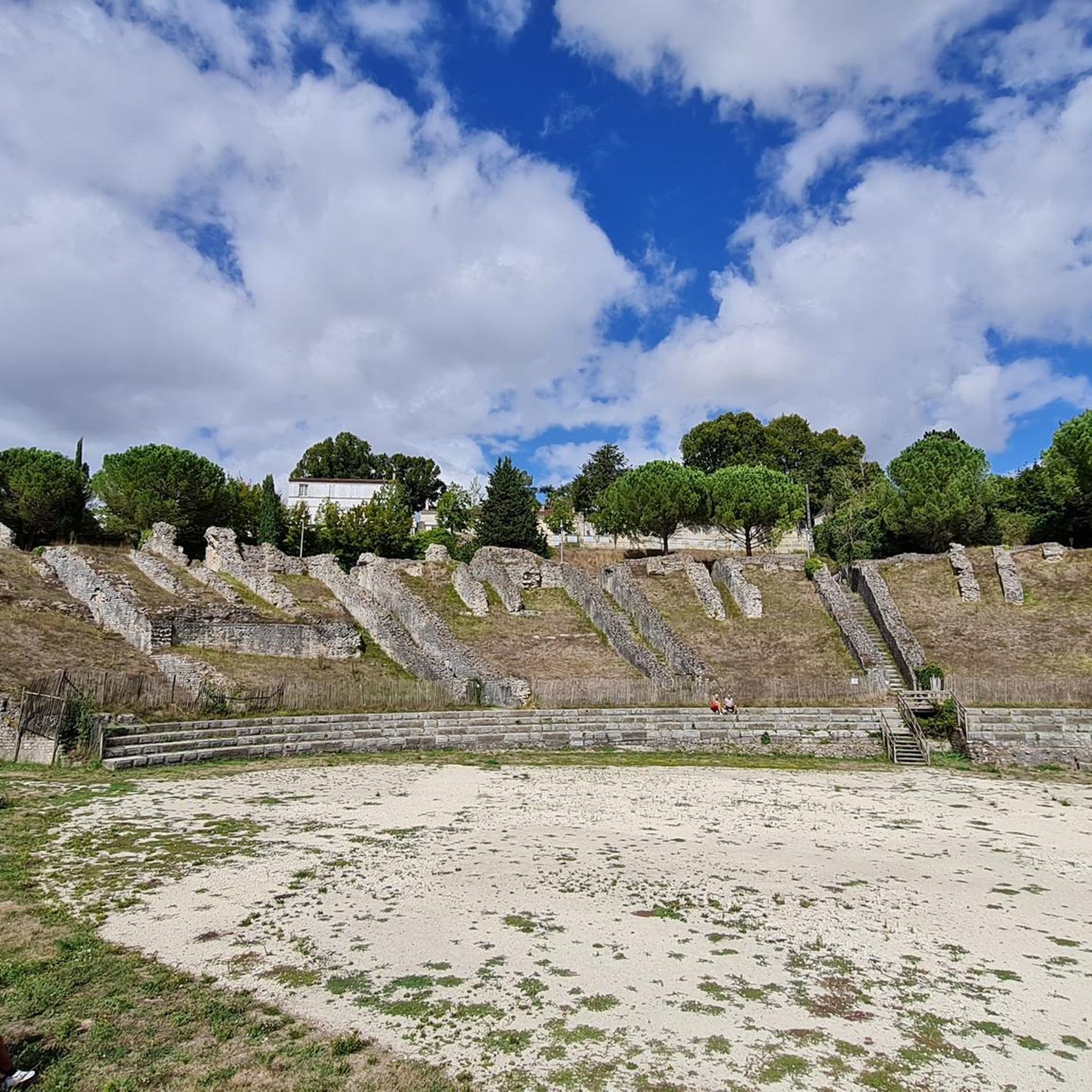
The Santons people occupied Saintonge during the Gallic era. The Romans conquered the region and settled on the banks of the Charente. The town of Saintes (then designated Mediolanum), located at the western end of the Via Agrippa which linked Lyon (capital of the Three Gauls) to the Atlantic coast, quickly became monumental. At the time of Augustus (27 BC – 14 AD), the city probably became the capital of the province of Greater Aquitaine (Aquitania). This then extended from the Loire to the Pyrenees. Mediolanum is endowed with important public monuments: the amphitheater, the arch of Germanicus, the thermal baths and the aqueduct are still partially visible today. At the time of its peak (end of the 1st century – beginning of the 2nd century), the city must have had several thousand inhabitants. The amphitheater of Mediolanum is one of the earliest in Gaul. It is estimated that its construction began during the reign of Tiberius (14 – 37 AD), and was completed during the reign of Claudius (41 – 54 AD). Like many amphitheaters of the Roman Empire, that of Saintes was located on the outskirts of the ancient city in a chosen and developed site: the “vallon des Arènes”. Thanks to a favorable topography, the builders were relieved of part of their work, the amphitheater resting on the slope of the valley. This elliptical monument, with imposing dimensions (126 meters long and 102 meters wide), made it possible to accommodate several thousand spectators around bloody and violent representations such as gladiator fights (munera) or animal hunts (venationes ). In the 3rd century, the city declined and was entrenched within an impressive rampart, built from the remains of public and funerary monuments from previous decades. The amphitheater is then no longer used. Since the Middle Ages, it has been used, among other things, as a stone quarry. It was classified as a Historic Monument in 1840. It was from this moment that it was gradually restored. Today, despite the disappearance of the superstructures, the remains provide a faithful image of what this monument could have been at the time of its splendor. The site welcomes visitors all year round. Certain objects found during various excavations in the amphitheater district are visible at the archaeological museum.
1
0

Crazannes Castle is a castle located in the commune of Crazannes in the Charente-Maritime department of France. It is known for its medieval watchtower, which was built in the 12th century. Crazannes Castle was built in the 12th century and has been owned by several noble families over the centuries. It has been expanded and modified over time, and its architecture is a mix of medieval, Renaissance and classical styles. Crazannes Castle is also home to underground caves dug into the limestone rock, which have been used as wine cellars and to store food supplies over the centuries. Visitors can explore the caves and learn about their history through guided tours. Crazannes Castle is open to the public during the summer season and offers guided tours, contemporary art exhibitions and cultural events throughout the year. It is also possible to rent rooms for private events such as weddings or receptions.
0
0

Saint-Vivien is a 12th century Saintonge Romanesque church typical of this part of France. It has been classified as a historical monument since 1907 and can also be visited from the inside.
0
0
This rather atypical-looking church is the result of several reconstruction campaigns, which spanned nearly eight centuries from the 12th to the beginning of the 20th century. The characteristic element lies mainly in its line of domes, built in 1901, and left visible. Built in cement, they give the building a false oriental air.
0
0
Charming little town remarkable for its church, having undergone numerous alterations including its facade, but the oldest part of which dates back to the beginning of the 12th century; and by its castle of the provostship. You will notice that the weather vane of its bell tower is a French flag. Indeed, under the 2nd Republic (1848-1852), a patriotic impulse resulted, with the agreement of the religious authorities, in the installation of flags on the bell towers of the churches. The St Saturnin church is one of the rare towns in the department to have kept this symbol.
1
0
Listed as a Historic Monument, the Château de Crazannes was built in the 14th century to replace an old feudal castle. Its nickname of “Château du Chat Botté” dates back to the 17th century, when it was the property of Jules Gouffier, Count of Caravaz. An eminent character who inspired Charles Perrault to create the Marquis de Carabas, Master of Puss in Boots in his famous tale. A park with century-old trees surrounds the castle and runs along the Charente. It has been included in the pre-inventory of remarkable gardens. The castle is open to visitors all year round for an entrance fee.
1
0
Frequently Asked Questions
What kind of terrain can I expect when road cycling near Écurat?
The region around Écurat offers a diverse landscape for road cyclists. While much of the Charente-Maritime is characterized by flat or gently undulating terrain, ideal for relaxed rides, sections near Saintes (just 5 km away) provide gently hilly countryside. You'll encounter quiet country roads winding through river valleys, vineyards, and classic Charentais farmland, offering a good mix of scenic beauty and varied topography.
How many road cycling routes are available around Écurat?
There are over 470 road cycling routes around Écurat available on komoot. This extensive network provides options for various skill levels and preferences, from leisurely rides through the countryside to more challenging excursions.
What is the best time of year for road cycling in Écurat?
The Charente-Maritime region, including Écurat, benefits from a mild and sunny climate, making it suitable for road cycling almost year-round. Spring and autumn generally offer pleasant temperatures and fewer crowds, while summer provides long daylight hours, though it can be warmer.
Are there road cycling routes suitable for beginners or families in Écurat?
Yes, Écurat offers numerous routes suitable for beginners and families. Over 120 easy routes are available, often utilizing small, low-traffic roads and towpaths. These routes allow for a relaxed cycling experience through picturesque villages and along the Charente River. For example, the Porche de Pont l'Abbé loop from Miclos is an easy option.
Are there any challenging road cycling routes for experienced cyclists around Écurat?
While much of the area is gently undulating, there are routes that offer more challenge. The region's varied topography, particularly near Saintes, includes sections with more elevation gain. There are 7 difficult routes available on komoot, and over 340 moderate routes that can provide a good workout for experienced riders looking for longer distances and more climbs.
What historical landmarks or attractions can I see along road cycling routes near Écurat?
Many routes around Écurat pass by significant historical and cultural sites. You can visit the Abbaye aux Dames de Saintes and the Saint-Pierre Cathedral (Saintes). Further afield, routes may lead you past charming châteaux like Crazannes Castle or the Sainte-Madeleine Church of Crazannes. The Abbaye aux Dames de Saintes – Cathedral of Saintes loop from Saint-Georges-des-Coteaux is a great route to explore these landmarks.
Are there any circular road cycling routes in the Écurat area?
Yes, many of the road cycling routes around Écurat are designed as loops, allowing you to start and finish at the same point. For example, the Porche de Pont l'Abbé – Saint Saturnin of Séchaud loop from Saint-Georges-des-Coteaux offers a moderate circular ride through the rural countryside and charming villages.
What do other road cyclists enjoy most about road cycling in Écurat?
The road cycling experience in Écurat is highly rated by the komoot community, with an average score of 4.4 stars from over 60 reviews. Cyclists often praise the quiet country roads, the picturesque river valleys, and the charming vineyards that characterize the routes. The blend of easy and moderate terrain also makes it appealing to a wide range of riders.
Can I access sections of the Flow Vélo national cycling route from Écurat?
Absolutely. Écurat is strategically located close to the Flow Vélo, a major national cycling route that follows the Charente River. You can easily access sections of this route, which offers diverse landscapes including verdant river valleys, wet woodlands, and pastures. The Flow Vélo often uses small, low-traffic roads and towpaths, perfect for road cycling. For more information, you can visit the Flow Vélo website.
Are there options for longer distance road cycling routes around Écurat?
Yes, for those looking for longer rides, there are several options. Many routes extend beyond 40 km, allowing for extended exploration of the Charente-Maritime countryside. For instance, the Porche de Pont l'Abbé – Saint-Savinien-sur-Charente loop from Saint-Georges-des-Coteaux is a moderate route spanning over 67 km.
What kind of natural features will I encounter on road cycling routes near Écurat?
Beyond the cultural sites, road cycling routes around Écurat immerse you in the natural beauty of the Charente-Maritime. You'll ride through serene river valleys, past lush vineyards, and through tranquil rural landscapes. The region's limestone quarries, such as those near Crazannes, also offer unique natural settings with distinctive vegetation.
Most popular attractions around Écurat

Get inspired with the komoot mobile app


Explore more
Browse the best Road cycling routes in other regions.
