The best road cycling routes around Luchat
4.2
(24)
980
riders
140
rides
Road cycling routes around Luchat, a commune in Charente-Maritime, offer access to varied landscapes suitable for road cyclists. The region is characterized by its proximity to major cycling arteries like the Vélodyssée and Flow Vélo, providing options for coastal, riverside, and countryside cycling. Cyclists can expect gentle slopes, quiet country roads, and dedicated greenways, with elevations generally remaining below 200 meters. The terrain includes vineyards, marshlands, and historic villages, making it accessible for various fitness levels.
Best road cycling routes…
Last updated: May 23, 2026
14
riders
Moderate road ride. Good fitness required. Mostly well-paved surfaces and easy to ride.
5.0
(1)
10
riders
47.9km
02:03
310m
310m
Moderate road ride. Good fitness required. Mostly well-paved surfaces and easy to ride.

Sign up for free
5.0
(1)
5
riders
51.2km
02:07
210m
210m
Moderate road ride. Good fitness required. Mostly well-paved surfaces and easy to ride.
6
riders
31.9km
01:23
210m
210m
Easy road ride. Great for any fitness level. Mostly well-paved surfaces and easy to ride.
6
riders
Moderate road ride. Good fitness required. Mostly well-paved surfaces and easy to ride.
Get access to more routes and recommendations from other explorers.
Sign up for free
Already have an account?
Our route recommendations are based on thousands of hikes, rides, and runs completed by other people on komoot.
Start today with a free account
Your next adventure awaits.
Login or Signup
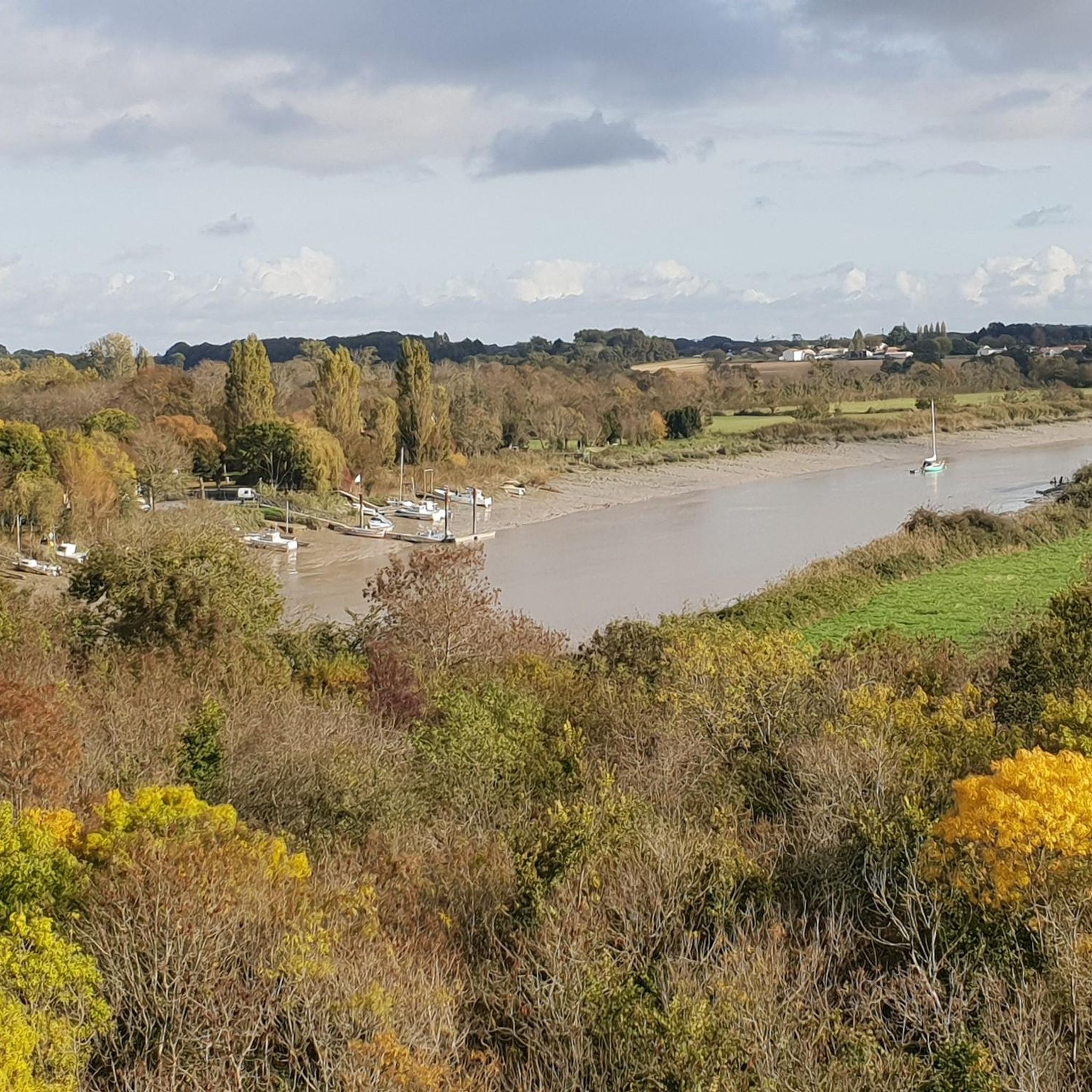


Tips from the Community

Here you'll find a romantic little lighthouse, and behind it lies a garden with a bench overlooking the sea, a lovely place to stop for a break. Afterwards, you can continue along the cliff to the right until you reach Euro Velo 1 again.
0
0

The Terre-Nègre lighthouse is a landmark forming a cylindrical tower a little over 26 meters high. Located on the tip of Terre-Nègre, in the commune of Saint-Palais-sur-Mer, in Charente-Maritime, it is intended to mark the southern pass of the Gironde estuary and to signal the presence of a dangerous sandbank, the "Anglais bar". This building forms a tower-column 3.16 meters in diameter and 26.60 meters high. A spiral staircase with a central core of 143 steps leads to a summit platform equipped with a directional light. The tower is painted in two different colors to make it more visible: the upper part is red, the lower part is white. The base of the lighthouse is hidden by a building that once served as the keeper's accommodation. The installation of a beacon at this location was considered as early as 1763. De Kearney took over the beaconing plan four years later. Construction work on the tower began in 1770 and was completed in 1773, probably under the supervision of the Bordeaux engineer Claude Tardy. In 1807, the tower was raised. However, this work was considered insufficient by some of the estuary's navigators. In 1834, sailors from the nearby port of Royan sent a request to the Ministry of the Navy to study the possibility of equipping the tower with a light. However, this request was postponed the following year due to lack of sufficient funds. A new request from sailors prompted the lighthouse commission to experiment with a first light in 1836. Finally, on October 15, 1838, a fixed white 4th order light was permanently installed. The latter was replaced in 1856 by a fixed white light of the 4th order of a small dioptric model with a reinforced sector of the 5th order catoptric. It was equipped with new lights in 1899 and 1904. In 1939, it was electrified. During the German occupation, the lighthouse served as an observatory for the soldiers of the Wehrmacht. Damaged during the fighting of 1945 (presence of breaches at the top of the tower), it was restored in the immediate post-war period. In March 1947, the lighthouse was operational again. A light with 3 occultations — changing every 12 seconds — was installed. Its colors are white, red and green. Its current range is 18 miles. Listed as a Historic Monument since 2011, the lighthouse is not open to visitors. However, it can be admired from the outside and a pretty passage provides direct access to the coastal path.
0
0

It is an absolutely beautiful village.
0
0

Along the Oysterfields, This is France at its best (when the sun shines!)
0
0

Small town with a special charm along the Charente.
0
0

The Abbaye-aux-Dames is built around the church of Sainte-Marie, built in the twelfth century. Famous for its facade and its characteristic "pinecone" bell tower, it is one of the emblematic monuments of Saintonge's Romanesque art. After several wars and fires, the place was restored in the 1970s and 1980s and is now a hotel. When you walk through the long corridors you feel like you have been transported back to the time when the abbey was still alive.
4
0
The market hall on the Place des Halles, which was probably built in the 16th century, consists of three naves that are divided by pillars made of quarry stone masonry. The open hall is closed by an octagonal tiled roof, which was renewed in the 20th century.
2
0

A former Benedictine abbey created in 1047, Abbaye-aux-Dames was the first women's monastery in Saintonge. These powerful women were nuns, that is to say, nuns living cloistered and having taken a vow of piety, occupying their lives in contemplation. They carried the crosier, in other words the pastoral staff of a bishop, and minted coins. Richly endowed, the abbey carried its influence well beyond the borders of the county and over time it became one of the most powerful women's monasteries in all of South-West France. With up to a hundred nuns at its peak, it was entrusted with the mission of instructing young girls, often from the French nobility, and counted among its most illustrious residents the future Marquise de Montespan, favorite of Louis XIV. The Abbaye-aux-Dames is structured around the Sainte-Marie church, built in the 12th century, famous for its facade and its characteristic “pine cone” bell tower. The premises were restored during the 1970s and 1980s and now house a Cité de la musique in which the Saintes Festival dedicated to classical music takes place each year. You can also stay in a wing of the building, the cells having been converted into hotel rooms, and leave your bike in a secure room.
0
0
Frequently Asked Questions
How many road cycling routes are available around Luchat?
There are over 140 road cycling routes around Luchat, offering a wide variety of options for different skill levels. You'll find a mix of easy and moderate trails to explore the region.
What kind of terrain can I expect on road cycling routes near Luchat?
The terrain around Luchat is diverse, featuring gentle slopes and elevations generally remaining below 200 meters. You can expect quiet country roads, dedicated greenways, and scenic paths through vineyards, marshlands, and historic villages. The region benefits from its proximity to major cycling arteries like the Vélodyssée along the coast and the Flow Vélo along the Charente River.
What is the best time of year for road cycling in Luchat?
The Charente-Maritime region, including Luchat, is generally pleasant for cycling from spring through autumn. Summers offer warm weather ideal for coastal rides, while spring and autumn provide milder temperatures perfect for exploring the countryside and vineyards. Always check local weather forecasts before heading out.
Are there road cycling routes suitable for beginners or families in Luchat?
Yes, Luchat offers numerous easy road cycling routes perfect for beginners or families. For instance, the Saint-Savinien-sur-Charente – Saint-Pierre Church of Aulnay loop from La Clisse is an easy 28.9-mile path that winds through the countryside, passing historic churches and villages.
Can I find challenging road cycling routes around Luchat?
While the region is known for its gentle slopes, there are moderate routes that offer a good challenge. The Pisany Market Halls – Coubre Lighthouse loop from Pisany is a 56.8-mile trail that provides a moderate challenge through varied landscapes, including some short ascents.
What historical or cultural landmarks can I see along road cycling routes near Luchat?
Many routes pass by significant historical and cultural sites. You can cycle past the Saint-Pierre Cathedral (Saintes), the Saint-Romain Church of Saint-Romain-de-Benet, or the Notre-Dame Church of Corme-Écluse. The broader region also features Romanesque churches, medieval castles, and towns like Saintes with its Gallo-Roman amphitheater.
Are there scenic viewpoints or natural features to discover while cycling?
Absolutely. The Charente-Maritime region is rich in natural beauty. You'll encounter diverse coastlines, including views of the Atlantic, pine forests, and marshlands. Inland, routes wind through green belts along rivers like the Charente, vineyards, and sunflower fields. The nearby islands of Île de Ré and Île d'Oléron also offer unique cycling opportunities with salt marshes and picturesque villages.
Are there circular road cycling routes available in Luchat?
Yes, many of the road cycling routes around Luchat are designed as loops, allowing you to start and end at the same point. For example, the popular Pisany – Pisany Market Halls loop from La Clisse is a 56.5-kilometer circular route.
Where can I find parking for road cycling routes in Luchat?
While specific parking areas for each route are not always detailed, many routes start from villages or towns like La Clisse or Pisany, where public parking is generally available. It's advisable to check local maps or komoot route details for suggested starting points and parking options.
Is public transport accessible for reaching cycling routes in Luchat?
Luchat is a commune in a rural area, so public transport options might be limited compared to larger cities. However, nearby towns like Saintes and Pons serve as significant points along regional cycling networks and may offer better public transport connections, from which you can then cycle to various routes. Checking local bus or train schedules for the Charente-Maritime department is recommended.
Are there places to stop for refreshments or meals along the routes?
Many road cycling routes in Luchat and the surrounding Charente-Maritime region pass through charming villages and towns. These often have local cafes, bakeries, and restaurants where you can stop for refreshments or a meal. Planning your route with potential stops in mind can enhance your cycling experience.
What do other road cyclists say about the routes in Luchat?
The road cycling routes in Luchat are highly rated by the komoot community, with an average score of 4.2 stars from over 10 reviews. Cyclists often praise the varied terrain, quiet country roads, and the opportunity to explore both coastal and inland landscapes.
Most popular attractions around Luchat

Get inspired with the komoot mobile app


Explore more
Browse the best Road cycling routes in other regions.
