The best road cycling routes around Thézac
4.2
(34)
884
riders
127
rides
Road cycling around Thézac offers diverse landscapes characterized by rolling hills and picturesque countryside, providing varied terrain for cyclists of all skill levels. The region features dedicated cycling paths, including the Voie Verte Fumel–Monsempron-Libos, which is part of the larger Véloroute de la Vallée du Lot V86. Routes often follow the tranquil Lot River, offering scenic views and a calm cycling environment. This combination of natural features and established routes makes Thézac a compelling destination for road cyclists.
Best road…
Last updated: November 3, 2026
4.0
(2)
65
riders
108km
04:22
380m
380m
Moderate road ride. Good fitness required. Some segments of this route may be unpaved and difficult to ride.
6
riders
Moderate road ride. Good fitness required. Some segments of this route may be unpaved and difficult to ride.

4.0
(1)
6
riders
75.9km
03:16
430m
430m
Moderate road ride. Good fitness required. Mostly well-paved surfaces and easy to ride.
4.5
(2)
4
riders
37.7km
01:35
150m
150m
Easy road ride. Mostly well-paved surfaces and easy to ride.
5.0
(1)
5
riders
37.7km
01:34
160m
160m
Easy road ride. Mostly well-paved surfaces and easy to ride.
Get access to more routes and recommendations from other explorers.
Already have an account?
Our route recommendations are based on thousands of hikes, rides, and runs completed by other people on komoot.
Start today with a free account
Your next adventure awaits.

Tips from the Community

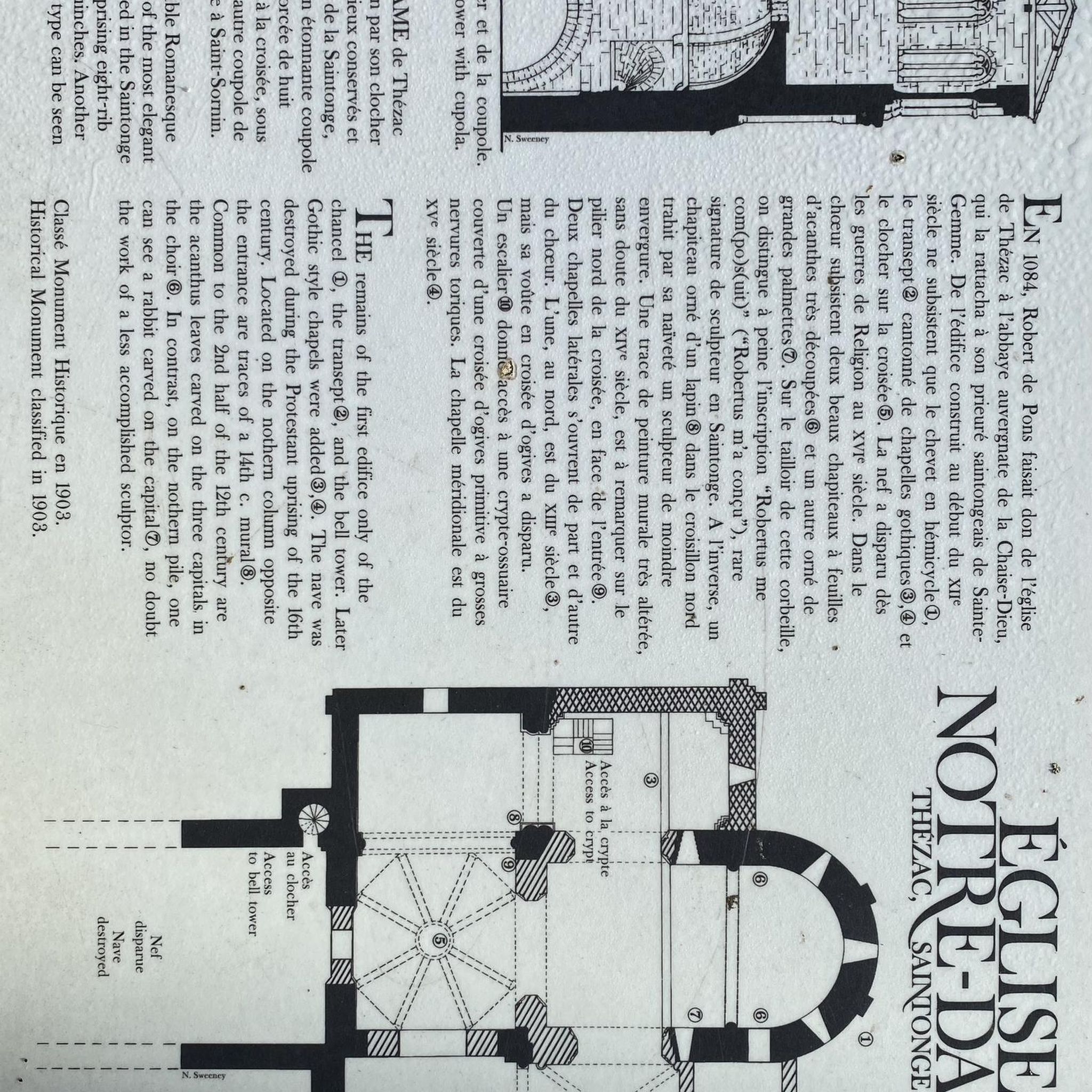
The Saint-Laurent church has a remarkable feature: its medieval Romanesque bell tower survived the destruction, while the church was rebuilt around it. 1. The origins: 1047 The first known mention of the church dates back to 1047. In a charter, Geoffroy Martel, Count of Anjou, ceded the churches of Saint-Laurent du Gua and Saint-Martin de Sanzillac (an old name associated with Saint-Martin du Gua) to the Abbaye aux Dames in Saintes, along with their parishes, lands, and revenues. This donation testifies to the religious importance of the territory as early as the 11th century. 2. The Romanesque church and its fortified bell tower The original church was a Romanesque building, of which the bell tower is today the main remnant. During the Hundred Years' War, the bell tower was adapted for defensive purposes. One can notably distinguish: -Two levels of Romanesque arcades and bays. -A wall walk for surveillance. -A fortified upper part. -A timber spire covered with slate, added at the beginning of the 16th century. This bell tower is particularly interesting because it combines Romanesque religious architecture with military adaptations. 3. The Wars of Religion and the destruction In the 16th century, the church suffered severe damage during the Wars of Religion. A fire destroyed a large part of the building. The bell tower itself was partially razed, then transformed into a fortified tower. The large Romanesque church thus almost entirely disappeared. 4. The reconstruction around 1800 Around 1800, the old church was considered too dilapidated and dangerous. It was decided to build a new sanctuary while preserving the medieval bell tower. An important architectural feature: the new church was built with a different orientation than the old one. The current facade presents a neoclassical style, with: -Pilasters. -A triangular pediment. -A monumental entrance reminiscent of a triumphal arch. 5. Treasures to discover inside Several elements deserve special attention. -The stained glass windows They date from the 19th and 20th centuries. Some represent episodes from the life and martyrdom of Saint Laurent, the patron saint of the church, as well as Saint Thérèse. -The high altar It comes from the old church of Dercie, a village that today belongs to the commune of Le Gua. -The maritime ex-voto It is a particularly interesting piece: a model of a three-masted ship, dating from the 19th century. It measures: 65 cm in height; 75 cm in length. Its hull is carved from a single block of wood. It represents a three-master with twelve gun ports depicted in black paint. 6. Classification as a Historic Monument -The bell tower is classified as a Historic Monument, but be careful: this classification concerns the bell tower and not the entire church. -The maritime ex-voto was classified as a Historic Monument on November 10, 1980. 7. A recent archaeological discovery: 2019 This is probably the most exciting aspect of the monument's history. During sanitation and redevelopment work on the Place de Verdun, archaeologists intervened around the church. They found: -Remains of the north wall of the original Romanesque nave. -Buried architectural elements. -Old circulation levels inside the church. -Graves. -Traces of medieval constructions nearby. These researches showed that the remains of the old church were much better preserved than previously thought. You can consult the official report from the Ministry of Culture: Archaeological report 2019 – Le Gua, pages 80 and 81 (PDF).
0
0

Exceptional view, the most beautiful village in France.
0
0

Here you'll find a romantic little lighthouse, and behind it lies a garden with a bench overlooking the sea, a lovely place to stop for a break. Afterwards, you can continue along the cliff to the right until you reach Euro Velo 1 again.
0
0
The Terre-Nègre lighthouse is a landmark forming a cylindrical tower a little over 26 meters high. Located on the Pointe de Terre-Nègre, in the commune of Saint-Palais-sur-Mer, in Charente-Maritime, it is intended to mark the southern passage of the Gironde estuary and to signal the presence of a dangerous sandbank, the "barre à l'Anglais". This building forms a column tower 3.16 meters in diameter and 26.60 meters high. A spiral staircase with a central core of 143 steps leads to a top platform equipped with a directional light. The tower is painted in two different colors to make it more visible: the upper part is red, the lower part is white. The base of the lighthouse is hidden by a building that once served as the keeper's living quarters. The installation of a landmark at this location was considered as early as 1763. De Kearney took up the marking plan four years later. Construction of the tower began in 1770 and was completed in 1773, probably under the direction of the Bordeaux engineer Claude Tardy. In 1807, the tower was raised. However, these works were considered insufficient by some of the estuary's navigators. In 1834, sailors from the nearby port of Royan sent a request to the Ministry of the Navy to study the possibility of equipping the tower with a light. However, this request was postponed the following year due to a lack of sufficient funds. A new request from the sailors prompted the lighthouse commission to test a first light in 1836. Finally, on October 15, 1838, a 4th-order fixed white light was installed permanently. The latter was replaced in 1856 by a 4th-order small dioptric model fixed white light with a 5th-order catoptric reinforced sector. It was equipped with new lights in 1899 and 1904. In 1939, it was electrified. During the German occupation, the lighthouse served as an observatory for Wehrmacht soldiers. Damaged during the fighting in 1945 (presence of breaches at the top of the tower), it was restored in the immediate post-war period. In March 1947, the lighthouse was operational again. A light with 3 occultations — changing every 12 seconds — was put in place. Its colors are white, red, and green. Its current range is 18 miles. Listed as a Historic Monument since 2011, the lighthouse is not open to visitors. However, it can be admired from the outside and a lovely path allows direct access to the coastal trail.
0
0

It is an absolutely beautiful village.
0
0

As high as a mountain, so get ready to stretch your legs!
0
0

…While in front of me, In the doubtful clarity in which its form was outlined, Standing on the hillside like a living monster Whose moon spread its enormous shadow on the grass, An immense windmill turned its arms in the wind... (October 23-24, 1897) Guy de Maupassant
2
0

Small town with a special charm along the Charente.
0
0
Frequently Asked Questions
What kind of terrain can I expect when road cycling around Thézac?
The region around Thézac is characterized by its rolling hills, offering a diverse landscape with both challenging ascents and enjoyable descents. You'll find routes winding through picturesque countryside, providing varied terrain suitable for different skill levels. Additionally, dedicated cycling paths like the Voie Verte Fumel–Monsempron-Libos offer calmer, flatter sections, often running alongside the tranquil Lot River.
Are there any easy road cycling routes suitable for beginners in Thézac?
Yes, Thézac offers several easy road cycling routes. For instance, the Les Halles de Cozes – Pisany Market Halls loop from Pisany is an easy 46.8 km (29.1 miles) trail with minimal elevation gain, perfect for a relaxed ride. The region's dedicated greenways, such as sections of the Voie Verte, also provide accessible and pleasant paths for those new to road cycling.
What are some notable landmarks or attractions I can see along road cycling routes near Thézac?
Many routes offer scenic views and pass by interesting sites. You can explore historical churches like the Saint-Romain Church of Saint-Romain-de-Benet or the Notre-Dame Church of Corme-Écluse. The region also features charming villages and the picturesque Lot River Valley, which many routes follow. While not directly on a route, the formidable Château de Bonaguil is a significant historical site nearby, accessible via an 8km path from the Voie Verte.
Are there any family-friendly road cycling options in Thézac?
Absolutely. The Voie Verte Fumel–Monsempron-Libos, part of the larger Véloroute de la Vallée du Lot V86, is an excellent option for families. This greenway is developed on a former railway line, providing dedicated paths without vehicle traffic, making it safe and enjoyable for cyclists of all ages and skill levels. It's ideal for leisurely rides through scenic countryside.
How many road cycling routes are available around Thézac?
There are over 100 road cycling routes available around Thézac, catering to various preferences and skill levels. This includes a good mix of easy, moderate, and some more challenging options, ensuring there's something for everyone.
What is the best time of year to go road cycling in Thézac?
The region's pleasant climate generally makes spring and autumn ideal for road cycling. During these seasons, temperatures are mild, and the natural scenery is particularly beautiful. Summer can also be enjoyable, especially if you start early in the morning to avoid the midday heat. Always check local weather forecasts before heading out.
Are there any loop routes for road cycling in Thézac?
Yes, many road cycling routes around Thézac are designed as loops, allowing you to start and end at the same point. Examples include the popular Pisany Market Halls – Coubre Lighthouse loop from Pisany, which is a moderate 91.4 km (56.8 miles) ride, and the St Romain de Benet Church – Fisherman's cottages loop from Saint-Romain-de-Benet, a 68.6 km (42.6 miles) moderate path.
Where can I find parking for road cycling trails in Thézac?
While specific parking areas for each route may vary, many routes start from towns or villages that offer public parking facilities. For routes utilizing the Voie Verte, look for access points in towns like Fumel or Monsempron-Libos, which typically have parking available. It's always advisable to check the starting point of your chosen route for specific parking recommendations.
What do other road cyclists enjoy most about cycling in Thézac?
The road cycling experience in Thézac is highly rated by the komoot community, with an average score of 4.35 stars from over 30 reviews. Cyclists often praise the diverse landscapes, the tranquility of routes along the Lot River, and the well-maintained dedicated greenways like the Voie Verte. The combination of scenic views and varied terrain for all skill levels is frequently highlighted.
Are there any advanced or challenging road cycling routes in Thézac?
While the region is known for its rolling hills, which provide some challenging ascents, there are also routes designed for more experienced cyclists. For example, the Pisany Market Halls – St Romain de Benet Church loop from Pisany is a moderate 78 km (48.5 miles) route with over 439 meters of elevation gain, offering a good workout. The varied terrain ensures that even advanced riders can find routes to test their endurance.
Can I find cafes or places to stop for refreshments along the road cycling routes?
Many road cycling routes in Thézac pass through or near charming villages and towns. These often provide opportunities to stop for refreshments at local cafes, bakeries, or restaurants. Exploring towns like Tournon d'Agenais or Montaigu-de-Quercy, or even visiting local vineyards for tastings, can be a delightful part of your cycling experience.
Most popular attractions around Thézac

Get inspired with the komoot mobile app


Explore more
Browse the best Road cycling routes in other regions.
