The best road cycling routes around Salles-D'Angles
4.6
(60)
1,866
riders
466
rides
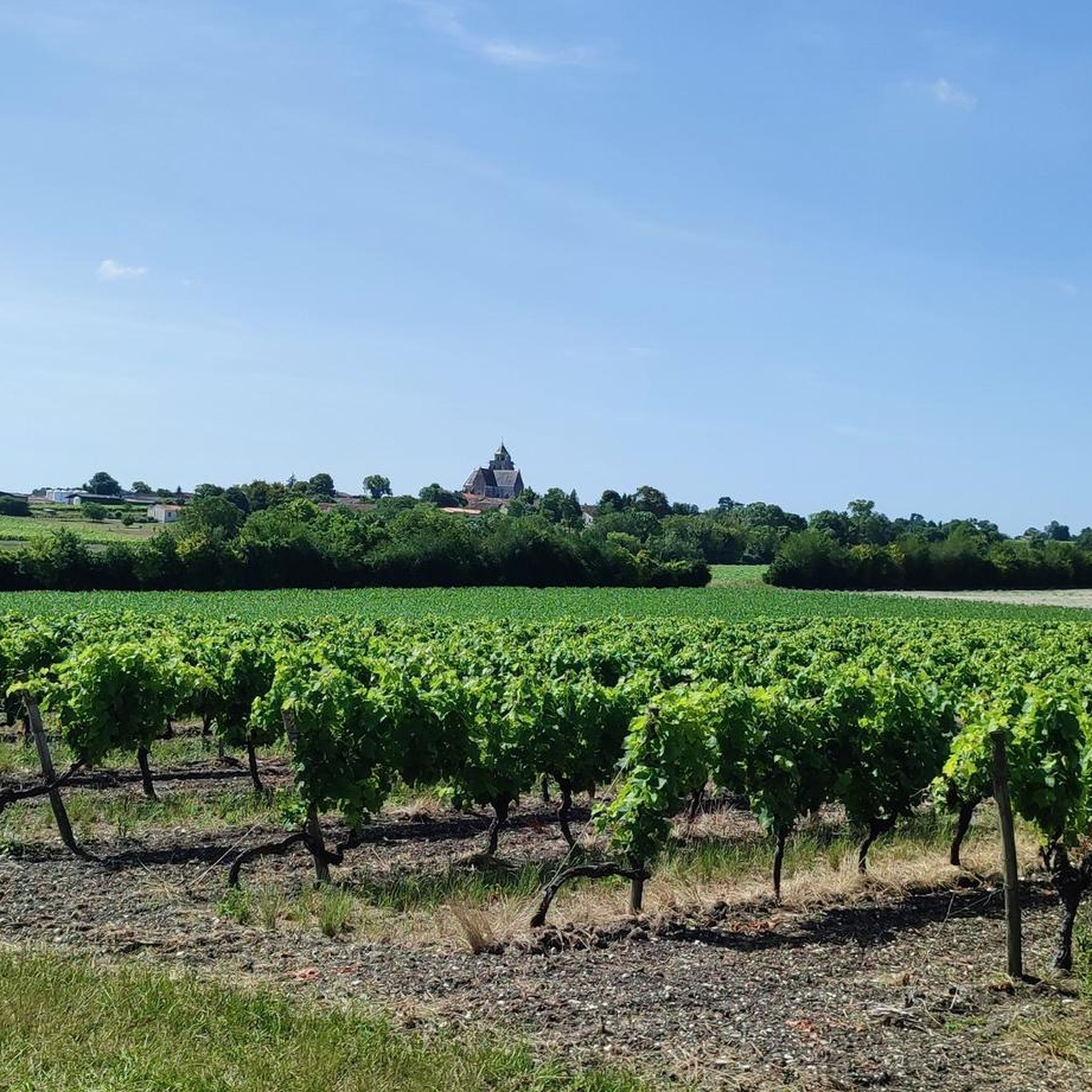
Road cycling around Salles-D'Angles, located in the Charente department of France, features routes through the "Grande Champagne" region, known for its extensive vineyards and rolling hills. The terrain is characterized by well-paved surfaces and moderate elevation gains, often following the Né river valley. This area provides a balanced mix of challenging and enjoyable rides for road cyclists.
Best road cycling routes around Salles-D'Angles
- The most popular road cycling route is Le Moulin de la Baine – Saint-Martin Church loop from…
Last updated: November 15, 2026
10
riders
61.1km
02:28
300m
300m
Moderate road ride. Good fitness required. Mostly well-paved surfaces and easy to ride.
5.0
(2)
12
riders
55.1km
02:17
290m
290m
Moderate road ride. Good fitness required. Some segments of this route may be unpaved and difficult to ride.

5
riders
56.1km
02:25
360m
360m
Moderate road ride. Good fitness required. Some segments of this route may be unpaved and difficult to ride.
5.0
(1)
4
riders
62.5km
02:37
430m
430m
Moderate road ride. Good fitness required. Some segments of this route may be unpaved and difficult to ride.
5
riders
Moderate road ride. Good fitness required. Some segments of this route may be unpaved and difficult to ride.
Get access to more routes and recommendations from other explorers.
Already have an account?
Our route recommendations are based on thousands of hikes, rides, and runs completed by other people on komoot.
Start today with a free account
Your next adventure awaits.

Tips from the Community

The site of La Baine, in Chaniers, predates the current mill. 14th century: the first attested mills A document dated 1310 mentions cloth mills at La Baine. They were built on piles driven into the riverbed and were used, among other things, for fulling fabrics. These mills then belonged to the dean and chapter of the cathedral of Saintes. They had been destroyed a few years earlier by the Count of la Marche. In 1313, the chapter obtained authorization to rebuild two mills, a weir, and a fishery. 17th century: Colbert's royal mill It was in the 17th century that La Baine gained considerable importance. A complex of five wheat mills was rebuilt on a secondary branch of the Charente, which was not used for navigation. Around 1630, the mills belonged to the brothers Charles and Jacques Duval, who held the beneficial ownership, while the lordship of Chaniers was under the chapter of the Saint-Pierre de Saintes cathedral. Then came Jean-Baptiste Colbert, minister to Louis XIV and Secretary of State for the Navy. Around 1670, Colbert had the mill redeveloped and enlarged to considerably increase its production capacity. The new complex had seven water passages and thus became one of the most powerful mills in the region. Why was Colbert interested in La Baine? The reason was directly linked to the creation and development of the Rochefort arsenal. The mill primarily produced wheat and barley flour intended for the sustenance of the Royal Navy sailors. The grains arrived via the Charente aboard gabares (flat-bottomed barges). After delivering their cargo to the mill, the gabares departed with the flour destined, among other places, for Rochefort. The mill of La Baine was therefore part of a true royal industrial and logistical system organized around the Charente and Rochefort. 19th century: gradual transformation In the 19th century, milling activity continued. The old mills gradually became a true industrial establishment. In 1845, the site was operated by five different millers. From 1897, the complex was gradually brought together by Mr. Lardy, who modernized the facilities and introduced machinery. His son Rémy Lardy succeeded him. 20th century: the flour mill In the 1930s, the mill had become a true industrial flour mill. Its capacity reached about 50 quintals of wheat per day. In 1936, the hydraulic power was supplied by several wheels about 5 meters in diameter. The total water intake was about 4 meters, with a head of 1.50 meters. The facilities included, among other things: two double grinders; a double converter; a pair of millstones; a plansichter; five purifiers. Milling activity finally ceased in the mid-20th century, with sources placing the end of industrial activity around the years 1940-1960, depending on whether one refers to the flour mill or the complete disappearance of milling activity. Today The building has been preserved and transformed into a restaurant, while retaining remarkable elements of its industrial past, notably the wheel and part of the old machinery. The Moulin de la Baine is now located at 14 rue Colbert, 17610 Chaniers, directly above the Charente. A particularly interesting point The mill, the dam, and the locks form an inseparable historical ensemble. The current dam has, however, undergone modern transformations: a prefectural decree from 2012 classifies the hydraulic structure of the Moulin de La Baine as a Class D dam, among other things.
0
0


Courcoury is a natural island surrounded by the Charente and Seugne rivers, giving it a unique landscape setting between marshes and waterways, conducive to biodiversity and outdoor activities. It is also the only village in Charente-Maritime to have been awarded 4 stars by the "Villes et villages étoilés" label, recognizing its efforts to reduce light pollution through intelligent and environmentally friendly public lighting.
1
0

A beautiful church with beautiful houses hidden in an ancient but romantic village, it's worth a stop. The Saint-Étienne church in Brives-sur-Charente is recent. It was consecrated in 1868 and reflects the 14th-century Gothic style. It replaced an older church, of which only a baptismal font, listed as a historic object in 1922, and a capital remain. This font, square and made of a single block of siliceous limestone, is a rare specimen of 12th-century sculpture and symbolism. Certain characteristic features, such as the draperies, allow it to be dated to the 1150s. On three sides, we discover the Annunciation made to Mary, then on the main face of the font, Christ officiating in heaven, and finally Christ descending into hell, savior of souls.
0
0

HISTORY OF THE HOUSE OF HINE In 1791, Thomas Hine (1775-1822), then aged 16, left his native land on the south coast of England to go to France… in the middle of the French Revolution. He went to Jarnac, Charente, where he was hired as a clerk in the Ranson et Delamain trading house, which produced his father’s favourite cognac. James Delamain (1738-1800), a Huguenot who had emigrated from Ireland, founded the trading house in 1763 with his father-in-law Jean-Isaac Ranson. On 3 October 1797 (13 Brumaire Year VI), Thomas Hine married Françoise Élisabeth Delamain, daughter of James Delamain and Marie Ranson. In 1817, the Ranson et Delamain house was liquidated, the heirs having been unable to agree on the succession. The eponymous son-in-law founded Thomas Hine & Co, and his cousins Paul Roullet and Henri Delamain (James' grandson) founded the Maison Roullet et Delamain seven years later, which would become Delamain et Cie. The links between the two Protestant Jarnac families remained close, and Thomas Hine's great-granddaughter, Adrienne Hine (1850-1922) married Philippe Delamain (1847-1902) - they had sons Jacques and Robert Delamain. Today, as in Thomas Hine's time, the Hine establishments line the banks of the Charente in Jarnac. The logo is inspired by Hine's speaking arms, hind meaning doe in Old English. He is lying down, his head turned backwards, symbolically looking towards England2. In 1962, Hine was granted the Royal Warrant of Her Majesty Queen Elizabeth II, and became the official supplier of cognac to the Court of England. In 1987, the company was bought by Moët Hennessy. In 2003, it became the property of the CL Financial group, which emerged from the Angostura group. The House was bought in 2013 by the Edv company. TYPOLOGY OF HINE EAUX DE VIE The House of HINE is located on the banks of the Charente, in the heart of the Cognac region. In the cellars, which ensure the protection of the precious vintages under seal, little has changed in more than 260 years. From the neighboring quays once began the journey of HINE cognacs around the world. This house is one of the oldest in Jarnac. Cognacs exclusively from the Grande and Petite Champagne vintages, a distillation with the lees, and an aging in fine grains with a light to moderate heating. Here, every manufacturing detail will be revealed to you. > To find out more: - https://hine.com/fr - Address: 16 quai Orangerie 16200 Jarnac - 05 45 35 59 59 - Visits, Tasting and Purchases possible - Opening periods: From 01/04 to 31/12 Monday, Tuesday, Wednesday, Thursday and Friday from 9 a.m. to 5:30 p.m. Excluding public holidays. Full price: from €20. Free for children under 18. (Subject to change)
0
0

The Church of Saint-Martin de Coucoury was built around the 11th century. It is a pretty example of a Romanesque church.
1
0

Here we find the ruins of the castle of Merpins. In the Middle Ages, it was an important medieval fortress, in what is now Merpins-Vieux-Bourg. A stopover is essential!
0
0
In 1073, the castle already exists; the first known lord was Guillaume de la Rochandry at the beginning of the 12th century. The 1449 inscription on the castle attests to its reconstruction following the destruction caused by the Hundred Years War. In 1505, Jean de Sainte-Maure, lord of Jonzac, founded the Carmelite monastery on the remains of an old chapel dedicated to Saint Nicolas. The cloister was built in 1657. The young Louis XIV, the Queen Mother and Mazarin stayed at the castle in 1659. The castle remained at Sainte-Maure until the end of the 17th century, then passed through marriage to Espardes de Lussan, which transformed the fortress in beautiful stately home with neat ornamentation and guard until the Revolution. Currently the north wing of the castle houses the buildings of the Town Hall (restored in the 19th century), and the south wing, those of the sub-prefecture. The cloister was restored between 1976 and 1978, and now houses a cultural center, with exhibition halls and an archaeological museum. The towers, postern and fountain in the basement date from the 12th century. Of the old feudal castle, only the postern and an isolated tower remain, connected to the main body by a large hall. The moat in front of the drawbridge was filled was filled in the 19th century. It was reopened at the beginning of the 21st century. The imposing gatehouse is marked 1549 and therefore dates from the 16th century, a period of work including the north-west tower, while the south-west tower, of a smaller diameter, is from the 17th century. The towers flanking the postern have retained their defenses. At each, the loopholes have been retained or enlarged. Stone stairs serve each floor and access the walkway. This passage seems to have been discovered, as evidenced by the gargoyles. The crenellation includes machicolations with archers in the middle of the merlons. The slate roofs are high pepperboxes on the towers, and a curious set with two sides connecting two pepperboxes for the gatehouse The fountain located in the basement of the sub-prefecture, has a niche and a niche frame decorated with sculptures imitating stalactites. Carved mask. The fountain was probably built by Léon de Sainte-Maure, Count of Jonzac, who enlarged and embellished the castle in the middle of the 12th century. In a former courtyard of the castle, a theater was built in the 19th century. It is a round building with approximately 300 seats.
0
0
Frequently Asked Questions
What is the typical terrain and difficulty for road cycling in Salles-D'Angles?
The road cycling terrain around Salles-D'Angles is characterized by rolling hills and extensive vineyards, primarily on well-paved surfaces. Routes generally feature moderate elevation gains, offering a good balance of challenge and enjoyable riding. The area is within the "Grande Champagne" region, known for its distinctive landscape.
How long do road cycling routes in Salles-D'Angles typically take to complete?
Road cycling routes in Salles-D'Angles vary in length and duration. For example, the Le Moulin de la Baine – Saint-Martin Church loop from Merpins is about 60.9 km and takes approximately 2 hours 28 minutes. Shorter routes like the Saint-Brice Castle loop from Saint-Fort-sur-le-Né are around 46.5 km and can be completed in about 1 hour 59 minutes.
Are there routes suitable for beginners or less experienced cyclists?
While many routes are classified as moderate, the area offers options for various ability levels. The well-paved surfaces and moderate elevation gains make it accessible for those with good basic fitness. For instance, the Bourg-Charente – Bourg-Charente Castle loop from Base aérienne 709 Cognac Châteaubernard is a 52.9 km ride with 290m elevation, which could be a good starting point.
What historical sites or natural features can I see while cycling in Salles-D'Angles?
The region is rich in historical and natural beauty. You can cycle past picturesque vineyards, the Né river valley, and various châteaux. Notable historical sites include the Bourg-Charente Castle, a 17th-century mansion, and the Logis de Gardépée in Saint-Brice. Routes often offer glimpses of the region's distinctive architecture and landscapes.
Are most road cycling routes in Salles-D'Angles circular?
Yes, many of the road cycling routes in Salles-D'Angles are designed as loops, allowing you to start and end in the same location. Examples include the Château d'Ars loop from Merpins and the Saint-Fort Dolmen – Dolmen among the vines loop from Saint-Fort-sur-le-Né.
When is the best time of year to go road cycling in Salles-D'Angles?
The region generally offers pleasant conditions for road cycling, particularly during spring and autumn when temperatures are milder and the vineyards are either budding or displaying their autumnal colors. Summer can also be enjoyable, though it's advisable to cycle earlier in the morning or later in the afternoon to avoid the midday heat.
Are there places to stop for refreshments or food along the routes?
Being in the heart of the Cognac region, you'll find opportunities to stop in towns and villages along the routes. These often offer local cafes, restaurants, and even Cognac houses for tastings. Planning your route with komoot can help identify suitable stops for refreshments.
What do other road cyclists enjoy the most about road cycling in Salles-D'Angles?
The area is highly rated by the komoot community, with an average score of 4.5 stars from over 50 reviews. Cyclists often praise the picturesque vineyards, the well-maintained roads, and the balanced challenge of the moderate routes. The blend of scenic landscapes and cultural points of interest, such as historic châteaux, also contributes to a highly enjoyable experience.
Are there any specific attractions related to Cognac along the cycling routes?
Yes, Salles-D'Angles is situated in the premier cru of the Cognac appellation. While cycling, you'll pass through extensive vineyards. The region is home to renowned Cognac houses like Hennessy and Remy Martin, which are within a short distance and offer cultural insights into the famous spirit. The Bourg-Charente area, for example, is close to the Bourg-Charente Castle, which houses cellars for Grand Marnier.
What are some of the longer road cycling routes available?
For those seeking longer rides, the Saint-Fort Dolmen – Dolmen among the vines loop from Saint-Fort-sur-le-Né is a notable option, covering approximately 69.5 km with an elevation gain of 430m. This route offers an extended exploration of the region's vineyards and natural features.
Is there parking available near the starting points of the routes?
While specific parking information for each route start is not detailed, routes often begin from towns or villages like Merpins or Saint-Fort-sur-le-Né, where public parking facilities are typically available. It's advisable to check local parking options in these areas before your ride.
Most popular routes around Salles-D'Angles
Most popular attractions around Salles-D'Angles

Get inspired with the komoot mobile app


Explore more
Browse the best Road cycling routes in other regions.
