The best walks and hikes around Rancogne
4.5
(102)
349
hikers
95
hikes
Hiking around Rancogne offers diverse natural landscapes within the Charente department of Nouvelle-Aquitaine, France. The region is characterized by rolling, wooded hills, river valleys, and a blend of open fields and forests. The Tardoire River valley is a prominent natural feature, known for its picturesque and preserved nature. Trails often traverse varied terrain, including earth and stone paths, connecting villages with the surrounding countryside.
Best hiking trails around Rancogne
- The most popular hiking route is Grottes des Garennes – Château…
Last updated: May 15, 2026
10
hikers
3.68km
00:58
30m
30m
Easy hike. Great for any fitness level. Easily-accessible paths. Suitable for all skill levels.
9
hikers
3.28km
00:51
10m
10m
Easy hike. Great for any fitness level. Easily-accessible paths. Suitable for all skill levels.

Sign up for free
3
hikers
Easy hike. Great for any fitness level. Easily-accessible paths. Suitable for all skill levels.
4.3
(3)
6
hikers
Moderate hike. Good fitness required. Easily-accessible paths. Suitable for all skill levels.
5.0
(2)
6
hikers
10.2km
02:50
180m
180m
Moderate hike. Good fitness required. Easily-accessible paths. Suitable for all skill levels.
Get access to more routes and recommendations from other explorers.
Sign up for free
Already have an account?
Our route recommendations are based on thousands of hikes, rides, and runs completed by other people on komoot.
Start today with a free account
Your next adventure awaits.
Login or Signup

Tips from the Community

15th century stone bridge known as that of the Château de la Rochefoucauld. From the building, there is a superb view of the imposing castle and the waters of the Tardoire. It has been listed as a Historic Monument since 1935. The castle, renowned for being one of the most beautiful and oldest in Charente, can be visited all year round. It is the only castle in France that has been inhabited by the same family for more than 1,000 years. Do not miss !
2
0

In the heart of Charente, the Château de la Rochefoucauld stands like a page of history mixed with an enchanted tale. Built around the 16th century on the site of an 11th century fortress, this gem has been cherished by the same family since its earliest days. And that’s something! Strolling through its rooms or admiring the landscape from its towers, you feel the weight of history. It's as if the castle whispers to us both history lessons and stories of adventure.
0
0

Inside is a statue of Saint Anthony: The statue opposite represents Saint Anthony, a monk of the Carmelite monastery of La Rochefoucauld, who lived at the beginning of the 14th century. Saint Anthony is represented as a bearded old man dressed in a hooded homespun robe. He has a bell and a missal in his right hand. He puts his left hand on his chest. He is barefoot and in sandals. The features are severe, the tormented face. The statue dates from the 17th century (the base is later). Its author is unknown. It was carved directly from a piece of walnut wood with polychromy only on the front, but it had to be painted on the back as well. It has been classified as a Historic Monument since July 1, 2003. A restoration by Mrs. Bénédicte Leblanc was carried out in 2005. A local popular devotion to this statue developed: it was attributed the power to heal children. Cloths were placed at the feet of the saint; candles were also burned very close to the statue, even on the arm. This statue was presented at the Musée des beaux-arts d'Angoulême, from October 1999 to January 2000 during the exhibition "Treasures of Charente" and at the foyer des Carmes in La Rochefoucauld, in April-May 2019 for the exhibition "Treasures" of our churches in the Community of Communes La Rochefoucauld-Porte du Périgord. Note that the large stained glass window of the apse of the church of Souffrignac has for illustration this Saint Antoine, Carmelite of La Rochefoucauld. Saint Anthony traveled through the countryside, announcing his passage with a bell. One day when he was going to the church of Peyroux (municipality of Orgedeuil), passing by the chapel of Landes, a mother joined him between the summit of La Faurie and Les Bourdichoux. The woman begged him to ask God for the healing of her sick child. Father Antoine pressed one of the child's diapers over his heart, prayed, and the child recovered. This “miracle” was repeated later. In testimony of their gratitude to the good monk, the inhabitants of Saint-Sornin, in the 16th century, would have taken advantage of the passage of a sculptor to have the statue of the Saint executed, carved, it is said, in the most beautiful walnut of the plain of Chadries. .
1
0
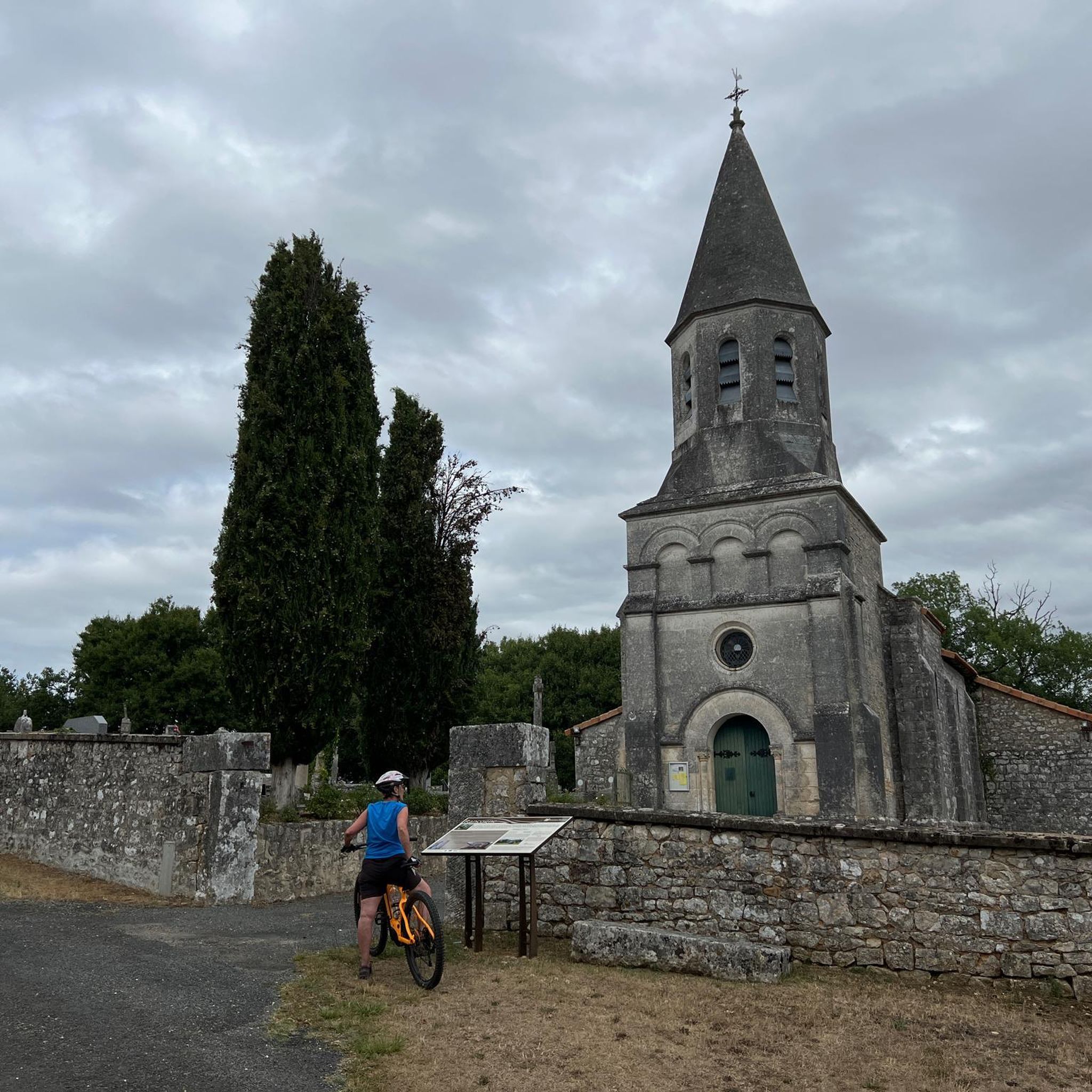
This former Augustinian priory-cure belonged to the priory of Notre-Dame des Salles-Lavauguyon, of the diocese of Limoges. It remained a convent until around 1560. The church was restored in 1862, as indicated by the engraved lintel on the south face of the bell tower. Built in local materials of Bajocian limestone and tertiary elements, this church consists of a single nave of three bays, followed by a narrow rectangular choir opening onto two modern side chapels. Inside, the nave is coated and currently covered with a lowered barrel vault from the 19th century. A possible apse, of modest size, could complete the building to the east. It was replaced by a large arcade built in the 19th century, closed by a wall in its lower part and a modern stained glass window in its upper part. From the choir, a 17th century door provides access to the south chapel, serving as a sacristy, while opposite an arcade pierced in the north wall allows communication with the north chapel. Outside, you reach the bell tower by means of a stone staircase then a metal miller's ladder leading to a high door, datable to the 17th century. From the top of this door, the rest of the bell tower has been redone and pierced with four modern arched bays. The facade is a complete reconstruction of the 19th century. The Virgin with the Rosary. Look for this painting on the wall to the right. It is very dark and well damaged; but, as it is, it attracts restoration in memory of its possible origins: either the Venetian school or the work of Murillo's workshop. The story says that in the middle of the 17th century, the ambassador of the King of Spain returning to his country fell ill in the area and was treated at the presbytery. As a thank you for the good care received, returned to his country, he asked Murillo, a great Spanish painter, for a replica of his painting The Virgin with the Rosary, exhibited today at the Goya Museum in Castres, and gave it as a gift to Saint-Sornin. . THE CHURCH St Saturnin's church was originally a priory depending on Notre-Dame of Salles-Lavauguyon, in Limoges diocese. If kept its conventual status until around 1560. Erected in fhe 11th century, It was restored in the 19” century. Two chapels were added to each side in the 17th century. They communicate with the rectangular choir through iwo archways. On the right wall, there hangs a dark painting in very bad repair. It is supposed to be a copy of Murillo's famous Virgin of the Rosary.
1
0

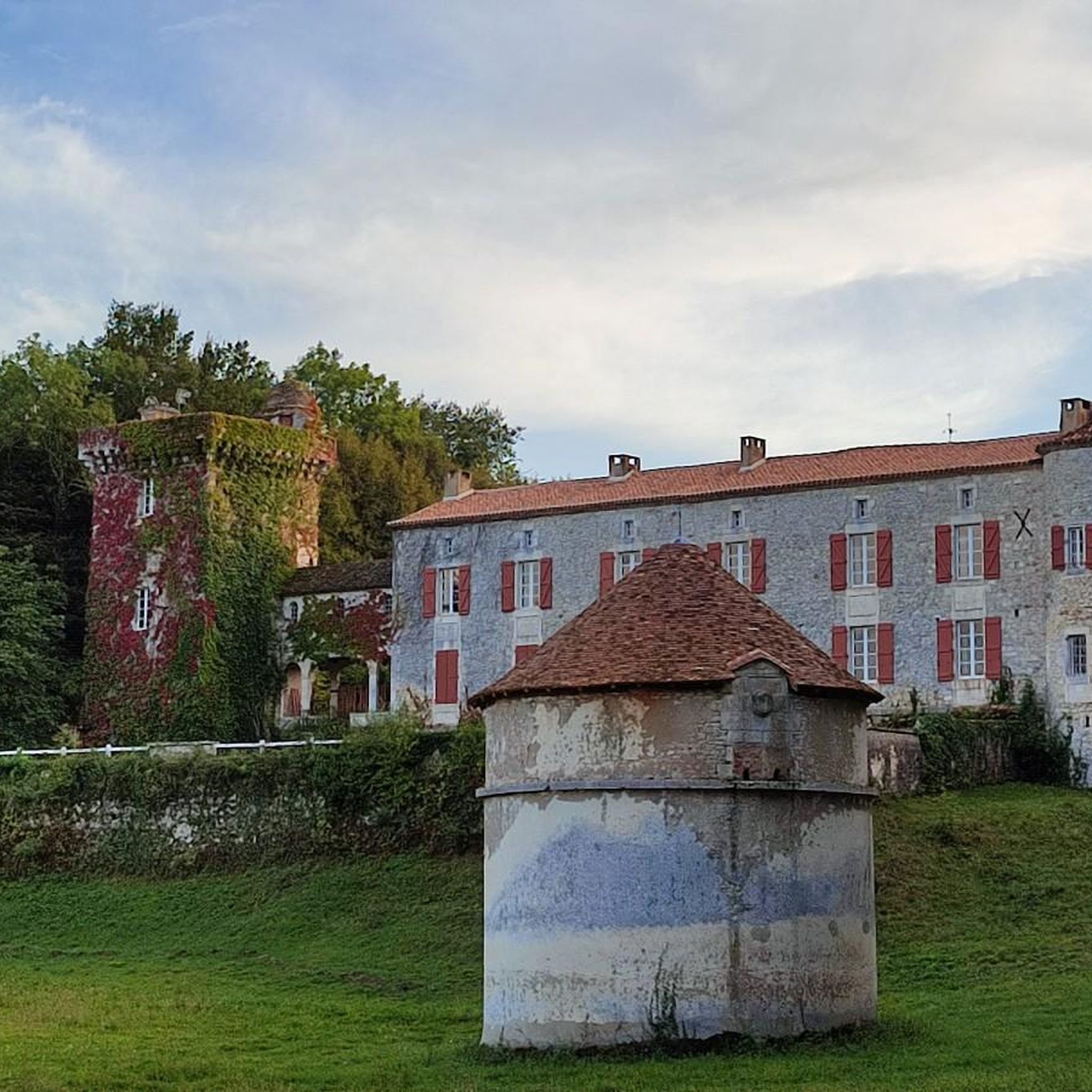
This magical 16th century Renaissance castle is built on an 11th century fortress whose towers have been preserved. The castle and its gardens have been classified as a historical monument since 1955. Definitely worth the short detour!
0
0

Appearing in 1019 with Foucauld, lord of La Roche, the La Rochefoucauld family has long been considered a branch of the Lusignan, due to the similarity of their arms. It seems, in reality, that Foucauld was a close relative of the Viscount of Limoges, descendant of a Grand of the court of Charlemagne. Only four other families in France (including that of the Capetians) can claim such seniority. The history of the castle is inseparable from the history of the La Rochefoucauld family which, itself, is part of the political life of its time, century after century. The castle of La Rochefoucauld provides a remarkable illustration of the interweaving of politics and architecture through the life of a family which has continuously owned the castle since Fucaldus laid the first fortification around 980. With the history of the La Rochefoucauld family, the use of architecture for social and political purposes finds one of its most spectacular manifestations. This earned it the justified title of “pearl of Angoumois”. The castle is an anthology of seven centuries of architecture and the home of the La Rochefoucauld family, still present for over a thousand years. To see: the monumental Renaissance staircase (108 steps!), the boudoir of Marguerite de Valois, the kitchens dug into the karst, the state rooms, guards, the 18th century libraries, the main courtyard and its galleries from the 16th.
3
0
Appeared in 1019 with Foucauld, Lord of La Roche, the family of La Rochefoucauld has long been considered a branch of the Lusignan, due to the similarity of their weapons. It seems, in fact, that Foucauld was a close relative of the Viscount of Limoges, descended from a Grand of the court of Charlemagne. Only four other families in France (including that of the Capetians) can claim such seniority. The history of the castle is inseparable from the history of the La Rochefoucauld family, which itself, century after century, is part of the political life of its time. The castle of La Rochefoucauld gives a remarkable illustration of the interweaving of politics and architecture through the life of a family which has owned the castle without interruption since Fucaldus laid the first fortification around 980. With the history of the La Rochefoucauld family, the use of architecture for social and political ends finds one of its most spectacular manifestations. This earned it the justified title of "Pearl of Angoumois". The castle is an anthology of seven centuries of architecture and the residence of La Rochefoucauld, still present, for more than a thousand years. To see: the monumental Renaissance staircase (108 steps!), Marguerite de Valois' boudoir, the kitchens dug into the karst, the ceremonial rooms, the guards, the 18th century libraries, the main courtyard and its galleries 16th century. Visit sheet translated into 17 languages.
1
0

The weir system directly below is in need of renovation. The water gushes out from under the weir!
0
1
Frequently Asked Questions
How many hiking trails are available around Rancogne?
There are over 80 hiking trails around Rancogne, offering a wide range of experiences for different skill levels. The region is known for its diverse landscapes, from river valleys to wooded hills.
What kind of terrain can I expect on hikes near Rancogne?
Hiking trails near Rancogne feature varied terrain, including rolling, wooded hills, river valleys, and a mix of open fields and forests. You'll encounter paths made of earth and stone, sometimes including ancient Roman roads, as well as passages through undergrowth and alongside cultivated areas.
Are there easy hiking options suitable for beginners in Rancogne?
Yes, Rancogne offers many easy hiking options. There are over 30 easy routes available. An excellent choice for a gentle walk is the Grottes des Garennes – Château de Vilhonneur loop from Vilhonneur, which is 2.3 miles (3.7 km) long and explores local caves and a chateau.
Can I find circular hiking routes in the Rancogne area?
Many of the hiking trails around Rancogne are circular, allowing you to start and end at the same point. Examples include the Château de La Rochefoucauld – Château de La Rochefoucauld loop from La Rochefoucauld-en-Angoumois and the Logis de Rochebertier loop from Vilhonneur.
What natural features or landmarks can I see while hiking near Rancogne?
The region around Rancogne is rich in natural beauty and historical sites. You can explore the scenic Tardoire River valley, known for its prehistoric sites, and the picturesque area around the Grotte de Montgaudier. Hikers can also discover several castles, such as La Rochefoucauld Castle and Montbron Castle, which often feature on local routes.
What is the best time of year for hiking in Rancogne?
The Charente region, where Rancogne is located, is beautiful throughout the year, with rolling, wooded hills that change colors with the seasons. Spring and autumn offer pleasant temperatures and vibrant landscapes, while summer provides longer daylight hours for exploration. Winter hiking is also possible, though conditions may vary.
Are there any challenging hikes for experienced trekkers?
Yes, for those seeking a more challenging experience, there are a few difficult routes. One such option is the Château Forest loop from Saint-Projet, a 12.7-mile (20.5 km) trail that leads through dense woodlands and open fields, typically taking over 5 hours to complete.
What do other hikers enjoy most about hiking in Rancogne?
The hiking trails around Rancogne are highly rated by the komoot community, with an average score of 4.5 stars from over 90 reviews. Hikers often praise the diverse landscapes, the blend of wooded areas and open countryside, and the historical points of interest found along the routes.
Are there any hikes that offer good viewpoints in the Rancogne area?
Many trails in the region provide excellent viewpoints. For instance, the 'Circuit Au fil de la Touvre' invites hikers to gain elevation, offering beautiful panoramas of the surrounding countryside as it connects villages to higher ground before descending towards the Touvre River.
Are the hiking trails around Rancogne suitable for families with children?
Yes, many of the easier and moderate routes are suitable for families. The diverse terrain and presence of natural features and castles can make for an engaging experience for children. Shorter loop trails, like the Grottes des Garennes – Château de Vilhonneur loop from Vilhonneur, are often good choices for family outings.
Is parking available at the trailheads in Rancogne?
While specific parking details for every trailhead are not always listed, hiking routes in the Charente region generally have accessible starting points. It is common to find parking in or near the villages from which trails depart, such as Vilhonneur or Saint-Projet, which serve as starting points for several popular loops.
Most popular attractions around Rancogne

Get inspired with the komoot mobile app


Explore more
Browse the best Hikes in other regions.
