The best road cycling routes around Arville
4.8
(7)
121
riders
71
rides
Road cycling routes around Arville are situated within the diverse landscapes of the Gâtinais Français Regional Natural Park, characterized by alternating forests, agricultural plains, and rolling hills. The region's topography, shaped by the sedimentary Paris basin, includes varied soils and features valleys carved by rivers like the Seine and Essonne. These physical features provide a mix of flat and moderately challenging terrain, ideal for road cyclists seeking varied routes.
Best road cycling routes around Arville
- The most popular road cycling…
Last updated: November 1, 2026
2
riders
47.1km
02:08
390m
400m
5.0
(1)
5
riders
47.6km
02:31
550m
550m
Moderate road ride. Good fitness required. Some segments of this route may be unpaved and difficult to ride.

7
riders
82.2km
03:40
750m
750m
Moderate road ride. Good fitness required. Mostly well-paved surfaces and easy to ride.
4.5
(2)
6
riders
Moderate road ride. Good fitness required. Some segments of this route may be unpaved and difficult to ride.
4
riders
Moderate road ride. Good fitness required. Some segments of this route may be unpaved and difficult to ride.
Get access to more routes and recommendations from other explorers.
Already have an account?
Our route recommendations are based on thousands of hikes, rides, and runs completed by other people on komoot.
Start today with a free account
Your next adventure awaits.



Tips from the Community

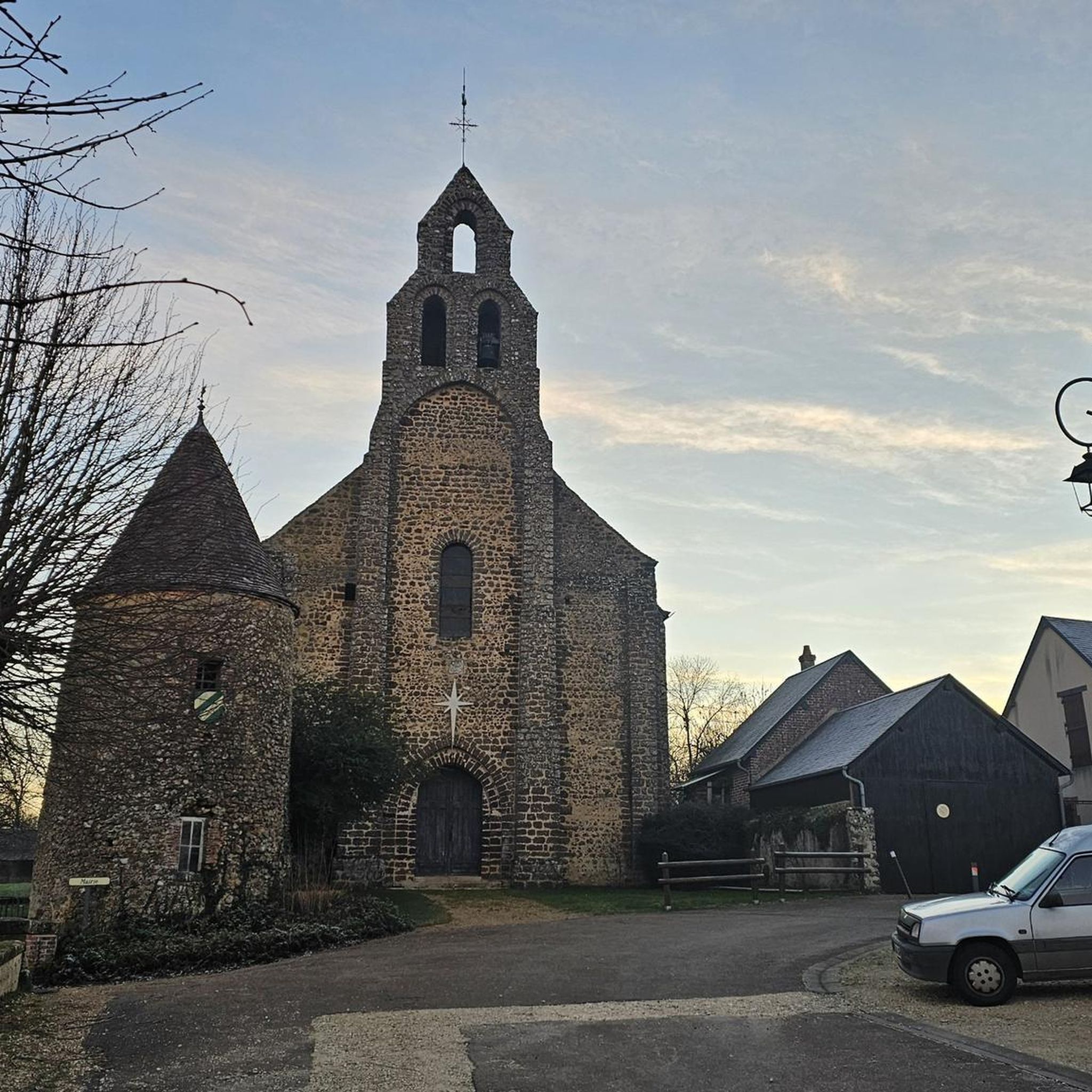
Mentioned as early as the 13th century as a dependency of the abbey of Saint-Père, near Chartres, the Notre-Dame des Étilleux church comprises three disparate parts, the most surprising of which is the four-level bell tower, topped by a belfry covered in slate and a lanternon. Protestants are said to have held a sermon there in 1577. Since its foundation, the church has undergone many transformations, notably the rather recent decoration of the choir, an intertwining of fair-weather cumulus clouds in stucco that allows one to guess the original stone wall and a pointed arch opening. A beautiful flamboyant door opens to the west onto a parvis renovated in 1995, and the eastern part, on the sacristy side, has retained its row of gargoyles adorning the choir's slopes. This church is renowned for the very beautiful statue it houses: a Virgin and Child whose pronounced hip sway, facial expression, and the drapery of the mantle are characteristic of a 14th-century representation.
0
0
The construction of the church of Coudray en Perche dates back to the 12th century, but the 16th century saw its enlargement by the addition of a higher choir with a stone vault. The interior is distinguished by the nave's inverted ship-hull structure with its painted ceiling and four equally painted beautiful beams. Also noteworthy are the stone baptismal fonts with their scaly wooden lid, which bears a sculpted angel's head. All the windows were remodeled as was often the custom in the Renaissance. In the 19th century, a gallery was built for the children of the sisters' school. Above, admire the stained glass window "Let the little children come to me." The opening of the chancel window led to the modification of the main altarpiece, due to the generosity of the Prince of Henin, owner of the Château de Montgraham. The pretty stained glass window, which thus descends into the middle of the altarpiece, relates to the story of the church's patron saint: it is a depiction of Jesus handing the keys to Saint Peter.
0
0
The church of Saint-Georges de Souancé is a vast edifice 34 m long. Built in the 16th century, perhaps on an older edifice, it was remodelled several times in the 19th century: notably in 1862 with the addition of a sacristy and a small chapel, while in 1894 the openings in the nave were enlarged and the choir vault was redone. The plan of the church consists of a nave of four bays, a choir bay of the same width, and a pentagonal apse. The bell tower, of square plan, is connected by a narrow passage to the nave. The sacristy, built in the 19th century, communicates with the choir bay; finally, the adjoining chapel opens onto the right part of the apse. The exterior silhouette of the edifice, situated on a steep slope, is dominated by the pointed gable of the apse. The bell tower, 21 m high, is topped by a four-sided roof. The first two levels could date from the 13th century, as suggested by the thickness of its walls, the arrangement of the slightly projecting buttresses, the narrow arched windows, long since blocked up. A strongly projecting band externally marks the separation of these two levels. Only the last storey, which houses the bells, is pierced by high windows; it is built slightly set back from the base of the tower, the setback being highlighted by a stone chamfer. The gable of the west facade, slightly less high than that of the choir, has, like it, a very pointed profile. It is finished with a rondel and crochets. The flamboyant-style portal is of a fairly common design: the depressed arch, flanked by two pilasters, is surmounted by a volute with acanthus leaves. A pointed arch window with two lancets opens in the gable wall, in the same axis as the portal. Two thick corner buttresses were probably built in the 16th century. The Count of Souancé states that the windows opened in the side walls last century replaced older semi-circular windows. Inside the edifice, the nave is covered with a wooden ceiling, referred to as "bardeaux" at the beginning of the century, while the 16th-century choir is vaulted with ogival cross vaults. The study of the stained glass windows and the coats of arms of the Le Breton, lords of Vilandry, the Souancé and Montdoucet, which appear on the keystones of the first two bays of the choir, seem to establish that the construction, begun around 1520, was completed before 1542. The stained glass windows of the choir tell the life of Saint George, patron saint of the church. After being subjected to poorly documented dismantling, they were reassembled in disorder during the 19th century. However, classified in 1907, they were re-leaded in 1923, a restoration that justified the award in 1926 of a prize of 5,000 F granted by the Académie des Inscriptions et Belles-Lettres from the Pellechot legacy. The Count of Souancé, a correspondent of this Academy, requested and obtained, in 1930, the inscription of the choir and bell tower of the church in the supplementary inventory, then, in 1935, the protection of the facade and of the wooden ceiling covering the nave. This protection was justified by the desire to prevent ill-conceived restorations from compromising the work that had just been completed by the architect of the Historical Monuments, Maunoury. The Count of Souancé recalled the unfortunate interventions that had previously been carried out in the edifice: widening of the nave windows, opening of reinforced concrete dormer windows in the tower roof, and, even more serious, the removal of the wall paintings uncovered in 1874, during the change of the altar. La Sauvegarde de l'Art français granted in 2002 a contribution of €7,000 for the sanitation works of the edifice and for the restoration of the bell tower. These works had been deferred for six years.
0
0
Under the Ancien Régime, the lordship of Béthonvilliers, located in Perche Gouët, depended on the lord of Authon. The parish belonged to the diocese of Chartres. The Saint-Martin church is built on a slight elevation, with the cemetery to the north. The very simple building consists of a single nave ending in a semi-circular apse. To the south stand a chapel with an almost square plan and a sacristy that communicates with the choir. The nave probably dates from the 16th century, the apse, rebuilt several times, dates from 1873-1875. The chapel predates the end of the 17th century, and the sacristy dates from the end of the 18th or the beginning of the 19th century; it seems that on the north side there was another chapel whose layout was symmetrical to that of the current sacristy. The west facade is devoid of any ornamentation: it is supported by two buttresses and surmounted by a bell tower, both late; the pointed arch entrance door is also from the 19th century. The north side facade bears the traces of the numerous modifications that took place over three centuries. On the wall of the first bay, we can still see the outline of the old door, arched and molded, opening onto the cemetery. On the choir wall, we can guess the frame of an old blocked-up door that opened onto the vanished chapel. In the upper part of the wall appears the outline of the oculus which was sealed up, when the windows of the new chevet were opened: it has its counterpart to the south, both obliquely illuminating the altar. This north facade is pierced by unequal openings, two of them, in pointed arch, have a tracery that dates from the work of the late 19th century. In the central bay opens a narrower window, undoubtedly old. The openings on the south facade correspond to those on the north facade and seem to be of the same date. The chapel is lit by a round-arched window on the east side. Internally, the nave is covered with paneling, in poor condition. The walls bear old plasterwork which has been covered with several layers of whitewash; traces of polychromy are noted on the intrados of the main arch and in several places in the nave. A Christ in Glory stands at the entrance to the choir. The Sauvegarde de l’Art français granted, for the 2003 financial year, a sum of €7,000 for significant waterproofing work: masonry, carpentry, roofing.
0
0

In the Middle Ages, Saint-Avit-au-Perche was a priory of the abbey of Saint-Calais, founded by Avit's companion. Today's church dates from the very beginning of the 12th century. It consists of a five-bay nave ending in a semicircular apse. It is covered with chestnut shingles. Several original windows remain; others have been reworked (including the first window, on the north side). This can be seen in the shape of the keystones. A walled-up side door to the south can be seen from the outside. It has an enormous mitre lintel. Inside, it has been transformed into a niche housing Our Lady of Lourdes. The apse is flanked by projecting buttresses. Those at the corners of the façade are from the 15th century. The western portal in a pointed arch is a 15th-century renovation that was completely redone at the end of the 20th century.
0
0
From its source to its confluence with the Ozanne, the Sainte-Suzanne covers 19.2 km and crosses 5 communes. From upstream to downstream: Authon-du-Perche; Beaumont-les-Autels; Coal pits; Les Altars-Villevillon; A glass.
0
0
Building built in the 15th century, ribbed vaulted, with straight apse; beginning of the 16th century, c. 1530, construction of the Sainte-Barbe chapel on the south side; Renaissance stained glass, not. Tree of Jesse (surviving fragments); 17th century altarpiece and high altar. History of protection: the classification order of April 25, 2003 replaces the classification order of February 11, 1911 and the registration orders on the supplementary inventory of historic monuments of January 20, 1926 and February 4, 2002.
0
0
Frequently Asked Questions
How many road cycling routes are available around Arville?
There are over 65 road cycling routes around Arville, offering a wide range of options for different skill levels. You'll find 19 easy routes, 45 moderate routes, and 1 more challenging route.
What kind of terrain can I expect on road cycling routes near Arville?
The region around Arville, part of the Gâtinais Français Regional Natural Park, features a diverse topography. You can expect a mix of expansive forests, open agricultural plains, and rolling hills. Routes often follow valleys carved by rivers like the Seine and Essonne, providing varied scenery and a balance of flat sections and moderate climbs.
Are there circular road cycling routes available around Arville?
Yes, many of the road cycling routes around Arville are designed as loops, allowing you to start and finish in the same location. For example, the Châteaux and Seigneuries of Perche Loop is a popular circular route that offers scenic views of historical châteaux and the countryside.
What scenic viewpoints can I expect along road cycling routes in Arville?
Road cycling routes in Arville often pass through the varied landscapes of the Gâtinais Français Regional Natural Park, offering scenic views of alternating forests, open agricultural plains, and rolling hills. You'll also find picturesque stretches along river valleys and charming rural vistas.
Are there any historical sites or châteaux I can visit while road cycling near Arville?
Yes, the region is rich in historical sites. You can cycle past or near notable attractions such as the Domaine national de Fontainebleau and the Parc du château de Vaux-le-Vicomte. Other châteaux with remarkable gardens, like the Château de Courances and the Parc and Château de Chamarande, are also accessible. For specific local points of interest, consider visiting the Notre-Dame Church of Chapelle-Guillaume or the Ruins of Guériteau Chapel.
What natural features will I encounter on road cycling routes around Arville?
The routes around Arville are set within the Gâtinais Français Regional Natural Park, known for its diverse natural features. You'll encounter expansive forests and woodlands, open agricultural plains, and rolling hills. The landscape is also shaped by valleys and rivers like the Seine, Juine, and Essonne, providing varied and scenic backdrops for your ride.
What is the best time of year for road cycling in Arville?
The spring and autumn months generally offer the most pleasant conditions for road cycling in Arville, with milder temperatures and beautiful scenery. The Gâtinais region is particularly known for its autumn foliage. Summer can also be enjoyable, though it's advisable to start earlier in the day to avoid the midday heat.
Is it possible to reach Arville by public transport with a bicycle?
While Arville is a rural commune, public transport options to the broader Seine-et-Marne department and nearby towns exist. It's recommended to check specific train or bus services for their bicycle carriage policies, as these can vary. For detailed information on public transport with bicycles, consult the regional transport authority websites.
Are there parking facilities for cyclists in Arville?
Parking is generally available in and around Arville, particularly in the town center or near popular starting points for routes. As a rural area, finding suitable parking for vehicles transporting bicycles is typically manageable, but specific designated cyclist parking might be limited. Always check local signage for parking regulations.
Are there family-friendly road cycling routes in Arville?
Many of the routes around Arville are suitable for families, especially those that traverse the flatter agricultural plains or follow quieter country roads. The region offers 19 easy routes that are generally less demanding. Always check the route details, including distance and elevation, to ensure it matches your family's fitness level.
Can I find places to eat or stay along the road cycling routes?
Yes, the region around Arville has charming small villages and towns where you can find cafes, restaurants, and accommodation. Nearby towns like Puiseaux, Nemours, and Fontainebleau offer local markets and dining options. It's a good idea to plan your route to include stops in these areas for refreshments or overnight stays.
What do other road cyclists say about the routes around Arville?
The road cycling routes around Arville are highly rated by the komoot community, with an average score of 4.75 stars from over 3 reviews. Cyclists often praise the varied terrain, which includes expansive woodlands, agricultural plains, and rolling hills, as well as the opportunities to explore historical châteaux and charming villages.
Are there routes that explore the Gâtinais Français Regional Natural Park?
Absolutely. Arville is situated within the Gâtinais Français Regional Natural Park, and many routes, such as the Stage 1 of the Véloscénie – Château de Montmirail loop from Arville, lead directly through its diverse landscapes. You'll experience the park's characteristic forests, plains, and rolling hills, often with views of its unique geological features.
Most popular attractions around Arville

Get inspired with the komoot mobile app


Explore more
Browse the best Road cycling routes in other regions.
