Attractions and Places To See around Saint-Rome - Top 20
Best attractions and places to see around Saint-Rome, a commune in the Haute-Garonne department of France, offers local points of interest and access to the broader Occitanie region. The area features natural landscapes where the Hers river intersects the Canal du Midi, alongside historic villages. It serves as a starting point for exploring cultural sites and natural features in the surrounding departments.
Best attractions and places to see around Saint-Rome
- The most popular attractions is Canal du Midi, a…
Last updated: May 11, 2026
Hers Crossing
Highlight • Other
Translated by Google •
Tip by

Montesquieu-Lauragais Village
Highlight • Settlement
The village was born from a feudal castle dating back probably to the beginning of the 10th century. A very old document reveals that in 1162, the …
Translated by Google •
Tip by

Sign up now to discover places like this
Get recommendations on the best single tracks, peaks, & plenty of other exciting outdoor places.
Sign up for free
Montgeard and its church
Highlight • Other
Translated by Google •
Tip by
Pilgrims' hostel near Ayguesvives
Highlight • Other
Translated by Google •
Tip by

Canal du Midi
Highlight (Segment) • Other
A beautiful car-free route along the always magical …
Translated by Google •
Tip by

Sign up for free to discover even more attractions around Saint-Rome.
Sign up for free
Already have an account?
Start today with a free account
Your next adventure awaits.
Login or Signup



Tips from the Community

Very beautiful church, typical of the southwest.
0
0

A pilgrims' hostel run by the Association of Friends of the Way of St. James Occitaine in a former lock keeper's house. Since April 2023, pilgrims with ID / Credencial can stay here for €17 per night. Breakfast is available for a donation. There are 14 places. It is advisable to reserve the evening before. The surroundings are very beautiful. Unfortunately, the traffic from the nearby motorway is very loud outside. ---- Gîte d'étape à Ayguesvives Ecluse du sanglier 31450 AYGUESVIVES Tel : +33 5 34663009 https://www.chemins-compostelle.com/hebergeur/fiche/1256/ayguesvives-gite-d-etape-haute-garonne-occitanie
0
0


"A 240.129 km long, 2.25 to 2.50 m deep waterway was declared a cultural monument as a "bridge" between the Mediterranean and the Atlantic with 328 structures such as bridges - such as the canal bridge over the Orb -, locks - such as the 7 lock cascades of Fonserrannes -, tunnels, aqueducts and 49 canals over streams and rivers." says the documentary from "Treasures of the World - Heritage of Humanity", a television series that brings world heritage sites closer to the culture-loving viewer (in German). The episode about the CANAL DU MIDI is available in the ARD media library under this link: => https://www.ardmediathek.de/video/schaetze-der-welt/gcanal-du-midi-frankreich-aufnahme-224/swr/Y3JpZDovL3N3ci5kZS82OTg2NDg2
2
0


With the canal over the river, unfortunately the short section of the surface is very rocky. More information: https://de.wikipedia.org/wiki/Canal_du_Midi?wprov=sfla1
4
0

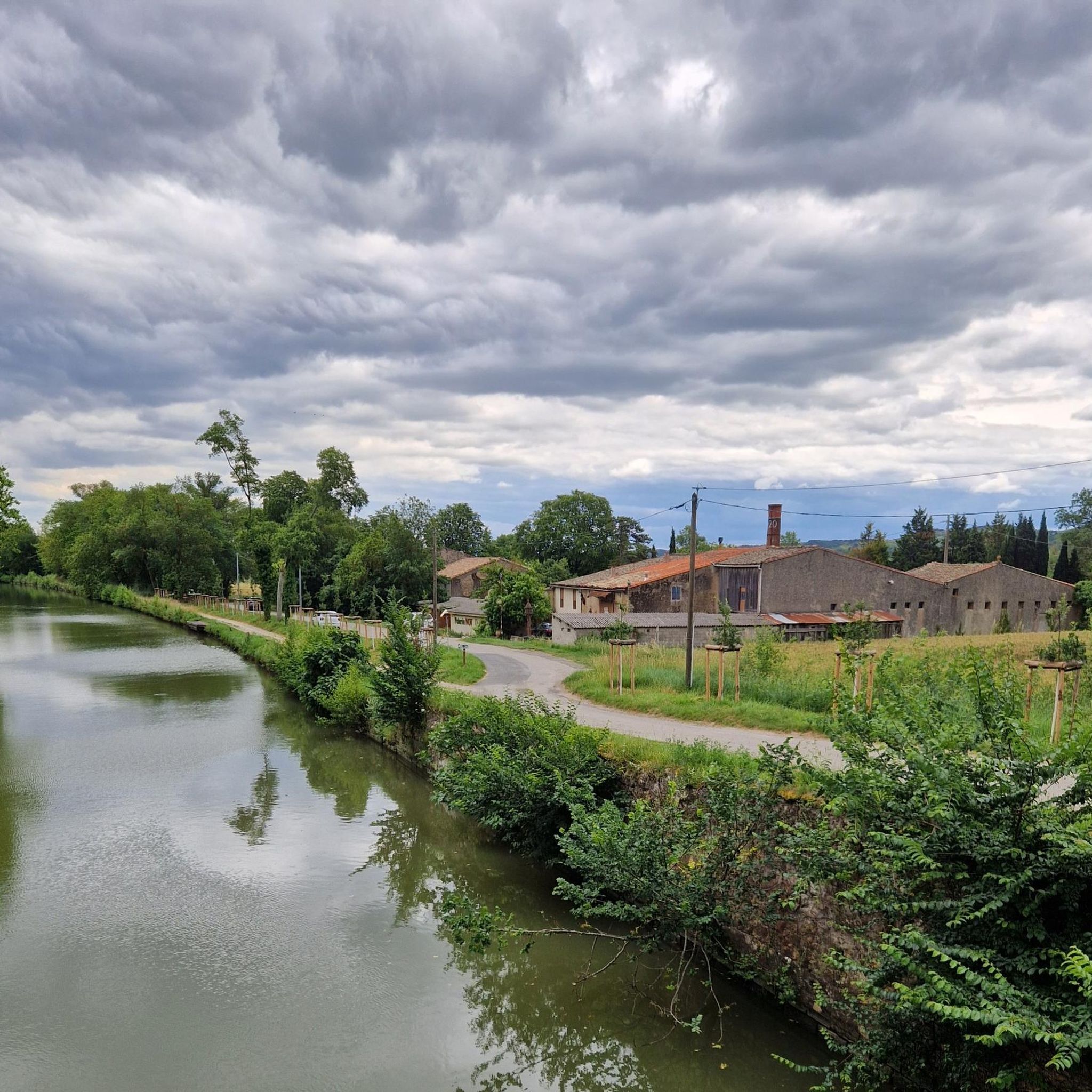
At this level, we observe how the Hers crosses the Canal du Midi. The Hers valley is also home to a truly magnificent greenway!
3
0

A castle village The village was born from a feudal castle dating back probably to the beginning of the 10th century. A very old document reveals that in 1162, the town bore the name of “Monteschivum”, made up of “mont” and a qualifier from the German word “esquiu”, which in Old French gave “eschiu”, c ' that is to say: wild, hostile, fierce. The village was called "Montesquieu" until 1797, then "Montesquieu-sur-le-Canal" and finally Montesquieu-Lauragais since 1889. At the top of the hill ... Montesquieu was installed on a height, to be easy to defend and favorable to the surveillance of the surroundings. Until the 13th-14th century, the region was covered by a thick forest (from Montaudran to Naurouze), a landmark for many brigands. The systematic clearing of this forest began with the installation of bastides in the 13th century, such as those of Villenouvelle, Saint-Rome and Villefranche. In the 18th century, the Hers pipeline accelerated its disappearance. A turbulent history In the 12th-13th century, Montesquieu was a hotbed of Catharism, with a dozen Cathar “houses” and even a Cathar cemetery, perhaps located in Le Rouquet. During the religious wars of the 16th century, the village was Protestant like many others in the region. After a siege of ten days, the Duke of Joyeuse and his Catholic troops reconquer it and completely destroy it in 1586. The inscription preserved next to the entrance to the sacristy proves that the work of reconstruction of the church , and undoubtedly from the village, began as early as 1600. Pastel blue In the 15th and 16th centuries, the pastel grew in a land of Laurentians certainly better than today, impoverished by the wheat-corn rotation which made the glory of the Toulouse region from 1820 to 1880. Written sources mention Montesquieu as a place of purchase of pastel between 1450 and 1540. They indicate the existence of “botigas del pastel” and pastelier mills. They numbered 16 at the beginning of the 15th century and another 9 in the 17th century.
1
1
Frequently Asked Questions
What natural features can I explore around Saint-Rome?
The region around Saint-Rome offers several natural features. You can visit the Hers Crossing, where the Hers river intersects with the historic Canal du Midi. The Hers valley also features a magnificent greenway, ideal for outdoor activities. The Canal du Midi itself is a UNESCO World Heritage site, offering pleasant car-free routes along its banks.
Are there any historic villages or cultural sites to visit near Saint-Rome?
Yes, the area is rich in history. The Montesquieu-Lauragais Village is a historic castle village dating back to the 10th century, strategically built on a height for defense. You can also explore Montgeard and its church, a 'pastel church' built during the golden age of pastel culture in Lauragais. Further afield, Toulouse offers heritage sites like Hôtel-Dieu St Jacques and Basilique St Sernin, while Mirepoix is known for its well-preserved bastide town center.
What outdoor activities are popular around Saint-Rome?
The region is excellent for outdoor activities, especially cycling and running. You can enjoy car-free riding along the Canal du Midi. For cycling, there are routes like the 'Écluse de l'Océan – Canal du midi loop' or the 'Renneville lock – Hers Crossing loop'. Runners can find trails such as the 'Running loop from Villenouvelle' or the 'Sanglier Lock loop'. Explore more options on the Cycling around Saint-Rome and Running Trails around Saint-Rome guide pages.
Are there family-friendly attractions or activities near Saint-Rome?
Beyond the general appeal of exploring historic villages and greenways, families might enjoy attractions in nearby Toulouse, such as the Cité de l'Espace, a space-themed museum and park. The Jardin des Martels, located about 39 km away, is also a notable garden with a mini-farm that can be fun for children.
What is the best time of year to visit Saint-Rome and its attractions?
The region generally enjoys pleasant weather for outdoor activities from spring through early autumn. Visiting during these seasons allows for comfortable exploration of the Canal du Midi, historic villages, and trails. Summer can be warm, making early mornings or late afternoons ideal for activities. Spring and autumn offer milder temperatures and beautiful scenery.
Can I find easy hiking or walking trails around Saint-Rome?
Yes, there are several easy routes suitable for walking or cycling. The greenway along the Hers valley near the Hers Crossing is generally flat and pleasant. The Canal du Midi also offers many accessible, car-free sections that are ideal for leisurely walks. For specific easy cycling routes, you can check options like 'La Calandre – Hidden Picnic Spot by the Pond loop' on the Cycling around Saint-Rome guide.
What do visitors particularly enjoy about the attractions near Saint-Rome?
Visitors appreciate the blend of natural beauty and historical significance. The car-free riding along the 'ever magical' Canal du Midi is a highlight, as is observing the unique Hers Crossing. The historic charm of places like Montesquieu-Lauragais Village and the architectural beauty of Montgeard's church are also frequently praised.
Are there any unique or 'hidden gem' spots worth discovering?
While not strictly 'hidden,' the Pilgrims' hostel near Ayguesvives, located in a former lock keeper's house, offers a unique glimpse into the historical pilgrim routes and provides a charming stop along the Canal du Midi. The small village of La Pomarède, in the Aude department, also offers a quieter, authentic local experience.
Where can I find accommodation or places to eat near the attractions?
While Saint-Rome itself is a smaller commune, nearby towns offer more options. The Pilgrims' hostel near Ayguesvives provides accommodation for pilgrims. Larger towns like Toulouse, approximately 28 km away, offer a wide range of hotels, restaurants, and cafes. Smaller villages along the Canal du Midi or in the Lauragais region will have local eateries and guesthouses.
What are some notable towns or cities to visit in the broader Occitanie region from Saint-Rome?
Saint-Rome serves as a good base for exploring the Occitanie region. Toulouse, a major city known for its red-brick architecture and cultural sites, is about 28 km away. Revel, 27 km east, is famous for its large arcaded central square and market. Castelnaudary, 25 km east-south-east, features a pleasant canal port. Other towns like Soreze, Pamiers, and Mirepoix also offer significant historical and architectural interest.
Are there any specific cycling routes for road bikes around Saint-Rome?
Yes, road cyclists can find several routes in the area. Options include the 'Aqueduc des Voûtes loop from Roudeille,' the 'Seyre Castle – Lac de Nailloux loop from Gardouch,' and the 'Hers Crossing – Canal du Midi loop from Gardouch.' These routes offer varying distances and moderate difficulty. You can find more details on the Road Cycling Routes around Saint-Rome guide page.
Most popular routes around Saint-Rome

Get inspired with the komoot mobile app


Explore more
Still not found the Highlight you’re looking for? See guides of the top attractions in other regions:
