The best cycling routes around Saint-Laurent-De-Belzagot
4.6
(10)
77
riders
26
rides
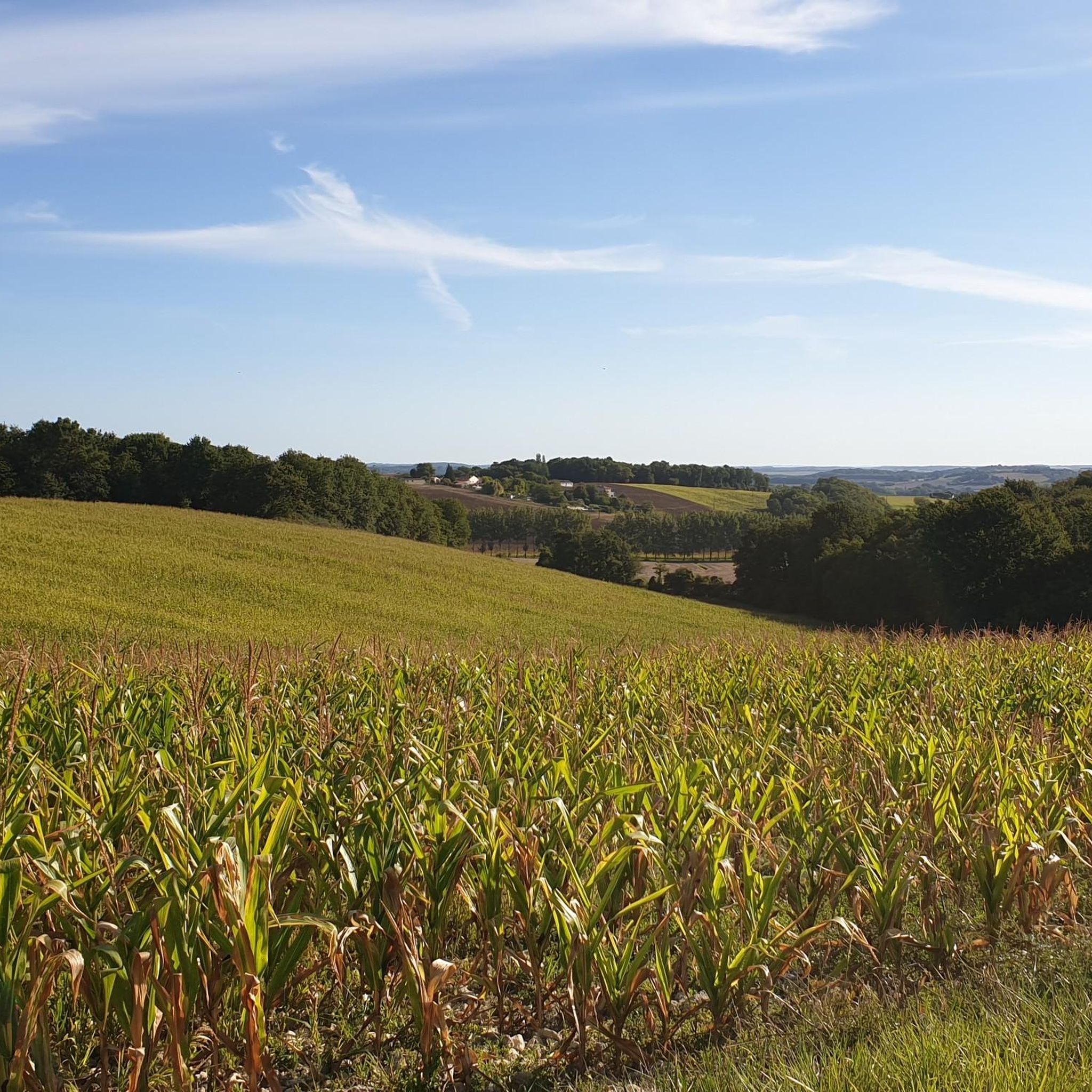
Touring cycling around Saint-Laurent-De-Belzagot features routes through river valleys, past lakes, and across rolling countryside. The region is characterized by its waterways, including the Charente River, and agricultural landscapes, offering varied terrain for cyclists. Elevation gains are present, with some routes featuring significant ascents.
Best touring cycling routes around Saint-Laurent-De-Belzagot
- The most popular touring cycling route is Lake Saint-Yrieix – La voie verte loop from Montmoreau, a 107.9 miles (173.7 km) trail that takes 10 hours 47 minutes to…
Last updated: May 20, 2026
2
riders
173km
10:43
1,430m
1,430m
Hard bike ride. Very good fitness required. You may need to push your bike for some segments of this route.
5.0
(1)
11
riders
187km
11:51
1,690m
1,690m
Hard bike ride. Very good fitness required. Mostly paved surfaces. Suitable for all skill levels.

Sign up for free
5.0
(4)
5
riders
27.2km
01:51
400m
400m
Moderate bike ride. Good fitness required. Mostly paved surfaces. Suitable for all skill levels.
4.0
(1)
4
riders
36.9km
02:17
340m
340m
Moderate bike ride. Good fitness required. Mostly paved surfaces. Suitable for all skill levels.
5
riders
37.5km
02:18
340m
340m
Moderate bike ride. Good fitness required. Mostly paved surfaces. Suitable for all skill levels.
Get access to more routes and recommendations from other explorers.
Sign up for free
Already have an account?
Our route recommendations are based on thousands of hikes, rides, and runs completed by other people on komoot.
Start today with a free account
Your next adventure awaits.
Login or Signup



Tips from the Community


Beautiful little town center
0
0

Very narrow passage to drive through. You always have to be a little careful.
1
0

Marie atypical and picturesque which is located in a former small manor beautifully restored. There is a lighted well placed in the center of its hall of honor. This town hall is undoubtedly one of the most beautiful in Charente. https://www.montmoreau.fr/index-module-orki-page-view-id-114.html
0
0
Passage which allows you to see the town hall building, authentic and well restored, that of the church and a beautiful panorama of Montmoreau.
0
0
This is one of the six Romanesque churches in the new commune of Montmoreau. It is located in the heart of a very hilly landscape, perched on top of a hill, and offers a beautiful view of the center of Montmoreau. The construction of this Romanesque church dates back to the 12th century. At that time, it was a former vicarage of the diocese of Périgueux, dependent on the abbey of Nanteuil-en-Vallée. The nave now houses a set of well-preserved neo-Gothic furniture from the 19th century. There are a Stations of the Cross, a pulpit, and a painting of Saint-Amand (Bishop of Bordeaux in the 5th century). On the south wall of the nave, there are traces of a wall painting that is unfortunately very damaged, but one of the characters can still be distinguished: a light tonsured man. These remains are a reminder that religious buildings were generally painted in medieval times. The painted scenes covered the interior space, more the sanctuary, reserved for the religious, than the nave where the laity were confined. https://www.montmoreau.fr/index-module-orki-page-view-id-115.html
0
0
Church located near the cemetery. It is a Romanesque church, pierced by an ogival door on important corner buttresses. Rebuilt in the 15th century, it was restored from 1656 to 1668, then in 1830. Two side chapels were added, and an arcade bell tower on the facade. https://fr.wikipedia.org/wiki/Juillaguet
0
0
Montmoreau Castle is in the new commune of Montmoreau in Charente Montmoreau is a new French commune located in the Charente department, in the Nouvelle-Aquitaine region. It was created on January 1, 2017 from the merger of Montmoreau-Saint-Cybard, Saint-Amant, Saint-Eutrope, Saint-Laurent-de-Belzagot and Aignes and Puypéroux. Montmoreau Castle stands at the top of a natural hill overlooking the Tude Valley. In the centuries of instability and disorder that followed the collapse of Roman Gaul, the invasion of the Arabs from Spain around 700 and the Viking raids in 844 added to the anxiety of the populations of our region. Then the disintegration of the Carolingian empire led to a dispersion of the centers of power from which feudalism would be born. This is why the 10th and 11th centuries were a time when a large number of fortified entrenchments or camps were established, often built on "castral mounds", which are at the origin of many of today's "castles". The hill of Montmoreau offered in a way a perfect natural mound for the construction of what was probably at first a simple fortified camp and became a feudal castle in the 11th century. It occupied the platform and was provided with a double fortified enclosure. The two round towers of the current building belonged to the feudal castle. Likewise the porch chapel, Notre-Dame chapel, which was located in the first enclosure. But excavations would surely reveal traces of other remains. The current castle was built on this same site in the middle of the 15th century, perhaps by Guy de Mareuil, lord of Montmoreau, Villebois and Mareuil. With the exception of the two feudal towers, the entire building is partly Gothic and partly Renaissance. It is a perfect witness to this pivotal period between a world that was ending and a world that was beginning. Over the centuries, it seems that the various lords and then owners of the castle never had enough money to add buildings from different periods to the building, as can be seen in so many other castles. Preserved almost intact since its construction, the castle of Montmoreau therefore offers an architectural heritage of exceptional purity. The renovations carried out by the current owner aim, by reinforcing the solidity of the buildings, to restore the original aspects under the few modifications that have been made. Towards the east, overlooking the Tude valley, the castle displays a façade that looks great with its high main building flanked by the two round feudal towers and its sloping roofs of flat tiles from which the chimneys emerge. On the side of the north tower, about halfway up, we can make out an old door that opened onto the castle's patrol path. The Gothic gables of the central body bristle with stone plant crosiers. Their bases are seated on two sculptures of "intimidating lions", one opening its mouth to the north, the other to the south, and they are crowned by a finial. To the north and south, a pavilion leans against the gable. The southern one has just regained its original three-sided roof. Towards the west, the façade that faces the park also mixes eras. The mullioned Renaissance windows retain civil Gothic motifs. The hexagonal tower of the staircase projects from the façade. It has a very beautiful door in flamboyant Gothic style, with a tympanum sculpted with prismatic ribs and intertwined foliage practically erased by the erosion of time. But if you look closely, you can make out a bird in profile among the foliage on the right side. Perhaps the signature of the stonemason artist. In the corner of this tower and the façade, stands a watchtower with a pointed bell tower made of chestnut essentes (a type of shingle) whose base in a "cul-de-lampe" is completely in the Renaissance style. Source: https://montmoreau.fr/index-module-orki-page-view-id-116.html#:~:text=L'%C3%A9difice%20a%20%C3%A9t%C3%A9%20class%C3%A9,%C3%A9difice%20par%20la%20nef%20porche. https://fr.wikipedia.org/wiki/Ch%C3%A2teau_de_Montmoreau https://monumentum.fr/monument-histoire/pa00104431/montmoreau-chateau
0
0
Frequently Asked Questions
How many touring cycling routes are available around Saint-Laurent-De-Belzagot?
There are over 25 touring cycling routes in the Saint-Laurent-De-Belzagot area, offering a variety of distances and difficulty levels through river valleys, past lakes, and across rolling countryside.
Are there easy touring cycling routes suitable for beginners in Saint-Laurent-De-Belzagot?
While there are no routes officially graded as 'easy', there are 13 moderate touring cycling routes that offer a less strenuous experience. These routes often feature rolling countryside and can be a good option for those looking for a more relaxed ride.
What are some challenging touring cycling routes for experienced cyclists?
For experienced touring cyclists seeking a challenge, there are 14 difficult routes available. Notable options include the Old station portico – Along the Charente River loop from Montmoreau, which covers 170.9 km with significant elevation gain, and the Lake Saint-Yrieix – La voie verte loop from Montmoreau, a 187.0 km path incorporating a greenway.
Are there any family-friendly touring cycling routes in the area?
The Beautiful views – Duck family loop from Pillac is a moderate 27.2 km route that takes about 1 hour 51 minutes to complete. It leads through rolling countryside and is often enjoyed by families looking for a pleasant ride.
What kind of scenery can I expect on the touring cycling routes?
The routes around Saint-Laurent-De-Belzagot are characterized by picturesque river valleys, tranquil lakes, and expansive agricultural landscapes. Many paths follow the Charente River, providing extensive views of the waterway and the surrounding rural beauty.
Are there any circular touring cycling routes available?
Yes, many routes in the area are circular, allowing you to start and finish at the same point. Examples include the Étang du Risbadoux loop from Montboyer, a 37.6 km moderate route, and the Montmoreau Castle loop from Montmoreau, which is 36.9 km long.
What are some interesting landmarks or attractions to see along the routes?
The region offers several historical and natural points of interest. You can explore the charming village of Aubeterre-sur-Dronne, visit the unique Monolithic Church of Saint-Jean within Aubeterre-sur-Dronne, or see the historic Château de la Léotardie. The Saint-Eutrope Church of Montmoreau is another notable religious building in the vicinity.
What is the best time of year for touring cycling in Saint-Laurent-De-Belzagot?
Spring and autumn generally offer the most pleasant conditions for touring cycling, with milder temperatures and beautiful scenery. Summers can be warm, while winters are typically damp, making these shoulder seasons ideal for exploring the region by bike.
What do other touring cyclists enjoy most about the routes in Saint-Laurent-De-Belzagot?
The touring cycling routes in Saint-Laurent-De-Belzagot are highly rated by the komoot community, with an average score of 4.75 stars from more than 10 reviews. Cyclists often praise the varied terrain, the scenic views along the Charente River, and the peaceful agricultural landscapes.
Are there any routes that incorporate greenways or dedicated cycle paths?
Yes, some routes, like the Lake Saint-Yrieix – La voie verte loop from Montmoreau, incorporate sections of 'voie verte' (greenway), which are dedicated paths often built on disused railway lines or canal towpaths, offering a smooth and traffic-free cycling experience.
Most popular routes around Saint-Laurent-De-Belzagot
Most popular attractions around Saint-Laurent-De-Belzagot

Get inspired with the komoot mobile app


Explore more
Browse the best Cycling routes in other regions.
