The best road cycling routes around Favières
4.2
(36)
399
riders
199
rides
Road cycling routes around Favières are primarily found in a rural setting, characterized by preserved nature and green surroundings. The terrain typically features gentle rolling hills and open countryside, offering a tranquil environment for cyclists. This region provides a network of paved roads suitable for various skill levels, connecting villages and natural areas.
Best road cycling routes around Favières
- The most popular road cycling route is Fontenay-sur-Eure Church – Château de Fontaine-la-Guyon loop from Saint-Arnoult-des-Bois, a 35.4 miles (57.0…
Last updated: May 13, 2026
8
riders
7.55km
00:19
30m
30m
Moderate road ride. Great for any fitness level. Some segments of this route may be unpaved and difficult to ride.
4
riders
46.4km
01:50
170m
170m
Easy road ride. Great for any fitness level. Mostly well-paved surfaces and easy to ride.

Sign up for free
4
riders
Moderate road ride. Great for any fitness level. Some segments of this route may be unpaved and difficult to ride.
7
riders
Easy road ride. Great for any fitness level. Mostly well-paved surfaces and easy to ride.
5
riders
58.5km
02:22
280m
280m
Moderate road ride. Good fitness required. Mostly well-paved surfaces and easy to ride.
Get access to more routes and recommendations from other explorers.
Sign up for free
Already have an account?
Our route recommendations are based on thousands of hikes, rides, and runs completed by other people on komoot.
Start today with a free account
Your next adventure awaits.
Login or Signup



Tips from the Community

The parish church of Saint-Remy de Vérigny, located in the current new commune of Mittainvilliers-Vérigny, has been documented in the archives since 1126 as being dependent on the abbey of Saint-Père in Chartres. Its construction probably followed shortly after this date, as evidenced by the use of grison for both the buttresses and the frames of certain bays and the large west portal with a grison roller. The proximity of the manor and then the castle of Vérigny, owned by the prestigious families of O and Vieuville until the early years of the 18th century, encouraged donations and legacies in favor of the parish church. It is to Charles II of O that we owe the construction of the north aisle as well as the family chapel in the right bay of the choir, on the north side. The ribbed vaults and the hanging keystones sculpted with little angels evoke the creations of the second quarter of the 16th century such as those of the church of Bérou-la-Mulotière. If the only vestiges of stained glass windows preserved date from the
0
0
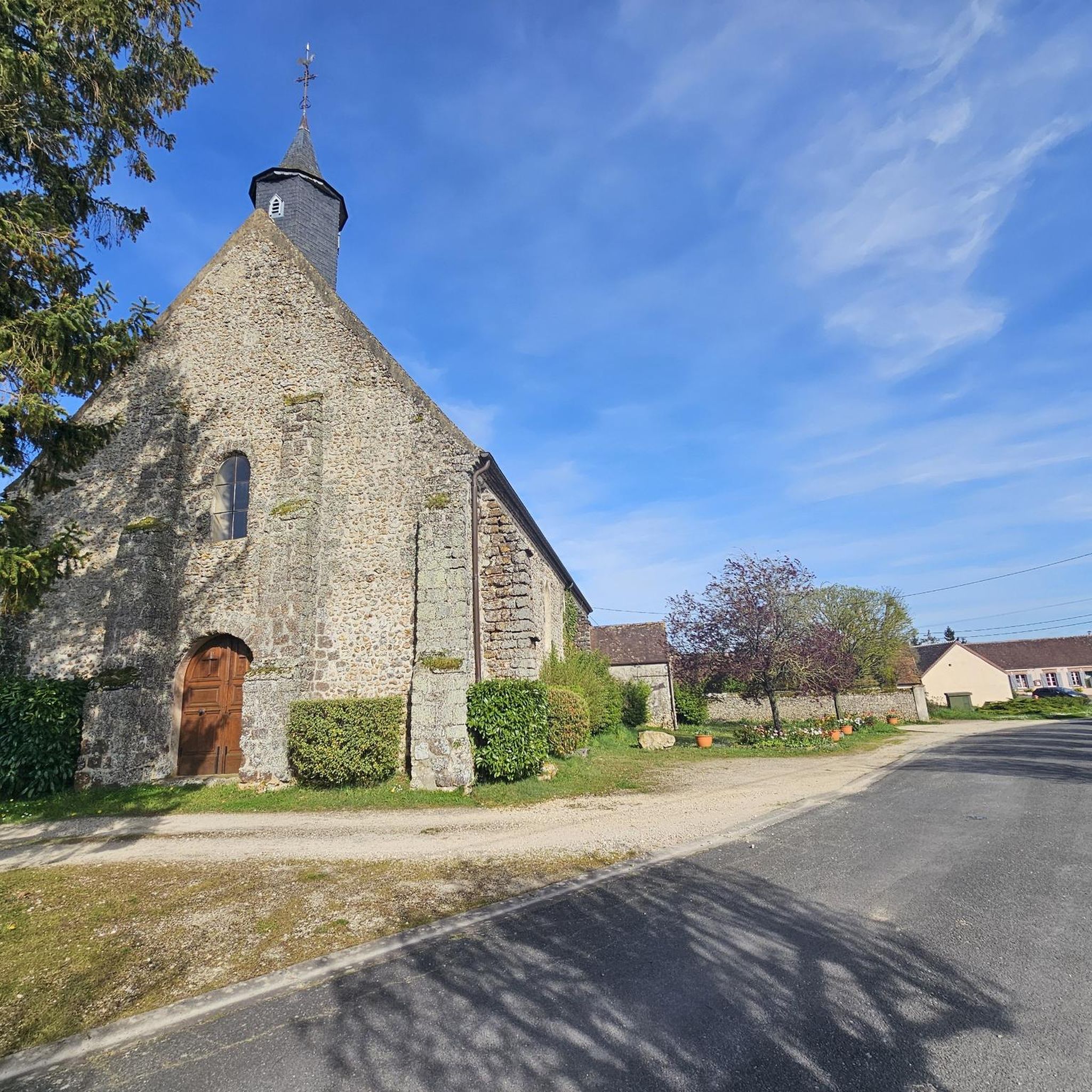
A modest place of worship, built in the middle of a tiny village, the Favril church was there as early as 1250. Under the reign of Saint Louis, Saint-Pierre du Favril was already there. This is confirmed by a register of the diocese of Chartres, drawn up in 1250, which mentions a parish church dedicated to Saint-Pierre au Favril (Faverilium). The text adds that there was a priest and 56 parishioners.
0
0
This church has Saint Martin as patron or rather protector, chosen for his holiness, example of charity, faith and mercy. This charity he showed by offering half of his coat to a shivering poor man to warm him. His radiant faith as a hermit and monk, founder in Ligugé in 460 of the first monastic community in Gaul...
0
0

Very beautiful church and the public toilets next to it are perfect, even for filling water bottles too large for the classic sinks.
0
0
Composed of a Romanesque nave with flat buttresses placed symmetrically on each side (typical of the end of the 11th century or the first half of the 12th century), it was completely remodeled in the 16th century and the end of the 20th century. The bays of the nave are from the 15th century, in flamboyant Gothic style, as is the rose window. The span of the bell tower and the choir, with ribbed vaults, date from the end of the 15th or beginning of the 16th century. As early as the 16th century, the bell tower had a clock, quite rare and expensive for the time. The pillars of the central bay are richly molded and crowned with thin bands of foliage serving as capitals. The windows are decorated with flamboyant tracery of varied designs. The Romanesque portal was also remodeled in the 16th century. The powerful central bell tower with buttresses [formerly had three bells named PIC DAN JON. There will only be one left after the Revolution, the other two having been melted down to make cannons and ammunition.
0
0
The church dating from the 12th and 17th centuries is located in its parish enclosure occupied by the cemetery. It is made up of a nave and an aisle. To the west, the Renaissance entrance portal dating from the 1st quarter of the 16th century is in the shape of a basket handle and the two wooden leaves are each composed of four ornate panels, organized in three registers, classified as historic monuments object at the same time as the building. The five-sided apse is covered with a wooden vault with visible beams and hallmarks.
0
0
The Saint-Pierre church bears within itself the testimony of the centuries by the successive contribution of what they had the possibility of offering of the most truly sacred, it appears in its harmonious silhouette at the crossroads of two great natural regions, Beauce and the Perch. A living work, injured several times but restored, it is more beautiful now than it ever was. Rebuilt at the end of the 15th century, the Saint-Pierre church has been classified as a "Historic Monument" since 1907. It has two chapels, one of which, under the imposing bell tower bearing the date 1620, forms the Latin cross. A major restoration campaign has been carried out in recent years. The roof has been completely redone, preserving the original framework. The western window blocked at the beginning of the 19th century has been restored, a new stained glass window restores its nobility. The church offers a remarkable interior, in particular its imposing altarpiece and a statue of the Trinity, both listed as heritage sites.
0
0
The Saint-Lubin church dates from the 13th century. In the 16th century, a 4-bay aisle was added to the north. In the 19th century, the door to the nave which communicated with the bishops' house was walled up. The church is decorated with wooden statues of Saint Lubin, Saint Peter and Saint Michael, as well as 13 bays of ornamental and figurative stained glass, including two signed Lorin: Mater dolorosa (bay 12) and Ecce agnus dei dated 1869 (bay n °18). The two bays of the sacristy, on the other hand, are simple wooden windows and classic glass panes.
0
0
Frequently Asked Questions
How many road cycling routes are available around Favières?
There are over 200 road cycling routes around Favières, offering a wide variety of options for different skill levels and preferences. You'll find 119 easy routes, 91 moderate routes, and 5 more challenging excursions.
What is the typical terrain like for road cycling in Favières?
Road cycling in Favières is characterized by a rural setting with preserved nature and green surroundings. The terrain primarily features gentle rolling hills and open countryside, providing a tranquil environment. The routes are mostly on paved roads connecting villages and natural areas.
What interesting landmarks or sights can I see along road cycling routes in Favières?
Many routes in Favières pass by notable landmarks. For instance, the Château de Fontaine-la-Guyon – Vérigny Castle loop from Favières takes you past both Château de Fontaine-la-Guyon and Vérigny Castle. Other attractions in the area include the Rond du Roi and Vaux Castle.
Are there any circular road cycling routes in Favières?
Yes, many of the road cycling routes in Favières are designed as loops, allowing you to start and end at the same point. Examples include the popular Fontenay-sur-Eure Church – Château de Fontaine-la-Guyon loop from Saint-Arnoult-des-Bois and the shorter Saint Martin Church loop from Favières.
Is Favières suitable for family-friendly road cycling?
Favières offers several easy routes that are suitable for families. The gentle rolling hills and quiet rural roads make for a pleasant cycling experience. Routes like the Saint Martin Church loop from Favières are shorter and have minimal elevation gain, perfect for a family outing.
What is the best time of year for road cycling in Favières?
The best time for road cycling in Favières is generally during the spring, summer, and early autumn months when the weather is mild and the countryside is lush. The preserved nature and green surroundings are particularly enjoyable during these seasons.
Are there options for parking when road cycling in Favières?
Given the rural nature of Favières and its surrounding villages, you can typically find parking in village centers or near popular starting points for routes. It's advisable to check specific starting locations for designated parking areas.
Can I access road cycling routes in Favières using public transport?
While Favières is a rural village, public transport options may be limited for direct access with a bike. It's recommended to check local bus or train schedules for connections to nearby towns, and then cycle from there. Many cyclists prefer to drive to a starting point in Favières or a nearby village.
Are there places to stop for refreshments or accommodation for cyclists in Favières?
Favières, being a rural village, has local amenities. You might find small cafes or eateries in the village center or in neighboring towns along your route. For example, Bar de la Rivière is a local spot. For accommodation, you would typically look for guesthouses or small hotels in Favières or nearby larger towns.
What do other road cyclists say about the routes in Favières?
The road cycling routes in Favières are highly rated by the komoot community, with an average score of 4.1 stars from over 35 reviews. Cyclists often praise the tranquil rural landscapes, the well-maintained paved roads, and the variety of routes suitable for different skill levels.
Are there shorter, easier road cycling routes for beginners in Favières?
Yes, Favières offers many easy routes perfect for beginners or those looking for a relaxed ride. For example, the Saint Martin Church loop from Favières is an easy 7.4 km (4.6 miles) trail with minimal elevation, often completed in under 20 minutes.
Are there longer road cycling routes for more experienced riders in Favières?
For more experienced riders seeking longer excursions, Favières has several moderate routes. The Fontenay-sur-Eure Church – Château de Fontaine-la-Guyon loop from Saint-Arnoult-des-Bois is a moderate 57.0 km (35.4 miles) route with 196 meters of elevation gain, offering a good challenge through the countryside.
Most popular attractions around Favières

Get inspired with the komoot mobile app


Explore more
Browse the best Road cycling routes in other regions.
