The best road cycling routes around Arrou
4.4
(20)
352
riders
93
rides
Road cycling routes around Arrou traverse a landscape characterized by gently rolling terrain and agricultural fields, typical of the Eure-et-Loir department in France. The region offers a network of roads connecting small villages, historical sites, and forested sections. Road cyclists can expect varied routes that wind through the countryside, providing opportunities for both endurance rides and shorter excursions.
Best road cycling routes around Arrou
- The most popular road cycling route is Porte de Boisville – Church of Bonneval loop from…
Last updated: May 21, 2026
35
riders
179km
07:25
890m
890m
Hard road ride. Very good fitness required. Mostly well-paved surfaces and easy to ride.
22
riders
146km
06:18
940m
940m
Hard road ride. Very good fitness required. Mostly well-paved surfaces and easy to ride.

Sign up for free
3.5
(2)
8
riders
Easy road ride. Great for any fitness level. Mostly well-paved surfaces and easy to ride.
6
riders
Moderate road ride. Good fitness required. Mostly well-paved surfaces and easy to ride.
5.0
(1)
4
riders
Moderate road ride. Good fitness required. Mostly well-paved surfaces and easy to ride.
Get access to more routes and recommendations from other explorers.
Sign up for free
Already have an account?
Our route recommendations are based on thousands of hikes, rides, and runs completed by other people on komoot.
Start today with a free account
Your next adventure awaits.
Login or Signup



Tips from the Community

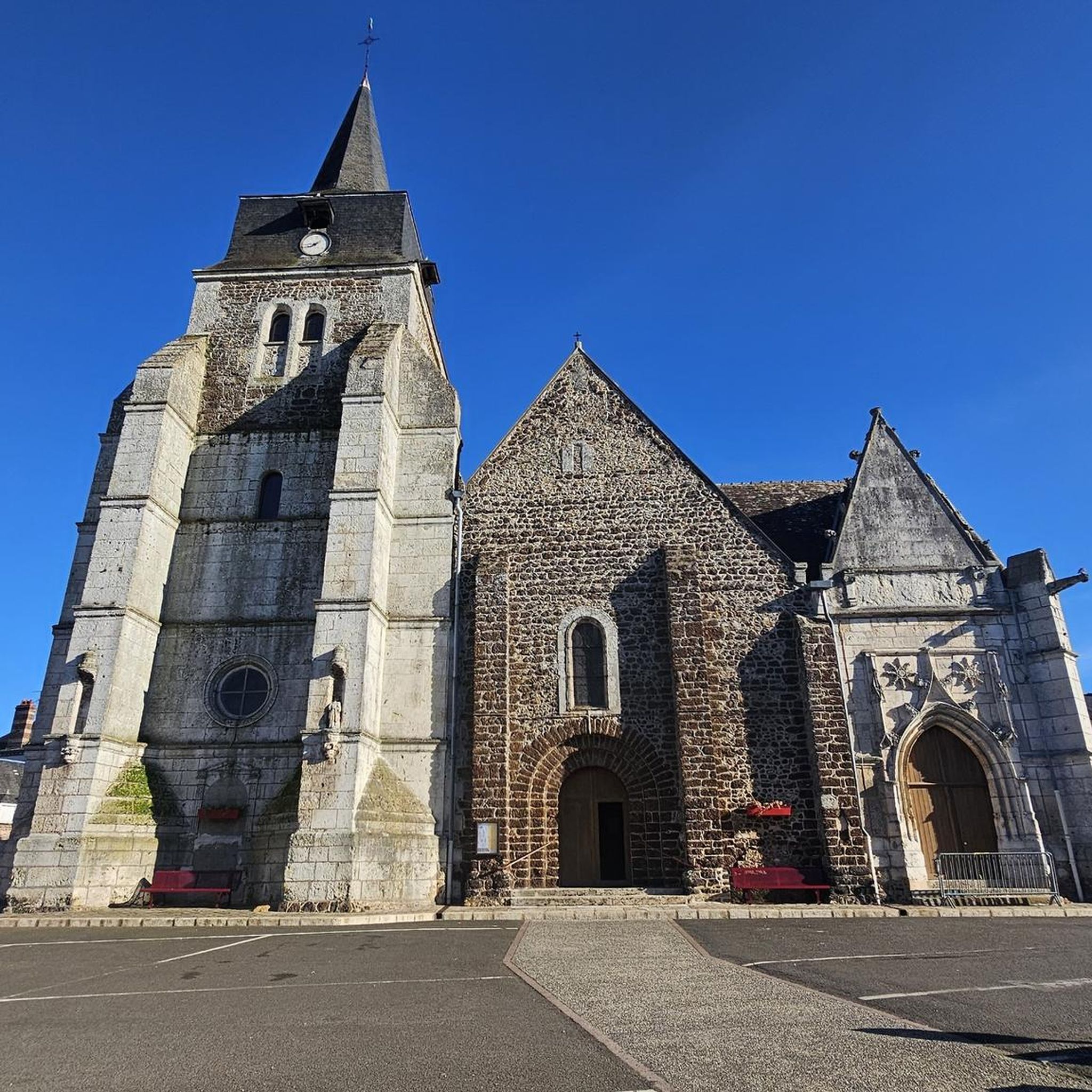
Placed under the patronage of Saint Hilaire, this parish was given by Gannelon de Montigny, lord of the place, to the abbey of Marmoutier around 1042. Its reconstruction probably dates from this period; it then became a priory. The church has a rectangular nave ending in a choir with a flat chevet. An examination of the masonry easily reveals two distinct periods of construction: the Romanesque period and the Renaissance. Built of flint rubble with rendering, the western part of the building appears to date from the 11th or 12th century. A limestone cornice supported by rather crude corbels underlines the base of the roof. To the south, two narrow Romanesque windows flared inwards light the nave. To the north, the bays were later reworked and enlarged. On this same side, a Romanesque doorway was walled up; It allowed the church to connect with a building whose traces of detachment remain. The bell tower was built to the north of the Romanesque nave, extending the western façade. The absence of a connection between the east and west walls of the bell tower and the north wall of the nave clearly indicates that it is an entirely later construction. However, its crowning is much later, as evidenced by its cornice, whose molding is in the classical style. Flanked by obliquely angled buttresses, it is covered with a saddleback roof. The eastern half of the church appears to be an extension built during the Renaissance period. Its ogee-shaped cornice and the decoration of the eastern gable, as well as the moldings of the buttress bands, attest to this dating. A vast rectangular choir then appears to have replaced a semicircular Romanesque apse; the eastern gable and the southern and northern façades were then pierced with networked bays. In the lower part of the north façade, projecting ashlars appear to have supported the roof of a lean-to building. To the south, a sacristy was built in the 19th century. Inside, the entire building is covered with a paneled vault with exposed tie beams and kingposts. The 18th-century high altar is surmounted by an Assumption of the Virgin inspired by Murillo's. For the restoration of the roofs and façades, the Sauvegarde de l'Art Français (French National Art Protection Agency) awarded a grant of €30,490 in 2001.
0
0

The imposing structure known as the "Château de Chateaudun" that reveals itself to visitors here is, of course, also available in other sports in the komoot system. For the corresponding hiking highlight, you'll find further relevant information and additional photos under the tips. If you're interested, see =>> https://www.komoot.com/de-de/highlight/936307
0
0

The church dates from the 12th century and was remodeled in the 15th or 16th century, its buttresses and bell tower date from the 19th century. It houses a wrought iron communion table from the 18th century.
0
0
This church contains 14th century wall paintings. These paintings were discovered in 1895. They formerly occupied the entire width of the western wall of the nave. The central part was destroyed following the renovation of the door. The left side represented paradise. Of the bust of Christ, in a trilobed medallion, which occupied the center, there remains only a fragment of the cruciform halo. The rest of the composition is divided into rectangular compartments, each enclosing, in the surviving part, a figure of a crowned chosen one. On the right, hell is represented by a cauldron in which several characters are immersed, including a pope, a bishop, a monk, a king, a queen. Above, a woman with her legs apart. On the right, an enormous horned demon sticks out its tongue. On the left, another carries a basket filled with the damned and is about to plunge a woman into the cauldron. Construction periods: 14th century
0
0
This church was originally supposed to be a simple chapel of the commandery, founded in the 12th century by the Templars, forming one side of the courtyard that groups the buildings. The monumental 15th century porch is flanked by two brick towers. The nave ends with a semi-circular apse covered in a cul-de-four. Construction periods: 12th century, 13th century, 15th century
0
0

Porte de Boisville Its ogival portal opens into a thick quadrangular massif where there was a room for operating the portcullis. We can still see the groove in the thickness of the walls. On the left and right two small funnel-shaped spaces allowed the defenders to observe and repel the enemies who appeared on the bridge. The gate was topped by a building serving as a guardhouse which was demolished in 1761. The guarding of these doors and their keys was in the troubled times of the Hundred Years' War the subject of concern for the inhabitants and also a source of quarrels and trials between the city and the abbey. This gate is preceded by a bridge of 5 stone arches, the one adjoining the gate was built in 1774 and replaced a drawbridge which defended the entrance.
0
0

Bonneval, nicknamed the little Venice of Beauce
0
0
Frequently Asked Questions
What kind of terrain can I expect when road cycling around Arrou?
Road cycling routes around Arrou feature gently rolling terrain and extensive agricultural fields, characteristic of the Eure-et-Loir department in France. You'll find a network of roads connecting small villages, historical sites, and occasional forested sections, offering a varied landscape for your rides.
How many road cycling routes are available in the Arrou area?
There are nearly 90 road cycling routes around Arrou listed on komoot, catering to various skill levels. This includes 40 easy routes, 45 moderate routes, and 3 more challenging options for experienced cyclists.
Are there any easy road cycling routes suitable for beginners or casual rides near Arrou?
Yes, Arrou offers a good selection of easy routes. For instance, the Saint Hilaire Church – Montigny Castle loop from Courtalain Saint-Pellerin is an accessible 27.7-mile (44.6 km) path that takes you through local villages and past historical landmarks, perfect for a relaxed ride.
What are some of the longer or more challenging road cycling routes around Arrou?
For those seeking a challenge, the Porte de Boisville – Church of Bonneval loop from Arrou is a difficult 109.2-mile (175.8 km) route with significant elevation gain. Another demanding option is the Bonneval – Meslay Castle loop from Courtalain Saint-Pellerin, covering 146.2 km with notable climbs.
What kind of landmarks or points of interest can I see along the road cycling routes?
The routes often pass through charming villages and near historical sites. You can discover several beautiful churches, such as the Notre-Dame Church of Chapelle-Guillaume, Saint Anne Church, and the Notre-Dame Church of Yèvres. Many routes also feature views of the agricultural landscape and small hamlets.
Are the road cycling routes around Arrou generally circular?
Many of the road cycling routes around Arrou are designed as loops, allowing you to start and end your ride in the same location. This is convenient for those who drive to their starting point. Examples include the Saint-Marc Church – Saint Peter's Church loop from Courtalain Saint-Pellerin.
What do other cyclists say about road cycling in Arrou?
The komoot community highly rates road cycling in Arrou, with an average score of 4.5 stars from over 17 reviews. Cyclists often praise the quiet village roads, the scenic agricultural land, and the variety of routes suitable for different abilities.
Is Arrou part of the Véloscénie cycling route?
While Arrou is located in the Eure-et-Loir department, which is traversed by sections of the Véloscénie, the routes listed in this guide are primarily local excursions through the immediate countryside. They offer a taste of the region's cycling without necessarily being direct segments of the Véloscénie itself.
What is the best time of year for road cycling around Arrou?
The Eure-et-Loir region, including Arrou, generally offers pleasant cycling conditions from spring through early autumn (April to October). During these months, you can expect milder temperatures and less precipitation, making for more enjoyable rides through the open countryside.
Are there options for family-friendly road cycling in Arrou?
Given the gently rolling terrain and the presence of numerous easy routes, Arrou can be suitable for family-friendly road cycling. Routes that stick to quieter country roads and avoid significant elevation gains, such as the shorter loops, are ideal for families with children or those preferring a more relaxed pace.
Can I find cafes or places to stop for refreshments along the routes?
The routes often connect small villages, which may offer local cafes, bakeries, or small shops where you can stop for refreshments. Planning your route in advance and checking village amenities can help ensure you have convenient stops along your ride.
Most popular attractions around Arrou

Get inspired with the komoot mobile app


Explore more
Browse the best Road cycling routes in other regions.
