The best road cycling routes around Dangeau
4.7
(56)
439
riders
207
rides
Road cycling routes around Dangeau traverse the gentle topography of the Eure-et-Loir department in France. The region is characterized by open countryside, agricultural lands, and the Loir River valley, providing a pleasant backdrop for cycling. Routes often connect charming historical towns such as Bonneval and feature landmarks like the Château de Châteaudun. This landscape offers varied terrain suitable for different road cycling preferences.
Best road cycling routes around Dangeau
- The most popular road cycling route is Church of Bonneval –…
Last updated: November 16, 2026
17
riders
67.0km
02:43
310m
310m
Moderate road ride. Good fitness required. Mostly well-paved surfaces and easy to ride.
6
riders
50.0km
02:05
280m
280m
Moderate road ride. Good fitness required. Mostly well-paved surfaces and easy to ride.

4.5
(2)
4
riders
36.3km
01:25
150m
150m
Easy road ride. Mostly well-paved surfaces and easy to ride.
4
riders
42.8km
01:41
160m
160m
Easy road ride. Mostly well-paved surfaces and easy to ride.
5
riders
60.3km
02:25
310m
310m
Moderate road ride. Good fitness required. Mostly well-paved surfaces and easy to ride.
Get access to more routes and recommendations from other explorers.
Already have an account?
Our route recommendations are based on thousands of hikes, rides, and runs completed by other people on komoot.
Start today with a free account
Your next adventure awaits.


Tips from the Community

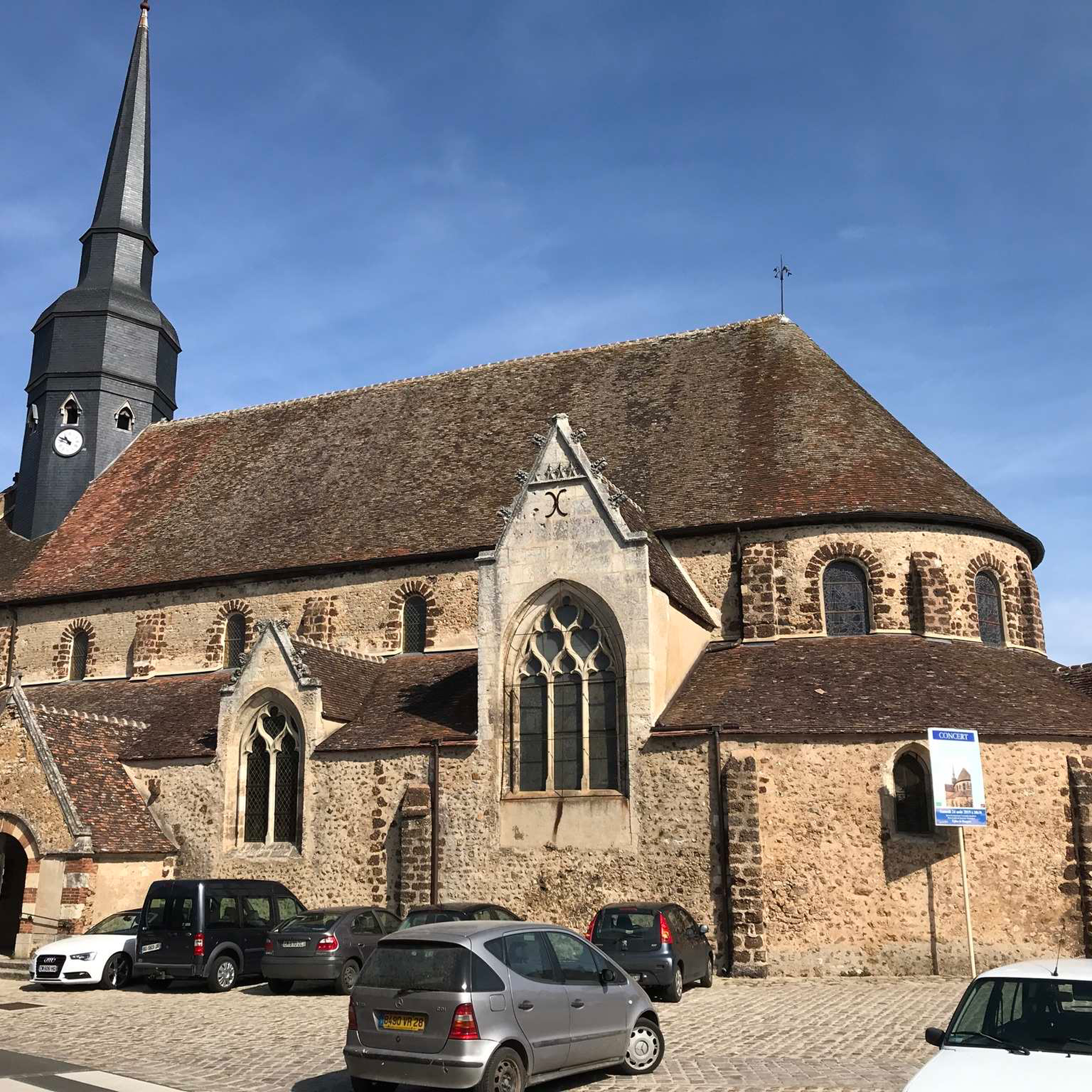
Placed under the patronage of Saint Hilaire, this parish was given by Gannelon de Montigny, lord of the place, to the abbey of Marmoutier around 1042. Its reconstruction probably dates from this period; it then became a priory. The church has a rectangular nave ending in a choir with a flat chevet. An examination of the masonry easily reveals two distinct periods of construction: the Romanesque period and the Renaissance. Built of flint rubble with rendering, the western part of the building appears to date from the 11th or 12th century. A limestone cornice supported by rather crude corbels underlines the base of the roof. To the south, two narrow Romanesque windows flared inwards light the nave. To the north, the bays were later reworked and enlarged. On this same side, a Romanesque doorway was walled up; It allowed the church to connect with a building whose traces of detachment remain. The bell tower was built to the north of the Romanesque nave, extending the western façade. The absence of a connection between the east and west walls of the bell tower and the north wall of the nave clearly indicates that it is an entirely later construction. However, its crowning is much later, as evidenced by its cornice, whose molding is in the classical style. Flanked by obliquely angled buttresses, it is covered with a saddleback roof. The eastern half of the church appears to be an extension built during the Renaissance period. Its ogee-shaped cornice and the decoration of the eastern gable, as well as the moldings of the buttress bands, attest to this dating. A vast rectangular choir then appears to have replaced a semicircular Romanesque apse; the eastern gable and the southern and northern façades were then pierced with networked bays. In the lower part of the north façade, projecting ashlars appear to have supported the roof of a lean-to building. To the south, a sacristy was built in the 19th century. Inside, the entire building is covered with a paneled vault with exposed tie beams and kingposts. The 18th-century high altar is surmounted by an Assumption of the Virgin inspired by Murillo's. For the restoration of the roofs and façades, the Sauvegarde de l'Art Français (French National Art Protection Agency) awarded a grant of €30,490 in 2001.
0
0
The Church of Saint Sauveur La Trinité, probably built in the 12th century, is notable for its Romanesque windows with columns and capitals. On its walls, alternating with the consecration crosses, one can admire a Stations of the Cross in blue enamel on earthenware. The choir is lit by five Romanesque windows decorated with stained glass depicting Our Lord and the four Evangelists.
0
0
The Henri Ey Hospital Center is a departmental public health establishment, specialized in psychiatry, which provides a mission of prevention and reception, care, aftercare and reintegration in mental health in Eure-et-Loir. It provides care in adult, child and adolescent psychiatry, as well as a medico-social activity in the field of geriatrics and psychological and mental disabilities.
0
0
The Saint-Lubin church, built on a sloping site, is a vast building with juxtaposed constructions, bearing witness to renovations and additions up to the 19th century, the oldest distinguished by the presence of grison, the most recent by limestone and flint. The sanctuary was ceded in 1077 by the monks of Saint-Denis de Nogent-le-Rotrou to the monks of the Saint-Père de Chartres abbey. Built in the 11th-12th century, the nave extended by a semi-circular apse is the oldest part of the church, in Romanesque style. In the thickness of the north walls of the nave are still visible the grison bonds which bear witness to the original openings. The building was considerably enlarged in the 15th and 16th centuries by the construction of a large transept, formed of two chapels, and a south aisle forming an alignment of gables attached to the slopes decorated with leafy motifs and finished with chimeras. The construction of the north aisle, just begun, was not finished. On the outside, on the west wall of the chapel, we can see the beginning of a first bay (stone arch and walls removed that remained unfinished). On the gable of the north transept, the walled door can be seen from the pointed arch and the ornate pinnacles, characteristic of the end of the 15th century. In the center, two animals present a coat of arms. On each side of the door, niches with canopies once housed statues. Above, we can still see a coat of arms presented by two bearded figures and probably surmounted by God the Father. According to local tradition, all or part of the extensions were due to the generosity of Florimont Robertet, who owned the barony of Brou from 1509 until his death in 1527, and it was because of this that the work was interrupted. Occupied by the revolutionaries, the building became a ten-day temple in 1794; it was finally returned to worship in 1802. Burnt down by lightning in 1813, the upper part of the bell tower, which was a slender spire, was replaced by the construction of a square limestone tower pierced with louvers. On the southern part of the bell tower, a turret provides access to the bells. In the southern part of the nave, a door, now blocked and highlighted by a basket-handle arch topped with a pinnacle, provided access to the cemetery that once surrounded the church. The building can boast of having preserved very uniform oak furniture, most of which was made in the second half of the 18th century.
0
0

Porte de Boisville Its ogival portal opens into a thick quadrangular massif where there was a room for operating the portcullis. We can still see the groove in the thickness of the walls. On the left and right two small funnel-shaped spaces allowed the defenders to observe and repel the enemies who appeared on the bridge. The gate was topped by a building serving as a guardhouse which was demolished in 1761. The guarding of these doors and their keys was in the troubled times of the Hundred Years' War the subject of concern for the inhabitants and also a source of quarrels and trials between the city and the abbey. This gate is preceded by a bridge of 5 stone arches, the one adjoining the gate was built in 1774 and replaced a drawbridge which defended the entrance.
0
0

Bonneval, nicknamed the little Venice of Beauce
0
0
Building from the 12th, 15th and 17th centuries, remarkable from a distance with its bell tower whose spire soars 52 m high. The vault of the vast nave is paneled in Norwegian fir. The Renaissance entrance door is topped with a double pediment. The church has 17th century furniture of Breton inspiration, the sculptures of which are the work of the Breton Charles Roscouët. The baptismal font and the furniture of the sacristy are also worthy of interest. Relics of Saint-Constance, given to the church of Yèvres in 1678 by Lord Cyprien Besnard de Rezey, Advisor to the King and Intendant of Finances, with the approval of Mgr Ferdinand de Neufville de Villeroy, Bishop of Chartres, whose portrait is prominently placed in the nave of the church. The visit ends with the "chapier", a piece of furniture with semi-circular drawers, which contains, "flat", an exceptional collection of priestly vestments and accessories. Recent work on the south porch has revealed exterior fonts and attractive moldings on the pillars.
0
0
The Saint Hilaire church is a vast building from the end of the 11th or 12th century which originally consisted of only a nave with choir and semi-circular apse supported by slightly protruding buttresses made of grison, an extremely hard ferruginous agglomerate which does not allow any work. of sculpture. You can see the primitive work in the walls of the nave and the choir with its small windows and the exterior buttresses in gray. Its appearance was considerably modified during the Renaissance period, when a transept was added, then during a second campaign of transformations, the small side chapels of the choir covered with ribbed vaults with vines and tiers which would have had to be topped with a pavilion roof. The entire monument is covered with a paneled vault with visible beams and hallmarks; above the sanctuary the shingle decorated with arabesques and painted cherubs' heads bears the date 1561. In the 17th century, like many churches of the time, the glass roof at the bottom of the apse was closed to build an altarpiece then fashionable, as it is today with the woodwork that accompanies it. On the west side of the north transept, above the small shed, we can clearly see in the masonry a stone arch which is perhaps the beginning of the cloister mentioned in the archives. In addition to the charm of its Renaissance parts, this church is fortunate to have beautiful furniture from the 17th and 18th centuries which preserves the appearance it had under the Ancien Régime: a lectern dated 1754, modified in 1784 with a antiphonary and a Chartres gradual from 1784. It is in perfect condition, as the cantors must have used it before the revolution. Another valuable piece, the solid oak work bench, cleaned a few years ago of the paint with which it had been decorated, and which now serves as an altar to meet the new standards of the liturgy for the mass facing the faithful.
0
0
Frequently Asked Questions
How many road cycling routes are available around Dangeau?
There are over 200 road cycling routes around Dangeau, offering a wide variety of options for different preferences and skill levels. The komoot community has explored these routes extensively, with more than 400 road cyclists using komoot to discover the area.
What is the typical terrain and difficulty level for road cycling around Dangeau?
The region around Dangeau features a gentle topography, characterized by open countryside, agricultural lands, and the Loir River valley. This landscape offers varied terrain suitable for easy, moderate, and difficult ability levels. Most routes are moderate, such as the Church of Bonneval – Porte de Boisville loop from Dangeau, which covers 37.5 miles (60.4 km) with around 300 meters of elevation gain.
What historical sites or natural features can I see along the road cycling routes near Dangeau?
Road cycling routes around Dangeau often connect charming historical towns and feature significant landmarks. You can encounter sites like the impressive Château de Châteaudun, the fortified town of Bonneval with its ancient fortifications, and the historic Porte de Boisville. The routes also traverse the scenic Loir River valley, offering pleasant natural backdrops.
When is the best time of year to go road cycling in Dangeau?
The region's open countryside and gentle terrain make it suitable for road cycling through much of the year. Spring and autumn generally offer pleasant temperatures and beautiful scenery, while summer provides longer daylight hours. The Eure-et-Loir department typically experiences mild weather, making it an enjoyable destination for cyclists outside of extreme winter conditions.
Are there family-friendly road cycling routes suitable for all ages around Dangeau?
Yes, Dangeau offers a selection of easy road cycling routes that are suitable for families or those looking for a more relaxed ride. The gentle topography and quiet country roads provide a safe and enjoyable environment for cyclists of all ages to explore the agricultural landscapes and charming villages.
Are there any circular road cycling routes around Dangeau?
Many of the road cycling routes around Dangeau are designed as loops, allowing you to start and finish in the same location. Examples include the popular Château de Châteaudun – Church of Bonneval loop from Logron, a moderate 41.2 miles (66.3 km) path, and the Château de Châteaudun – Saint-Valérien Church loop from Dangeau, which is 32.3 miles (52.0 km).
What do other road cyclists enjoy most about road cycling in Dangeau?
The komoot community highly rates road cycling in Dangeau, with an average score of 4.7 stars from over 30 reviews. Cyclists often praise the region for its quiet country roads, the picturesque agricultural landscapes, and the opportunity to visit historical towns and landmarks like Bonneval and the Château de Châteaudun along the way.
Are there any long-distance road cycling routes near Dangeau?
While Dangeau itself offers routes up to around 40 miles, its location in the Eure-et-Loir department means it's well-situated for connecting to longer regional cycling networks. The area is part of the broader Loir Valley, which features routes like the Vallée du Loir à Vélo, offering potential for extended tours through scenic countryside and historical towns.
Is there convenient parking available for road cyclists in Dangeau?
Dangeau and the surrounding towns typically offer public parking options, especially near town centers or local attractions. When planning your route, it's advisable to check specific starting points for available parking facilities to ensure a smooth start to your ride.
Can I find cafes or places to rest along the road cycling routes?
Yes, the road cycling routes often pass through or near charming towns and villages such as Bonneval and Châteaudun. These locations provide opportunities to stop for a coffee, a meal, or to replenish supplies at local cafes, bakeries, or small shops, allowing for pleasant breaks during your ride.
What kind of landscape can I expect while road cycling around Dangeau?
The landscape around Dangeau is characterized by open agricultural lands, vast fields, and gentle rolling hills. You'll experience a tranquil rural setting, interspersed with small villages, historical sites, and the occasional glimpse of the Loir River valley. It's a predominantly flat to gently undulating terrain, ideal for smooth road cycling.
Are there any specific castles or châteaux to look out for on the routes?
Absolutely. A prominent feature is the magnificent Château de Châteaudun, which you can view on routes like the Château de Châteaudun – Montigny Castle loop from Logron. Another notable historical building in the vicinity is the Château de Moléans, offering views of the Conie valley.
Most popular attractions around Dangeau

Get inspired with the komoot mobile app


Explore more
Browse the best Road cycling routes in other regions.
