The best road cycling routes around Boncé
4.5
(9)
352
riders
92
rides
Road cycling routes around Boncé are primarily characterized by a gently rolling agricultural landscape, interspersed with river valleys and historical villages. The region features open fields, quiet country roads, and occasional small ponds, offering a serene environment for road cyclists. Elevation changes are generally modest, making it suitable for various fitness levels.
Best road cycling routes around Boncé
- The most popular road cycling route is Ponds of Fontenay sur Eure – The Eure at Ver les Chartre loop from La…
Last updated: October 5, 2026
5.0
(2)
41
riders
Hard road ride. Very good fitness required. Mostly well-paved surfaces and easy to ride.
31
riders
138km
05:25
560m
560m
Hard road ride. Very good fitness required. Some segments of this route may be unpaved and difficult to ride.

10
riders
Easy road ride. Great for any fitness level. Mostly well-paved surfaces and easy to ride.
8
riders
11.2km
00:27
50m
50m
Easy road ride. Great for any fitness level. Mostly well-paved surfaces and easy to ride.
5
riders
51.9km
02:00
150m
150m
Easy road ride. Great for any fitness level. Mostly well-paved surfaces and easy to ride.
Get access to more routes and recommendations from other explorers.
Already have an account?
Our route recommendations are based on thousands of hikes, rides, and runs completed by other people on komoot.


Tips from the Community

very nice pond to rest
0
0

The oldest document mentioning the Church of Saint-Martin in Fresnay-le-Comte is the charter of Renaud de Mouçon, Bishop of Chartres, confirming the possessions of the Abbey of Marmoutier, near Tours. This charter dates only from the last years of the 12th century, but the church's foundation may have already existed at that time. The building comprises two parts of roughly equal size and from different periods. The older part, roughly corresponding to the nave, is of a rather undefined style. The west portal, with its pointed arch devoid of any decoration, may date back to the 12th or 13th century, as may the first window of the nave, on the right. In the north wall, there is a small, walled-up doorway, whose lintel, adorned with an accolade, is no earlier than the 15th century, but the relieving arch above it appears older, perhaps from the 12th century. Half of the church, including almost the entire chancel, is from a more recent period and easily recognizable. The polygonal apse and the windows with their flamboyant tracery of late design indicate the very end of the 15th century. An inscription on one of the chancel's tie beams gives a precise date: In the year 1529, this chancel was completely rebuilt. The statue of the Virgin Mary was baptized during the Mass of October 30, 2021, by Father Pierre Paul. This statue, moved from the Chapel of the Three Marys in Mignières, was restored by Mr. Martial Moulin, a sculptor from Chartres.
0
0
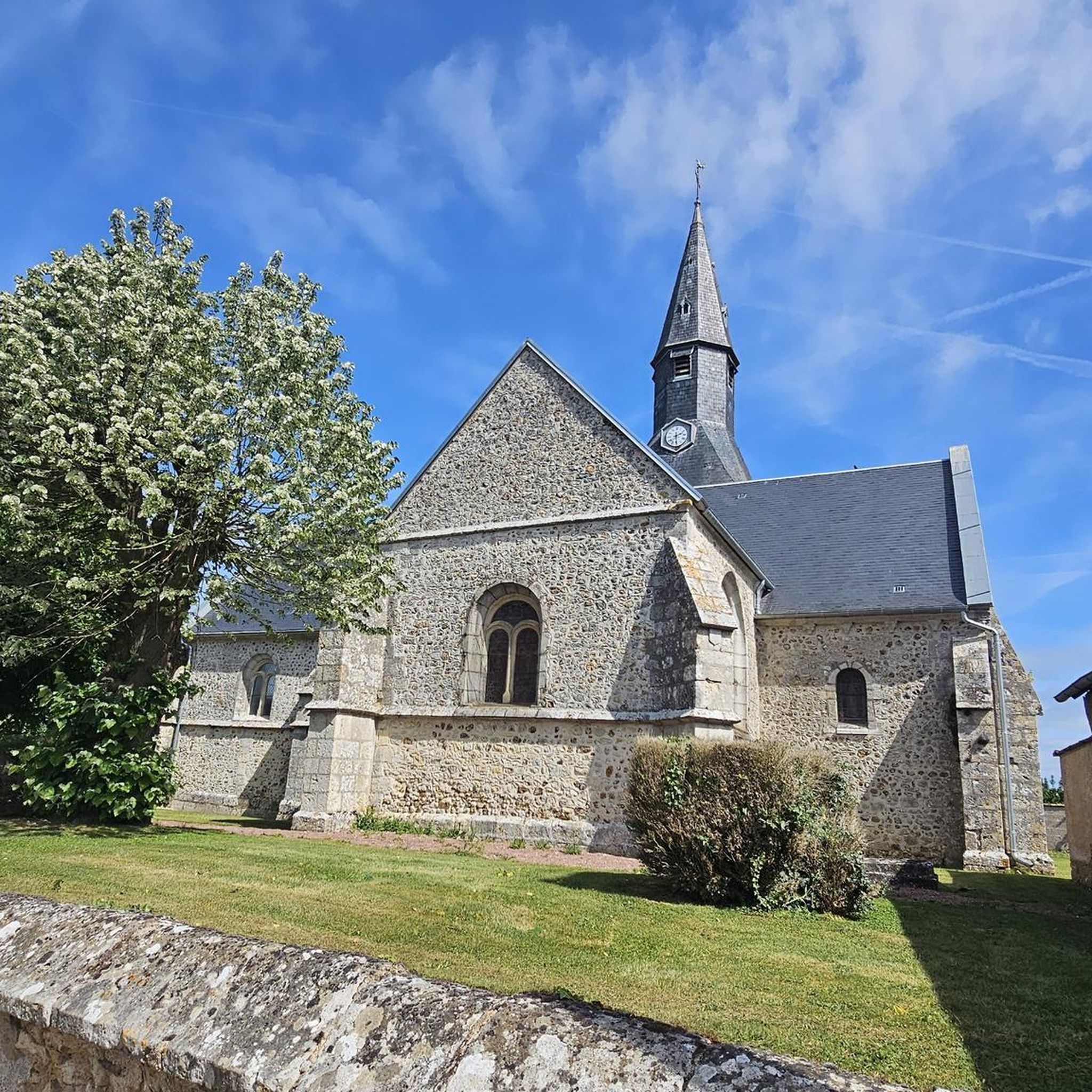
The church, dedicated to Saint Denis, is located in the diocese of Chartres. It was under the jurisdiction of the Benedictine abbess of Saint-Avit in Châteaudun. It comprises two distinctly contrasting parts: a low Romanesque nave, 17 meters wide by 8.5 meters long, and a taller Gothic chancel, 14 meters wide by 10 meters long. The western doorway, with its semicircular arch, is framed by columns whose bases are molded with two tori and whose capitals are adorned with leaves ending in volutes. The tympanum is plain, surrounded by a molded archivolt, and externally highlighted by an archivolt decorated with a sawtooth pattern, similar to that of the nearby church of Saint-Maur-sur-le-Loir. The western gable, framed by flat buttresses, is pierced above this doorway only by a small semicircular window. The nave's side walls are reinforced with buttresses. The north buttress is blank, while the south one has three windows, two of which, long and narrow, may be original; the third was likely widened later. A side door was added on this side in the 14th century. The chancel, with its flat apse, is topped by a high gable whose sloping sides are decorated with crockets. The central window with flamboyant tracery was walled up to accommodate the large altarpiece. The north wall is blank; only two flamboyant windows with triple lancets illuminate this part of the building on the south side. The structure is punctuated by flat buttresses with offsets. A stone inscription indicates the date of its construction: 1550. Inside, the nave and chancel are not vaulted in stone, as the large number of buttresses might suggest from the outside. They are covered with panelled wooden vaults. In the center of the nave, four wooden pillars and a hexagonal framework support the slate spire that crowns the building. Among the interesting furnishings are a 17th- or 18th-century baptismal font, a painting depicting the Education of the Virgin, a pulpit, a churchwarden's pew, choir stalls, Restoration-era choir paneling, and, most notably, a magnificent and imposing altarpiece from the church of Saint-Germain-les-Alluyes, from where it was transferred in 1812. It is the work of Charles Roscoët, who also worked at the churches of Alluyes and Moriers. The Vitray altarpiece dates from 1669; its central panel is framed by double twisted columns adorned with vine leaves and surmounted by a Baroque pediment in the center of which is a statue of a bishop saint (Saint Germain) between reclining figures. The two wings of the altarpiece, right and left, are topped with twisted columns and adorned with shell-shaped niches intended to hold statues. In 2005, the French Heritage Society (Sauvegarde de l’Art français) awarded a grant of €6,500 for the restoration of the gable, the belfry, and the bell tower roof, as well as the installation of a lightning rod.
0
0
According to tradition, the church choir covers the remains of an older building, possibly dating back to the 6th century, which was built to house the saint's body. According to current knowledge, the commune of Saint-Piat (Sanctus Piatus in Latin) officially appeared in 1087, mentioned in a charter of the Nottonville Priory (Eure-et-Loir), on which it depended. The current building was rebuilt during the time of Francis I, as suggested by the date 1535 engraved on two buttresses of the apse and the date 1542 engraved on a piece of wood from the vault. This is according to a study by the SAEL (Eure-et-Loir Archaeological Society). The three-sided apses, the dripstone towers (horizontal members projecting from a wall), and the sculpted roof structures are a testament to the importance of the reconstructions carried out in the department during the 16th century. The church of Saint-Piat is one of them. While the church has not been officially recognized, it nevertheless contains objects that have attracted attention both for their antiquity and quality, but not always for good reason. Their artistic value, far from attracting only religious or aesthetic interest, has also aroused a covetousness that, unfortunately, remains for some of them. Fortunately, those still in place are carefully cared for and offer the curious a story to discover, a beauty to slowly ponder as they progress toward the choir.
0
0

This church in Meslay-Le-Vidame, whose architecture reflects the formal language of antiquity, was dedicated to the patron saint of Saint Etienne. He was one of the first seven deacons of the original Jerusalem church and, according to the biblical accounts in the New Testament, the first martyr (martyr) of early Christianity. The church commemorates his death on Boxing Day, December 26th. As the Acts of the Apostles recounts: When Stephen recounted his vision of the open heavens, "And he, full of the Holy Spirit, looked up into heaven and saw the glory of God, and Jesus standing at the right hand of God" (Chapter 7, Verse 55), the people were so outraged that they drove him out of the city and stoned him.
0
0
On the night of April 2-3, 1903, a terrible fire completely destroyed the church of Saint-Sulpice. The spire, the roof, and all the furnishings—pews, pulpit, woodwork, altars—were consumed; only the walls remained standing. This church, 23.80 m long and 6.90 m wide, built in the shape of a perfect parallelogram with a straight chevet, formerly lit by a triple lancet window, was flanked on the right by a groin-vaulted chapel 6.10 m wide and 5.55 m deep, and on the left by the bell tower, beneath which was once a chapel, also groin-vaulted, but transformed into a sacristy a few years ago. This tower, reached by a stone staircase, was topped by an octagonal timber-framed spire, elegantly crafted and the tallest in the entire region. This church has been remodeled several times, most recently during the reconstruction of the Chapel of the Blessed Virgin in 1764. However, this dates back to the 16th century, as evidenced by the flamboyant ogival window with two mullions, only the top of which was visible, the lower part having been walled up to accommodate the altarpiece. The second window, on the south side, is semicircular with a mullion, adorned with stained-glass windows with figures of the Blessed Virgin, Saint Anne, and Saint Joachim framed in small medallions painted by Mr. Lorin in 1895. The nave wall received windows of the same style at the same time, but the enormous buttresses and the freestone stringcourse with dripstone were erected in the 16th century. The rest of the church, the gable of the façade with its Romanesque window flanked by two barely protruding pillars, the gable of the chevet with its triple lancet arch, protected by a semicircular arch of dressed stone, the entire north wall, also supported by slightly protruding buttresses and adorned with semicircular windows, and the bell tower, date from the late 12th century. The exterior entablature of the chevet was formed of carved corbels with foliage and strange, crude figures (alternating human heads and rams' heads), irrefutable evidence of this ancient origin. The church was consecrated after the 16th-century restoration, and a beautiful consecration stone with trefoiled ends can still be seen. The church's benefactor had his coat of arms carved on a projecting shield on the corner buttress of the façade gable, and inside the seigneurial tier. The destruction of the woodwork revealed two double oval shields on either side of the high altar, surmounted by a marquis's crown and supported by two greyhounds. The dexter shield bears a gules chevron, accompanied at the top by two roses of the same color and at the base by a cross of Lorraine; the sinister shield reveals a wild boar at the base and two flames or thunderbolts at the top. Could these be the arms of Mre Loup de Cosne? These same shields are found in the Chapel of the Blessed Virgin in four places and in the sacristy. In the Chapel of the Blessed Virgin, a third shield is also found bearing a standing lion, attached to a shield bearing a wild boar and two flames. In 1623, Loup de Cosne, Lord of Vovelle, had a daughter named Francoyse, baptized in Dammarie; in 1653, Charles de Cosne was lord of Loiville and Mre Mangot, lord of Boncé.
0
0


Unfortunately, the church was not accessible when I visited (mid-September 2024). You could only look in through a gate and the dance of death depictions on the left side were not really visible. In front of them were transparencies with skeleton drawings. Maybe those were the depictions...
0
0
Frequently Asked Questions
How many road cycling routes are available around Boncé?
There are over 100 road cycling routes available around Boncé, offering a wide range of options for different skill levels.
What kind of landscape can I expect when road cycling in Boncé?
Road cycling in Boncé primarily takes you through a gently rolling agricultural landscape. You'll encounter open fields, quiet country roads, and picturesque river valleys, often passing through historical villages and by small ponds, creating a serene cycling experience.
Are there easy road cycling routes suitable for beginners in Boncé?
Yes, Boncé offers a good selection of easy routes. Nearly half of the routes, specifically 49 out of 101, are classified as easy, making them ideal for beginners or those looking for a relaxed ride through the countryside.
Can I find challenging long-distance road cycling routes in Boncé?
Absolutely. For those seeking a challenge, Boncé features several long-distance routes. A notable difficult route is The Eure at Ver les Chartre – Ponds of Fontenay sur Eure loop from Voves, spanning over 82 miles (132 km) through open countryside. Another demanding option is the Orrouer Church – Vérigny Castle loop from Voves, which covers 86.5 miles (139.2 km) past historical landmarks.
Are there any circular road cycling routes around Boncé?
Yes, many of the routes in Boncé are designed as loops. For example, the popular Ponds of Fontenay sur Eure – The Eure at Ver les Chartre loop from La Bourdinière-Saint-Loup is a moderate 36.8-mile (59.3 km) circular trail featuring gentle climbs through the Eure valley.
What historical landmarks or points of interest can I see along the road cycling routes?
The routes often pass through historical villages and near significant sites. You can explore attractions such as the Moulin de Ver-lès-Chartre, the impressive Château des Boulard, and various historic churches like the Saint-Étienne Church of Meslay-le-Vidame.
What do other road cyclists enjoy most about the routes in Boncé?
The routes in Boncé are highly rated by the komoot community, with an average score of 4.5 stars from over 9 reviews. Cyclists often praise the serene environment, quiet country roads, and the charming agricultural landscapes interspersed with historical villages.
Are there any routes that pass by castles or châteaux?
Yes, you can find routes that take you past historical castles. The Château de Châteaudun – Bonneval loop from La Bourdinière-Saint-Loup is a moderate 118 km route that offers views of the Château de Châteaudun, providing a scenic and historical cycling experience.
Are there any routes that are particularly good for exploring river valleys?
Many routes in Boncé incorporate the region's river valleys. The Ponds of Fontenay sur Eure – The Eure at Ver les Chartre loop from La Bourdinière-Saint-Loup, for instance, features gentle climbs through the picturesque Eure valley, offering beautiful riverside scenery.
What is the general elevation profile of road cycling routes in Boncé?
The elevation changes in Boncé are generally modest, characterized by a gently rolling landscape. This makes the region suitable for various fitness levels, with most routes featuring gentle climbs rather than steep ascents.
Are there any routes that are particularly short and easy for a quick ride?
Yes, for a shorter, easier ride, consider the Eglise le Gault Saint Denis – Winding Road Through Fields loop from Le Gault-Saint-Denis. This easy route is about 15 miles (24 km) long and takes just over an hour to complete, perfect for a leisurely outing.
Most popular attractions around Boncé

Get inspired with the komoot mobile app


Explore more
Browse the best Road cycling routes in other regions.
